
Thursday, May 11, 2006
Covenant Zone-Blue Scarf/bandana Meeting
Tonight in the Atrium of the Vancouver Public Library, 7-9. Come and join in conversation of how we can grow a new Canadian covenant.


Convert or Die
From Jihad Watch
Jakarta, May 11, IRNA -- Iranian President Mahmoud Ahmadinejad said here Thursday that his letter to President George W. Bush did not concern the nuclear dossier, but rather was an invitation to Islam and the prophets culture.Robert Spencer notes:
[...]
Stressing that the letter was beyond the nuclear issue, the chief executive said that in principle, the country's nuclear case is not so significant to make him write a letter about it.
"We act according to laws and our activities are quite clear. We are rather intent on solving more fundamental global matters.
"The letter was an invitation to monotheism and justice, which are common to all divine prophets. If the call is responded positively, there will be no more problems to be solved," added the president.
The president said that the letter actually contained a clear message of invitation to human beliefs, adding that its response will determine the future....
Both bolded statements suggest that the letter was indeed the call to Islam that must precede any attack, in accord with Muhammad's words (in Sahih Muslim 4294) about inviting the unbelievers to accept Islam or dhimmitude and fighting him only if he refuses both. We shall see.UPDATE: IRNA also reports that Johnny Applemad is also telling the Europeans that they should either give up their Liberalism or Israel:
Referring to the concern expressed by western countries over his remarks about Israel, he said he was merely stating the truth, and urged countries who were threatened by his remarks to end their support for the cruel regime and see what would happen.
"Today, the occupied lands under the Zionist regime have been turned into a large prison and military camp. Liberalism has surrendered itself to the Zionist regime," he said.
[...]
If the Holocaust indeed happened, then those who committed the crime should compensate for it, the Iranian president suggested.
Referring to the expulsion of Jews from Europe as a reason behind the establishment of Israel by the Westerners, he said: "They (Westerners), particularly the British, with their anti-Jewish attitude forced groups of Jews to migrate."
Sunday, May 07, 2006
United 93 (updated below)
So I saw the film the other night. I came out of it sad and wanting to continue the fight; fortunately there were no ethical idiots in this theatre, on the lefty side of town, saying stupid things. In fact, there were not more than twenty people there and the film has only been out a week.
As I thought going in, I needed to walk home afterwards - for almost two hours - in order to burn off the tension. Judging from an intemporate email I wrote when home, the march was not long enough. The film's ending, as you know, is entirely unsatisfactory. Knowing what will happen, you nonetheless hope against hope that the final struggle will end differently. I suppose this is even true for the Jihadists and their western nihilist compadres who get a kick out of American death and destruction. The film's message, delivered equally to both sides, is that the war remains to be won, the full meaning of the event is yet to be written.
In terms of esthetics, the notable quality of the film is its investment in a certain kind of realism that might appear to be non-judgmental, as if that were possible in respect to such an event. Beyond its pacing of the unfolding event, there is very little obvious dramatization, and the actors are unknowns - some of the roles of the NORAD and air traffic control personnel are actually played by the real persons themselves, as if the film were a means for those who lived the trauma of 9/11 to give their testimony as to what really happened, and to allow for some catharsis.
Without much obvious symbolic manipulation, we are simply walked through the known moments of that horrible day. There is no background narrative on the people involved, so it seems as if evil simply appears on a mundane scene, its intentions unexplored, beyond the obvious religious-cultish motivations of the murderers we see often praying and chanting. Similarly, we are given no background on the lives of the victims, so that they appear before us much as would any strangers we see at the airport and on the plane.
One might thus think that the film offers us no obvious motivation with which to mythologize, or make sense, of the sacrificers' choice of victims. But the inevitable Americanness of the scene is highlighed by the insertion of a shot at the beginning of the film, where a "God Bless America" sign, supposedly on the road to the airport, is shown. This happens immediately after a shot of the murderers bowing to their god on a prayer rug in their hotel room. I took this juxtaposition as a vile attempt at suggesting, just possibly, some kind of moral equivalence between two forms of faith. I felt a similar revulsion on two other occasions.
The first was when we see the murderer who will "fly" the plane respond kindly to a flight attendant while being provoked by the fretful demands of his comrade that he stop waiting and start the hijacking. Despite this emotional distraction, he is nonetheless able to acknowledge and politely refuse the flight attendant's unanticipated appearance and offer of a drink - this is the only scene where we see the murderers significantly interacting with the crew before they reveal their homicidal intent. That the well-dressed and tonsored Jihadist leader - who is depicted as too nervous to signal his accomplices to begin their final evil as early as would have been necessary to turn the plane around and get to Washington before the passengers had time to learn what was going on and put an end to the Jihadist plan - would have the presence of mind to gallantly mask his certain disdain for the infidel woman he was about to kill, strikes me as unbelievable. While it does us no good to dehumanize the enemy - and thus fail in our duty to understand him, the better to defeat him - this scene struck me as over-romanticizing a bastard. But what do I or anyone really know about the man?
The other indignity of the film occurs as the credits begin to roll. We hear a young child's voice - a voice of innocence - singing "laa... laaah... laah". Maybe it's just me, but I could have sworn the first "la" was an "allah", as the rest are almost. That this might be the film's final word - though readily deniable - is morally ambiguous and unduly provocative. Is a god being invoked or his supposed betrayal being lamented?
When we attend a film in the midst of a war, a film portraying a most key event in the war, we are programmed by historical experience to expect a clear differentiation of good and evil; we expect the film to take a side. While it would take a moral moron not to recognize the unquestionable evil of the murderers' clearly-depicted act, the film's withdrawal from overt dramatization - beyond its subtle, ambiguous, manipulation of a few religious and patriotic symbols - and the absence of background narrative, makes it clear that moral judgment is left largely to the viewer. The film's embrace of realism is disquieting because it is not clear why any artist has the right to suspend frank moral judgment in deference to this reality. The event thus revealed is less that seen by a confident set of American eyes, as it is the perspective of some extra-national agglomeration.
In discussing another film, Saving Private Ryan, Eric Gans makes one of his characteristically brilliant observations, about realism:
In other words, the film holds our attention for two hours, even though we know what is going to happen, even as we should have no doubt about the nature of the evil unfolding, because we want the film's confirmation or testing of our own imagining of postmodern reality. This testing today imposes on us the question of whether a realist film - one that has hired Muslim academics in order better to depict the muderers' (mis?)practice of their religion - should in any way demonize or denounce the murderers and their faith by getting into the story behind their motivations. But it does not. For example, not one of the passengers or crew is shown conveying anti-Muslim epithets to the killers. Apparently the victims were not sufficiently informed, or too scared and defensive, to do that. This, we may or may not believe, would have been the most likely reality of ordinary Americans' on 9/11/2001.
As Gans says, our desire for realism follows from our falling out of a world in which both our guys and the enemy can be quickly distinguished by the use of familiar "ritual" devices. What is symbolically powerful about United 93, is that while the murderers are revealed as immersed in a world of ritual, their victims' rituals are comparatively banal. We hear about planned trips with family members, the trials of raising children, sporting interests, work schedules, and of course the passengers' last whispered words to loved ones, but little unites them as a group - beyond a vague Americanism - before the final moment of their lives when the immortal words "let's roll" are undramatically whispered and those who love life initiate a new historical era by fighting back, no longer putting faith in the old promise that one can survive if you give the terrorists what they want. However, like all acts of faith, that of the passengers on flight 93 enters the world in uncertainty and vulnerability. What bonds America most clearly on 9/11 is seen in the disciplined professionalism of the air traffic controllers and the NORAD team; but of course on this day this is all to no avail.
The film ends with the formation of a new covenant among the passengers and crew, an act of faith in each other, propelled by a pressing necessity. Let us hope that the realism of the future will similarly depict our falling out of the disconnected rituals of postmodernity and back into firmer covenantal bonds, such that a realistic film featuring Jihadists can have no choice but to reveal the utter hopelessness and indignity of their cause before peoples united to pummel every fantasy of virgin-rewarded martyrdom back into the dark holes of savage resentment from which they come. When we are united in defense of western values and no longer surprised by terrorism or puzzled as to its resentful and cultish motivations, it will run out of ideas and means with which to shock us. The effect of realism in United 93 exists only as long as we fail to do what we, if determined, could do: totally defeat and humiliate the common - readily justified by scriptures and history - conception of "Jihad" as war against the Infidel, such that Islam must radically change or die. Let the next generation view this film with the sense of unreality we today have for the reality portrayed in films from the fifies and beyond.
UPDATE: Peter Suderman has a different perspective on the film; he sees its realism - its careful research on everyone who boarded Flight 93 on September 11 - as a memorial to the passengers and crew. This raises the question of whether any narrative medium is suited to collectively memorializing numerous lives senselessly ended in acts of mass murder. As Stalin said, the story of a single life and death can be a tragedy; a million deaths is a statistic - in other words, no artistic medium can capture and fairly represent the nature and horror of the crime, nor can the lives and deaths of particular victims - whose live are ended with an entirely impersonal reason -be used as exemplary of the crime's story. This argument, often invoked in discussions of genocide, may not hold for an event like 9/11, and especially for the passengers of Flight 93 who, in fighting back, did indeed leave a memorial to their own lives and led the way to a new era where there can be no question of appeasing terrorists.
As I thought going in, I needed to walk home afterwards - for almost two hours - in order to burn off the tension. Judging from an intemporate email I wrote when home, the march was not long enough. The film's ending, as you know, is entirely unsatisfactory. Knowing what will happen, you nonetheless hope against hope that the final struggle will end differently. I suppose this is even true for the Jihadists and their western nihilist compadres who get a kick out of American death and destruction. The film's message, delivered equally to both sides, is that the war remains to be won, the full meaning of the event is yet to be written.
In terms of esthetics, the notable quality of the film is its investment in a certain kind of realism that might appear to be non-judgmental, as if that were possible in respect to such an event. Beyond its pacing of the unfolding event, there is very little obvious dramatization, and the actors are unknowns - some of the roles of the NORAD and air traffic control personnel are actually played by the real persons themselves, as if the film were a means for those who lived the trauma of 9/11 to give their testimony as to what really happened, and to allow for some catharsis.
Without much obvious symbolic manipulation, we are simply walked through the known moments of that horrible day. There is no background narrative on the people involved, so it seems as if evil simply appears on a mundane scene, its intentions unexplored, beyond the obvious religious-cultish motivations of the murderers we see often praying and chanting. Similarly, we are given no background on the lives of the victims, so that they appear before us much as would any strangers we see at the airport and on the plane.
One might thus think that the film offers us no obvious motivation with which to mythologize, or make sense, of the sacrificers' choice of victims. But the inevitable Americanness of the scene is highlighed by the insertion of a shot at the beginning of the film, where a "God Bless America" sign, supposedly on the road to the airport, is shown. This happens immediately after a shot of the murderers bowing to their god on a prayer rug in their hotel room. I took this juxtaposition as a vile attempt at suggesting, just possibly, some kind of moral equivalence between two forms of faith. I felt a similar revulsion on two other occasions.
The first was when we see the murderer who will "fly" the plane respond kindly to a flight attendant while being provoked by the fretful demands of his comrade that he stop waiting and start the hijacking. Despite this emotional distraction, he is nonetheless able to acknowledge and politely refuse the flight attendant's unanticipated appearance and offer of a drink - this is the only scene where we see the murderers significantly interacting with the crew before they reveal their homicidal intent. That the well-dressed and tonsored Jihadist leader - who is depicted as too nervous to signal his accomplices to begin their final evil as early as would have been necessary to turn the plane around and get to Washington before the passengers had time to learn what was going on and put an end to the Jihadist plan - would have the presence of mind to gallantly mask his certain disdain for the infidel woman he was about to kill, strikes me as unbelievable. While it does us no good to dehumanize the enemy - and thus fail in our duty to understand him, the better to defeat him - this scene struck me as over-romanticizing a bastard. But what do I or anyone really know about the man?
The other indignity of the film occurs as the credits begin to roll. We hear a young child's voice - a voice of innocence - singing "laa... laaah... laah". Maybe it's just me, but I could have sworn the first "la" was an "allah", as the rest are almost. That this might be the film's final word - though readily deniable - is morally ambiguous and unduly provocative. Is a god being invoked or his supposed betrayal being lamented?
When we attend a film in the midst of a war, a film portraying a most key event in the war, we are programmed by historical experience to expect a clear differentiation of good and evil; we expect the film to take a side. While it would take a moral moron not to recognize the unquestionable evil of the murderers' clearly-depicted act, the film's withdrawal from overt dramatization - beyond its subtle, ambiguous, manipulation of a few religious and patriotic symbols - and the absence of background narrative, makes it clear that moral judgment is left largely to the viewer. The film's embrace of realism is disquieting because it is not clear why any artist has the right to suspend frank moral judgment in deference to this reality. The event thus revealed is less that seen by a confident set of American eyes, as it is the perspective of some extra-national agglomeration.
In discussing another film, Saving Private Ryan, Eric Gans makes one of his characteristically brilliant observations, about realism:
The notion of realism is the most tantalizingly difficult of all esthetic ideas. All representation is revelatory; it can do no other than claim to show its object "as it really is." An esthetic can only claim not to be realistic when, as with modernism, a prior mode named "Realism" exists against which it can define its own truth. Thus we may begin by understanding realism, not as a specific historical movement, but as the claim that a given representation is "more real" than previous ones. Realism in this sense is a universal function of the historicity of the human, the necessarily "progressive" nature of culture that stands in tension with the necessary "decadence" of its ritualized traditions... A novel or a film appears realistic precisely to the extent that it makes earlier novels and films appear unrealistic. This process requires the unanticipated and revelatory foregrounding of some new element that "thickens" narration, at the same time deferring its end and intensifying its effect. High-cultural realism tends more toward the former pole, popular realism to the latter; in the first case, the detail nuances the violence of the narrative conclusion; in the second, it intensifies it.In depicting the murderers as well-dressed, neat, pious and devoted to their faith and the heinous act it ostensibly calls on them to perform, to the point that they are willing to lay down their own lives, the film's realism leaves open the possibility - for the legions of moral morons that we know are out there - to see nuance in the film's deferral of its violent conclusion, even as the film's realism also intensifies its unmistakably violent effect on the viewer. This blurring of Gans' distinction of traditional high and popular esthetics is in part possible because we live in an age where we have been trained by a form of realism to defer our judgment as to evident good and evil, at the behest of a culture of expertise and those who profess special knowledge of deeper realities (of subjects like terrorism) and their ostensible "root causes" unknown to most of us unless we engage in serious studies. There remains some question that we, broad-minded and realistic westerners, might see the murderers as tragically mistaken young men who could have become heroes if their committment to faith had been otherwise trained; in any case, the film's appeal to reality does not make us confident that we can simply demonize them as the bad guys and take from the film a commitment to the simple martial truths of the popular narrative.
In other words, the film holds our attention for two hours, even though we know what is going to happen, even as we should have no doubt about the nature of the evil unfolding, because we want the film's confirmation or testing of our own imagining of postmodern reality. This testing today imposes on us the question of whether a realist film - one that has hired Muslim academics in order better to depict the muderers' (mis?)practice of their religion - should in any way demonize or denounce the murderers and their faith by getting into the story behind their motivations. But it does not. For example, not one of the passengers or crew is shown conveying anti-Muslim epithets to the killers. Apparently the victims were not sufficiently informed, or too scared and defensive, to do that. This, we may or may not believe, would have been the most likely reality of ordinary Americans' on 9/11/2001.
As Gans says, our desire for realism follows from our falling out of a world in which both our guys and the enemy can be quickly distinguished by the use of familiar "ritual" devices. What is symbolically powerful about United 93, is that while the murderers are revealed as immersed in a world of ritual, their victims' rituals are comparatively banal. We hear about planned trips with family members, the trials of raising children, sporting interests, work schedules, and of course the passengers' last whispered words to loved ones, but little unites them as a group - beyond a vague Americanism - before the final moment of their lives when the immortal words "let's roll" are undramatically whispered and those who love life initiate a new historical era by fighting back, no longer putting faith in the old promise that one can survive if you give the terrorists what they want. However, like all acts of faith, that of the passengers on flight 93 enters the world in uncertainty and vulnerability. What bonds America most clearly on 9/11 is seen in the disciplined professionalism of the air traffic controllers and the NORAD team; but of course on this day this is all to no avail.
The film ends with the formation of a new covenant among the passengers and crew, an act of faith in each other, propelled by a pressing necessity. Let us hope that the realism of the future will similarly depict our falling out of the disconnected rituals of postmodernity and back into firmer covenantal bonds, such that a realistic film featuring Jihadists can have no choice but to reveal the utter hopelessness and indignity of their cause before peoples united to pummel every fantasy of virgin-rewarded martyrdom back into the dark holes of savage resentment from which they come. When we are united in defense of western values and no longer surprised by terrorism or puzzled as to its resentful and cultish motivations, it will run out of ideas and means with which to shock us. The effect of realism in United 93 exists only as long as we fail to do what we, if determined, could do: totally defeat and humiliate the common - readily justified by scriptures and history - conception of "Jihad" as war against the Infidel, such that Islam must radically change or die. Let the next generation view this film with the sense of unreality we today have for the reality portrayed in films from the fifies and beyond.
UPDATE: Peter Suderman has a different perspective on the film; he sees its realism - its careful research on everyone who boarded Flight 93 on September 11 - as a memorial to the passengers and crew. This raises the question of whether any narrative medium is suited to collectively memorializing numerous lives senselessly ended in acts of mass murder. As Stalin said, the story of a single life and death can be a tragedy; a million deaths is a statistic - in other words, no artistic medium can capture and fairly represent the nature and horror of the crime, nor can the lives and deaths of particular victims - whose live are ended with an entirely impersonal reason -be used as exemplary of the crime's story. This argument, often invoked in discussions of genocide, may not hold for an event like 9/11, and especially for the passengers of Flight 93 who, in fighting back, did indeed leave a memorial to their own lives and led the way to a new era where there can be no question of appeasing terrorists.
Friday, May 05, 2006
Reality is not Optional
I hadn't encountered the following writer until today. So far I am now a huge fan. Below is a small portion from a longer essay on the man's central premises. This is not Kos Kidz kibitzing or Teen-age Sociology Bimbo rap. Nor is it Thomas Hobbes. Regardless, this is superior entertainment for those with curiosity and a desire for fair play.
I don't keep abreast of currents in modern thought, so if you, dear reader, care to inform me and others about Sowell or other relevant thinkers, please feel free to do so.
****
The Superiority of Systemic Rationality
According to Sowell, knowledge consists largely of the unarticulated experiences and rationality of the many as embedded in customs, traditions, and systemic processes such as the market, family, language, and law. Knowledge is a multiplicity of social experiences distilled over generations in cultural processes.
Sowell argues that systemic rationality is superior to individual intentional rationality. Even the most outstanding individuals are very limited – man lacks the moral and intellectual pre-requisites for deliberate comprehensive planning. The inherent constraints of human beings are sufficiently severe to preclude dependence on individual articulated rationality. Sowell is highly skeptical about the capacity of elites to master complexity and to choose on behalf of others. Not only are the elite and the ordinary person close in capability and morality, there are no uniquely correct answers that would justify transferring decision-making authority to elite surrogate decision makers. There are no solutions only trade-offs with respect to problems such as crime, poverty, and irresponsibility. As a result, the preferred decision-making mechanism is systemic processes that convey the experiences and revealed preferences of the many. The historic systemic wisdom expressed inarticulately in the culture of the many is more likely to be correct than the special insight of the few. The degree of social rationality does not depend on the degree of individual rationality. The relevant comparison is between that total direct knowledge brought to bear through social processes versus the secondhand knowledge of generalities possessed by a smaller elite group.
Sowell puts his hopes for social order in sturdy institutions – he does not look for unsupported benevolence for society to progress or for solutions to social problems. To the extent that he envisions social changes he thinks in terms of trade-offs rather than solutions. Trade-offs must be incremental rather than categorical if limited resources are to produce optimal results in any social system as a whole. Results depend on the kinds of social processes at work and the incentives, constraints, and modes of interaction generated by such processes. Incentives may be positive or negative (rewards or penalties) and may be structured so there are gradations corresponding to different kinds of results.
Systemic causation in the form of legal traditions, family ties, social customs, price changes, etc., creates an unintended order which arises as a consequence of individual interactions directed toward various and conflicting ends. These social processes are to be judged by their ability to extract the most social benefit from man's limited potentialities at the lowest cost. The world is a system of innumerable and reciprocal interactions constrained within the confines of natural and human limitations – individual problems cannot be solved one by one without creating or adding to problems in other areas.
Sowell takes evils for granted as inherent in human nature and seeks to discover contrivances by which they can be contained. He seeks the special causes of peace, wealth, and a law-abiding order rather than the causes of war, poverty, and crime. Since war is a rational activity engaged in by most nations whenever they have a prospect of gaining anything by it, the goal should be to raise the costs of war to potential aggressors through the threat of force (i.e., by military preparedness and military alliances). Since war originates in human nature, peace (not war) requires explanation and specific provisions to produce it. In addition, with respect to Third World countries, we need to explain the causes of prosperity and development (not the causes of the natural condition of poverty) through responsiveness to systemic economic incentives. Likewise, counterincentives such as moral training, social pressure, and punishment must be created and maintained in order to prevent or deter crime since incentives to commit crimes are commonplace.
A man has insufficient personal knowledge to rely on reason alone when making decisions. Rational decision-making has costs in terms of time and other resources – the cost of a decision is the cost of the process of deciding. Sowell explains that rational principles themselves suggest a limit to how much rational calculation to engage in. Trade-offs apply to the decision-making mechanism itself. For example, the sorting and labeling of people, activities, and things involves a trade-off of costs and benefits – the more finely tuned the sorting, the greater the benefits and the costs. Beyond some point, sorting categories finer would not be worth the additional cost for the particular decision-making purpose. Also, culture offers a way of economizing on deliberate decision-making by providing a wide range of beliefs, attitudes, values, preferences, traditions, and customs (whose authentication has been historical and consensual) as low cost inputs into the decision-making process as long as there is freedom for the individual to choose whether prospective incremental improvements in the particular decision are worth the additional cost of more rational calculation. These and other social arrangements such as firms, legal traditions, family ties, churches, politics, ideology, voluntary associations, the expert, etc., can be viewed as devices for economizing on knowledge.
Informal relationships such as personal ties within families and communities are able to acquire much knowledge at lower cost than formal organizations, generally able to apply it in more individualized fashion, and are less likely to adopt previously made decisions as precedents. Informal social processes can adjust the time, scope, and specialness of treatment of the pertinent characteristics of each individual and each episode. Social processes which rely on emotional ties and social penalties such as guilt, fear, shame, or stigma, facilitate mutual accommodation without the use of force and avoid the inefficiencies of force as a social mechanism. Sowell explains that informal relationships or decision-making processes are generally preferable but are not categorically superior to more formal relationships or processes. There must be some discernible benefits peculiar to particular more structured relationships and precedental decisions that can be shown to be greater than the benefits of the corresponding informal decision processes. The apportionment of decision-making between informal and formal processes involves a trade-off of flexibility for security.
Freedom and Other Process Characteristics
One of the most important trade-offs is between the amount of freedom and the amount of other characteristics desired in a society such as material goods, scientific progress, or military power. For Sowell, freedom is a process characteristic referring to a social relationship among people – exemption from the arbitrary power of others but not release from the restrictions of circumstances.
Power is exerted to the extent that someone's pre-existing set of options is reduced – it is not an exercise of power to offer a quid pro quo that adds to his existing options. Sowell explains that using political power to deal with economic processes reduces freedom. He argues that efforts to produce social benefits must focus on general processes and on power restrictions, meaning restricting the ability of some to reduce the options of others. The most that man can do for freedom through social processes is to establish widely known rules which limit how much power is granted to one person over another and limit the specific conditions under which the power holder is authorized to exercise it.
According to Sowell, rights are rigidities and boundaries that limit the exercise of government power and carve out areas within which individual discretion is free to shape decisions without being second guessed by political or legal authorities. Rights involve the legal ability of people to carry out certain processes without regard to the desirability of the particular results, as judged by others. Although rights belong to individuals, they originate, take their meaning, and find their limits in the needs of social processes. Political and legal institutions protect the rigidities people want in some areas of their life such as exemption from force or fraud as exemplified in laws on murder, kidnapping, property ownership, etc. The social benefits of property rights are that they present an economic process with greater efficiency, a social process with less strife, and a political process with more diffused power and influence. When general rights (such as those listed above) involve virtually universal desires, incorporating them into law eliminates the transaction cost of pointlessly litigating anew. In addition, peace of mind and a sense of independence and dignity are benefits from operating under known rules applicable to all, rather than being personally assessed and controlled by other individuals. Political and legal systems should be limited to areas in which they have a relative advantage as decision making processes (such as reliability).
According to Sowell, rights can also mean legal entitlements regardless of their moral merits. In this sense, rights are simply factual claims about the availability of state power to back up individual claims. Social trade-offs are involved in the creation of rights which includes a loss of flexibility – something that is incrementally preferable at a given point becomes categorically imposed at all points by the force at the disposal of the state.
For Sowell, equality is a process characteristic – a social process which ensures equal treatment represents equality whether or not the actual results are equal. Equality is the equalization of processes. As long as the process itself judges everyone by the same criteria, there is equality of opportunity. There would be a major conflict between allowing freedom of individual action and prescribing equality of social results.
The argument is not that it is literally impossible to reduce or eliminate specific instances of inequality, but that the very processes created to do so generate other inequalities including inequalities of power caused by expanding the role of the state. Equal results may be attainable only by causing processes to operate very unequally toward different individuals or groups. Attempts to equalize economic power lead to greater and more dangerous inequality in political power. Social results such as differences in income are not deemed sufficiently important to override the process goals of freedom of civil and economic action.
Justice means adherence to agreed upon rules the violation of which deranges the expectations of others and adversely changes their future conduct as they lose confidence in the general reliability of existing and future rules and agreements. Justice derives its importance from the need to preserve society through the provision of general principles. Sowell explains that men will suffer more by a breakdown of order than by some injustices. What is involved is a trade-off between individual justice and the social benefits of certainty. Judicial activism would derange the whole process. A better verdict may be reached in a specific case but at the cost of damaging the consistency and predictability of the law. There cannot be a law-abiding society if no one knows in advance what laws they are to obey but must wait for judges to create ex post facto legal rulings based on evolving standards rather than known rules. The losses of poorer judicial decisions are offset against the prospective guidance of known rules leading to fewer criminal law violations or needs for civil litigation. General stability of expectations and standards are more important than the particular benefits of wisdom and virtue. A judge should therefore apply the rules even if in the specific instance the known consequences will appear to be undesirable.
Law exists to preserve society. It follows that criminal justice is concerning with deterring crime, not with finely adjusting punishments to the individual. Sowell explains that law represents the evolved and codified experience of all men who have ever lived – it is the experience of the many, rather than the wisdom of the few.
Sowell contends that the best processes should be used and protected because the attempt to produce the best results directly is beyond human capacity. It is our bounded rationality that makes general rules of social processes necessary. However, adopting a systemic view does not entirely exclude the individual factor.
For Sowell, individualism means leaving the individual free to choose among systemically generated opportunities, rewards, and penalties. Each individual's best contribution to society is to adhere to the special duties of his institutional role. What is morally central is fidelity to duty in one's role in life. In carrying out defined roles the individual is relying on the experiential capital and unarticulated historical experience of the ages. For example, a businessman should promote stockholders' interest rather than attempt to improve society and a judge should carry out the law, not try to change it. Specialization is highly desirable. There is a superiority of experts within a narrow slice of understanding. Practically every individual has some advantage over all others because he possesses unique talents, resources, and information. What is denied is that expertise confers a general superiority which should supersede more widely dispersed types of knowledge.
1. This article represents an introduction to Thomas Sowell's systematic vision by presenting his essential ideas in a logical, accessible manner. This is done by rewording and rearranging the ideas found in Sowell's most relevant works including: Knowledge and Decisions (New York: Basic Books, Inc., 1980), A Conflict of Visions (New York: William Morrow and Company, Inc., 1987), and The Vision of the Anointed (New York: Basic Books, 1995). Although this brief article can hardly do justice to Sowell's work which is powerful, clear, and nuanced, it can provide a background for readers who wish to study Sowell's work in greater depth and detail. >>
http://www.quebecoislibre.org/010929-12.htm
****
I enjoyed this article immensely. If there are others you would like to pass on, please leave names and titles in the comments section below.
I don't keep abreast of currents in modern thought, so if you, dear reader, care to inform me and others about Sowell or other relevant thinkers, please feel free to do so.
****
The Superiority of Systemic Rationality
According to Sowell, knowledge consists largely of the unarticulated experiences and rationality of the many as embedded in customs, traditions, and systemic processes such as the market, family, language, and law. Knowledge is a multiplicity of social experiences distilled over generations in cultural processes.
Sowell argues that systemic rationality is superior to individual intentional rationality. Even the most outstanding individuals are very limited – man lacks the moral and intellectual pre-requisites for deliberate comprehensive planning. The inherent constraints of human beings are sufficiently severe to preclude dependence on individual articulated rationality. Sowell is highly skeptical about the capacity of elites to master complexity and to choose on behalf of others. Not only are the elite and the ordinary person close in capability and morality, there are no uniquely correct answers that would justify transferring decision-making authority to elite surrogate decision makers. There are no solutions only trade-offs with respect to problems such as crime, poverty, and irresponsibility. As a result, the preferred decision-making mechanism is systemic processes that convey the experiences and revealed preferences of the many. The historic systemic wisdom expressed inarticulately in the culture of the many is more likely to be correct than the special insight of the few. The degree of social rationality does not depend on the degree of individual rationality. The relevant comparison is between that total direct knowledge brought to bear through social processes versus the secondhand knowledge of generalities possessed by a smaller elite group.
Sowell puts his hopes for social order in sturdy institutions – he does not look for unsupported benevolence for society to progress or for solutions to social problems. To the extent that he envisions social changes he thinks in terms of trade-offs rather than solutions. Trade-offs must be incremental rather than categorical if limited resources are to produce optimal results in any social system as a whole. Results depend on the kinds of social processes at work and the incentives, constraints, and modes of interaction generated by such processes. Incentives may be positive or negative (rewards or penalties) and may be structured so there are gradations corresponding to different kinds of results.
Systemic causation in the form of legal traditions, family ties, social customs, price changes, etc., creates an unintended order which arises as a consequence of individual interactions directed toward various and conflicting ends. These social processes are to be judged by their ability to extract the most social benefit from man's limited potentialities at the lowest cost. The world is a system of innumerable and reciprocal interactions constrained within the confines of natural and human limitations – individual problems cannot be solved one by one without creating or adding to problems in other areas.
Sowell takes evils for granted as inherent in human nature and seeks to discover contrivances by which they can be contained. He seeks the special causes of peace, wealth, and a law-abiding order rather than the causes of war, poverty, and crime. Since war is a rational activity engaged in by most nations whenever they have a prospect of gaining anything by it, the goal should be to raise the costs of war to potential aggressors through the threat of force (i.e., by military preparedness and military alliances). Since war originates in human nature, peace (not war) requires explanation and specific provisions to produce it. In addition, with respect to Third World countries, we need to explain the causes of prosperity and development (not the causes of the natural condition of poverty) through responsiveness to systemic economic incentives. Likewise, counterincentives such as moral training, social pressure, and punishment must be created and maintained in order to prevent or deter crime since incentives to commit crimes are commonplace.
A man has insufficient personal knowledge to rely on reason alone when making decisions. Rational decision-making has costs in terms of time and other resources – the cost of a decision is the cost of the process of deciding. Sowell explains that rational principles themselves suggest a limit to how much rational calculation to engage in. Trade-offs apply to the decision-making mechanism itself. For example, the sorting and labeling of people, activities, and things involves a trade-off of costs and benefits – the more finely tuned the sorting, the greater the benefits and the costs. Beyond some point, sorting categories finer would not be worth the additional cost for the particular decision-making purpose. Also, culture offers a way of economizing on deliberate decision-making by providing a wide range of beliefs, attitudes, values, preferences, traditions, and customs (whose authentication has been historical and consensual) as low cost inputs into the decision-making process as long as there is freedom for the individual to choose whether prospective incremental improvements in the particular decision are worth the additional cost of more rational calculation. These and other social arrangements such as firms, legal traditions, family ties, churches, politics, ideology, voluntary associations, the expert, etc., can be viewed as devices for economizing on knowledge.
Informal relationships such as personal ties within families and communities are able to acquire much knowledge at lower cost than formal organizations, generally able to apply it in more individualized fashion, and are less likely to adopt previously made decisions as precedents. Informal social processes can adjust the time, scope, and specialness of treatment of the pertinent characteristics of each individual and each episode. Social processes which rely on emotional ties and social penalties such as guilt, fear, shame, or stigma, facilitate mutual accommodation without the use of force and avoid the inefficiencies of force as a social mechanism. Sowell explains that informal relationships or decision-making processes are generally preferable but are not categorically superior to more formal relationships or processes. There must be some discernible benefits peculiar to particular more structured relationships and precedental decisions that can be shown to be greater than the benefits of the corresponding informal decision processes. The apportionment of decision-making between informal and formal processes involves a trade-off of flexibility for security.
Freedom and Other Process Characteristics
One of the most important trade-offs is between the amount of freedom and the amount of other characteristics desired in a society such as material goods, scientific progress, or military power. For Sowell, freedom is a process characteristic referring to a social relationship among people – exemption from the arbitrary power of others but not release from the restrictions of circumstances.
Power is exerted to the extent that someone's pre-existing set of options is reduced – it is not an exercise of power to offer a quid pro quo that adds to his existing options. Sowell explains that using political power to deal with economic processes reduces freedom. He argues that efforts to produce social benefits must focus on general processes and on power restrictions, meaning restricting the ability of some to reduce the options of others. The most that man can do for freedom through social processes is to establish widely known rules which limit how much power is granted to one person over another and limit the specific conditions under which the power holder is authorized to exercise it.
According to Sowell, rights are rigidities and boundaries that limit the exercise of government power and carve out areas within which individual discretion is free to shape decisions without being second guessed by political or legal authorities. Rights involve the legal ability of people to carry out certain processes without regard to the desirability of the particular results, as judged by others. Although rights belong to individuals, they originate, take their meaning, and find their limits in the needs of social processes. Political and legal institutions protect the rigidities people want in some areas of their life such as exemption from force or fraud as exemplified in laws on murder, kidnapping, property ownership, etc. The social benefits of property rights are that they present an economic process with greater efficiency, a social process with less strife, and a political process with more diffused power and influence. When general rights (such as those listed above) involve virtually universal desires, incorporating them into law eliminates the transaction cost of pointlessly litigating anew. In addition, peace of mind and a sense of independence and dignity are benefits from operating under known rules applicable to all, rather than being personally assessed and controlled by other individuals. Political and legal systems should be limited to areas in which they have a relative advantage as decision making processes (such as reliability).
According to Sowell, rights can also mean legal entitlements regardless of their moral merits. In this sense, rights are simply factual claims about the availability of state power to back up individual claims. Social trade-offs are involved in the creation of rights which includes a loss of flexibility – something that is incrementally preferable at a given point becomes categorically imposed at all points by the force at the disposal of the state.
For Sowell, equality is a process characteristic – a social process which ensures equal treatment represents equality whether or not the actual results are equal. Equality is the equalization of processes. As long as the process itself judges everyone by the same criteria, there is equality of opportunity. There would be a major conflict between allowing freedom of individual action and prescribing equality of social results.
The argument is not that it is literally impossible to reduce or eliminate specific instances of inequality, but that the very processes created to do so generate other inequalities including inequalities of power caused by expanding the role of the state. Equal results may be attainable only by causing processes to operate very unequally toward different individuals or groups. Attempts to equalize economic power lead to greater and more dangerous inequality in political power. Social results such as differences in income are not deemed sufficiently important to override the process goals of freedom of civil and economic action.
Justice means adherence to agreed upon rules the violation of which deranges the expectations of others and adversely changes their future conduct as they lose confidence in the general reliability of existing and future rules and agreements. Justice derives its importance from the need to preserve society through the provision of general principles. Sowell explains that men will suffer more by a breakdown of order than by some injustices. What is involved is a trade-off between individual justice and the social benefits of certainty. Judicial activism would derange the whole process. A better verdict may be reached in a specific case but at the cost of damaging the consistency and predictability of the law. There cannot be a law-abiding society if no one knows in advance what laws they are to obey but must wait for judges to create ex post facto legal rulings based on evolving standards rather than known rules. The losses of poorer judicial decisions are offset against the prospective guidance of known rules leading to fewer criminal law violations or needs for civil litigation. General stability of expectations and standards are more important than the particular benefits of wisdom and virtue. A judge should therefore apply the rules even if in the specific instance the known consequences will appear to be undesirable.
Law exists to preserve society. It follows that criminal justice is concerning with deterring crime, not with finely adjusting punishments to the individual. Sowell explains that law represents the evolved and codified experience of all men who have ever lived – it is the experience of the many, rather than the wisdom of the few.
Sowell contends that the best processes should be used and protected because the attempt to produce the best results directly is beyond human capacity. It is our bounded rationality that makes general rules of social processes necessary. However, adopting a systemic view does not entirely exclude the individual factor.
For Sowell, individualism means leaving the individual free to choose among systemically generated opportunities, rewards, and penalties. Each individual's best contribution to society is to adhere to the special duties of his institutional role. What is morally central is fidelity to duty in one's role in life. In carrying out defined roles the individual is relying on the experiential capital and unarticulated historical experience of the ages. For example, a businessman should promote stockholders' interest rather than attempt to improve society and a judge should carry out the law, not try to change it. Specialization is highly desirable. There is a superiority of experts within a narrow slice of understanding. Practically every individual has some advantage over all others because he possesses unique talents, resources, and information. What is denied is that expertise confers a general superiority which should supersede more widely dispersed types of knowledge.
1. This article represents an introduction to Thomas Sowell's systematic vision by presenting his essential ideas in a logical, accessible manner. This is done by rewording and rearranging the ideas found in Sowell's most relevant works including: Knowledge and Decisions (New York: Basic Books, Inc., 1980), A Conflict of Visions (New York: William Morrow and Company, Inc., 1987), and The Vision of the Anointed (New York: Basic Books, 1995). Although this brief article can hardly do justice to Sowell's work which is powerful, clear, and nuanced, it can provide a background for readers who wish to study Sowell's work in greater depth and detail. >>
http://www.quebecoislibre.org
****
I enjoyed this article immensely. If there are others you would like to pass on, please leave names and titles in the comments section below.
Thursday, May 04, 2006
Blue Scarf Meeting, Thursday, 7-9 pm
While this blog has been quiet for several days now, due to illness and other committments, I hope that our meeting tonight in the Atrium of the Vancouver Public Library will be occasion to meet new friends, renew our energies and again find time to grow this blog. I am working on a couple of essays that I will be happy to discuss with anyone. We will also discuss more generally our hopes for organizing Canadians to take charge of the promise of the internet, and its ability to decentralize the means by which political opinion in this country is formed and exchanged.
Thursday, April 27, 2006
Regular Thursday Night Meeting Postponed
Due to illnesses, the regularly scheduled meeting of the Vancouver blue scarfs/covenanters at Library Square will not take place tonight. We apologize for the late notice to anyone who was planning to join us for the first time.
Wednesday, April 26, 2006
In reply to Charles, a vision of Canadian history
 In the comments to the previous post, I mentioned that in the period from the American civil war (after which a large veterans pension plan was introduced) up to the 1960s, the US arguably had a larger welfare state than Canada. Charles, who thinks Canadians are somewhat lacking in the mutual trust necessary to remain relatively independent of the state, raised the question of whether the flag debate of 1964 was tied into the change that saw the growth of the Canadian welfare state from the 1960s on.
There must have been a lot of anti-traditionalist sentiment around, for something so integral to the nation to have been cast aside, and "improved".I hope my answer justifies a new post (since it's good to put them up regularly):
Charles,
I've never studied the 1964 flag debate in any detail, but of course a new flag was, on the whole, something favoured more by the Liberal than the Conservative party. From what I know, I think the primary, most conscious motivation for a change was to create a sign of Canadian independence from the British Empire, and so by extension to placate Quebecois nationalists (did it work?)
Canadian nationalism, from Confederation to the 1960s, was a complex thing because it assumed at least three major levels of popular sovereignty: the local or provincial, the Dominion or federal, and the imperial. One's nation and culture was not simply Canadian but also and equally British, while at the local level, say in a Vancouver soccer league, one might identify with old country loyalties - e.g. as a Scottish or Welsh team, though less often as, say, a Glaswegian team (you can’t often be so particular in a new land filled with all kinds of people, especially one where Friulians are identifying as Italians for the first time, and Cantonese as Chinese) - which had the effect, I believe, of draping the local scene in the sundry symbolism of nationhood (see, for example, A.M.Stephen's poem, "Vancouver") and buttressing the provinces’ claim to be a primary spokesman of our democratic impulses.
Idealistic Canadians were always more keen than the English to promote schemes of "imperial federation" in which representatives of all the white Dominions (and maybe others, later) would have a role in ruling the empire. In a way, the flag debate marked the end of that and other imperial dreams, which is why it angered so many veterans and John Diefenbaker. But it also involved an attempt to make us identify more with Canada as defined by Ottawa, and less with Canada as defined locally while under the protection of the “broadest” (imperial) flag possible.
If you read the 1867 constitution act, it looks like the plan of the Fathers of Confederation was to build a strong federal government – the feds have, for example, the right to nix provincial legislation (a right Ottawa has since learned never to use). But once the constitution came to life in the face of certain realities, as the courts started to interpret it, it became clear that the provincial governments would become significant powers, especially as the importance of education and social welfare programs grew (and on this question of the division of powers, our comparisons to the American welfare state would have to dwell).
So Canadians who had strong attachments to the realities of everyday democracy had, by extension, an attachment to provincial sovereignty - in this they were not unlike the English who didn't want any kind of imperial federation because it would dilute English sovereignty in London.
Yet at the same time as the provinces established their importance, Canadians had utopian dreams for the empire (no system of government is benign or conflict free, so one dreams; and in a world of conflicts, it is easy enough to think that what works for us should work for other, less advanced, people...) But after two world wars, imperial dreams faded, the UN came on scene, and there was an opportunity for Ottawa to become ascendant, stealing a march on the provinces by being the agent behind the symbolic deconstruction of the old imperialism and Canadians' self-identification as equally British and Canadian. Remember the Lester B. Pearson who gave us the flag was also the Lester B. Pearson who got a Nobel peace prize for playing the UN middle man in the Suez conflict pitting Britain against Arabs (and Americans), which was obviously no longer the Britain it had been a generation or two earlier, or Pearson would have been lynched on the streets of Canada, whatever criticism he and the Liberal government did receive for their treacherous conduct.
When Pierre Trudeau came to power after the 1964 flag debate, this “Ottawa-centrism” further matured. With some reason, Trudeau saw the Quebec of his youth as being run by a Church-backed oligarchy, the Maurice Duplessis mafia, and he thought the only way the people could be freed from local tyrants was by having their rights established and protected at the centre (on the model of the national government in the US enforcing civil rights in the south). Thus began the now familiar process of building up the state in the name of protecting peoples' rights. Of course, after such a good idea gets taken too far, local institutions are criticized and eroded and people worry about doing things that will be stopped by some branch of the state in the name of protecting someone's rights. So we end up with many rights and less and less ability to govern ourselves...
In my rose-coloured view of the old Red Ensign flag, what the Union Jack in the corner represents is not so much any kind of central political sovereignty in London (though there was, at least until the 1930s, such a power over Canada in foreign affairs and matters of war), as an always unfulfilled and unfulfillable dream of some future unity among the many nations who are part of the empire or commonwealth of nations, and who, while united by shared values and traditions against any trouble coming from the less civilized world, are nonetheless moving towards and/or practicing local self rule according to the parliamentary and democratic norms, and the model of Christian nationhood, first developed in England. In other words, having a Union Jack in one's Dominion flag is like having the Queen on one's coin. She is the symbolic head of state, but she has little political power; therefore, no politician can buttress his power by claiming her symbolic role. The Queen represents all Canadians, while in real political life, no one can. Thus, to change flags was to create a new symbol, one more obviously identified with a worldly political power: Ottawa; and, some say, given the choice of colours and the party in government at the time, it was an identification with the Liberal party itself.
Tuesday, April 25, 2006
"That's not me": defining ourselves by what we are not
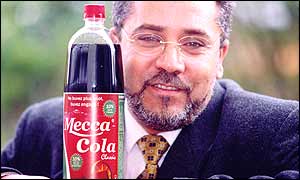
Taoufik Mathlouthi, founder of Mecca-Cola, broadcasts a noteworthy (although hardly newsworthy) confession: mosques in Paris preach anti-french hatred.
From France-Echos:
It’s Mathlouthi himself that admits it: some mosques are propagating hatred right in the center of Paris!
Radio-Mediterranean (88.6 Mhz), this Sunday April 16 2006 – Mosques are sites for anti-french hatred.
It’s Mathlouthi that admits it first-hand in an outburst of frankness (he said he had hesitated before making the admission). “If you don’t mind, [I’m]not naming the mosque in order not to be controversial… I made my Friday prayers in a Parisian mosque… the [sermon?] preached, is not the preaching of islam that I know… hearing things like “may god destroy their state and may their goods become our booty!”,… speaking for myself as a muslim, this has nothing to do with me. … the imams are forming entire generations of young muslims from texts that reject hatred.”
Coming from the fanatical Mathlouthi himself who, several minutes beforehand had supported the Hamas government as “the only democratically elected government in the islamic world”, this is a significant confession. ……
Mecca-cola is a fascinating concept: a product born as an alternative, basing its appeal not so much on its value as a product, but on its very existence as an alternative.
We in the Great White North undoubtedly recognize the appeal of such products, for are we not bombarded every day with the slogan, “buy Canadian”? When I read “Proudly made in Canada” firmly stamped upon a product, I can’t help see it as a tacit apology: “sorry this isn’t better than the American version”. For if it was truly the superior product, why would its point of origin weigh upon my choice as a consumer? Why the invitation to reward one through a punishment of another?
Canada itself can be seen an extention of the philosophy that brought about Mecca-Cola: a deliberate rejection of America, an embrace of an alternative. All too often Canadians define themselves by simply saying they are not American, and like our entreprenial Mathlouthi, perceptions about money turn out to be at the root of the distinction.
From what I take to be Mecca-Cola’s mission statement:
“One of the perversions of capitalism lies in the generation within oneself of the most brutal and the most inhumane part of oneself.
The spirit which governed the creation of Mecca-Cola was to create a profit-making business which would help to relieve human suffering where action is still possible…”
We may roll our eyes at the destination of these charitable donations (“The most intolerable and the most immediate suffering is that of the Palestinian people...”) but my contention is that, like too many patriotic statements made about Canada, it’s all about perceptions on how we view money, compared to those "selfish, greedy" Americans.
Why the automatic mistrust towards the incentive to make money (the "evil" of the Profit Motive)? Why the reflex fear of having money (the "evil" of being "rich")? Sadly, Canadians seem to not trust themselves nearly as much as our neighbors to the south trust themselves. Surely, the more we make, the more we can share. The more prosperous we can become, the more charitable we can afford to be. The incentive to denigrate wealth creation, seems to come from a lack of trust, of oneself and one’s group. It is not “money” that is the root of all evil, it is “Love of money [that] is the root of all evil” (I Tim.6:10).
It would be, of course, naïve to automatically expect all human beings to always act in their own enlightened self-interest. Being human, we are part animal, and will frequently fall prey to our instinct to think and act in ways that satisfy short-term, not long-term, opportunities.
Is it possible to define ourselves only in the negative? Ultimately no, it is not sufficient, for there needs to be another point of comparison to measure against, in order to establish a more complete identity. We should not think in purely binary terms, “this or that”. We need to think in broader terms, along a scale, so that we may shift ourselves closer to one extreme or to another. By recognizing a broader range, we can narrow our choices to a more accurate representation.
We look at animals, and beyond their family or pack, their "tribe", we do not see them sharing their goods. Should we look at the human animal, and see him as only capable of similar behavior? It’s an easier riddle to solve, if we suggest three choices, rather than just two. “Man will never share”, vs “man will always share”, can be discounted as too absolutist; is not the more likely choice to be, “man will share, sometimes”?
A principle, not a rule.
A Golden Mean, balanced between two extremes.
Canada and the United States of America were created as nations with different understandings of where man’s trust of himself should be placed along this scale. Up here, right or wrong, better or worse, by retaining our attachment to our british identity rather than joining the colonies in rebellion, we chose a definition of ourselves as less trustworthy than our neighbors to the south. We chose to believe that we are not as able to view materialism as a means to an end. We chose to be suspicious of the profit motive, we chose to be suspicious of wealth, suspicious of ourselves.
We created Canada.
We erect enormous social safety nets to catch those who fall, because we presume they will be left to rot, unassisted by their fellows. We deny the likelyhood of charity through heavy taxation. In doing so, do we not deny mankind its proper birthright, as being positioned between two extremes? Between, at one extreme, the animal kingdom, and its self-oriented materialism, and the other, a vision of god, with all its implied spiritual elevation above the material?
Canadians do not trust themselves, as a people, as much as Americans trust themselves, to do the right thing. Whether this is a major cause of the anti-american hatred that fuels so many canadians in these sad times, I leave for another post. (mostly because I have no idea!)
It is genuinely hard to see beyond the present, and the needs of the present. To see past and future, involves a great deal of faith... and trust in the potential for change.
"Yes, I tell you that it is easier for a camel to go through the eye of a needle than for a rich person to enter the kingdom of God." (Matthew 19:23-24)
I read this, not as praise of poverty, but as admission that charity is sacred. Charitable contributions being extracted at the point of a gun, through taxation, is not charity, since there is no element of choice. The difficulty of the choice, does not mean it's impossible. It's just hard. Allowing citizens to make the choice for themselves, involves a degree of trust and faith. And hope. Surely our covenant, as participants in the shared experience of this nation, should aspire to a vision of mankind that is capable of positive growth, of change for the better?
If we are to define ourselves by what we are not, let's look upward, towards spiritual magnificience, not downwards, towards an animal-oriented definition for ourselves; let's presume we are capable of more, not delude ourselves that we are doomed to be less.
An embrace of the potential for good. That's my vision for Canada.
Sunday, April 23, 2006
Ark of the Covenant Spotted
Mika, a commenter at Belmont Club sent this to me:
Whether or not there was ever a single person, Moses, the revelation that takes his name certainly occurred. People living in a pagan world - where gods are invoked for all the usual reasons of men who fear or desire the power behind the sacred but are never conceivably defined as a theological problem to be pursued in loving faith - cannot simply make up a story like Exodus without having had a profound theological and/or anthropological revelation. To imagine a monotheistic God who refuses name or form but only offers a definition of the divine - I am what I am - in reponse to a call for his name is to come to a whole new understanding of the divine and one peculiar people's defining relationship with him.
A new form of covenant can only come into being as an act of faith. No doubt such an act propelled the Exodus, whatever the role of the Santorini volcano. The differentiation of consciousness that an act of faith entails is something the film did not try to explain. Nor do we expect the so-often-gnostic professors who rarely have any real faith to understand this aspect of our humanity. And hence we expect them to doubt the kind of evidence, for the claim that the Exodus happened - pretty much as it says in the Bible - that this film presents.
You've got to see the film, in any case, just to catch a glimpse of the jewellery that might well be a representation of the ark itself.
UPDATE: Mika, in comments, gives us the website for the film.
Director posits proof of biblical ExodusI caught the second half of this film, and was fascinated by it. I have no idea how to weigh the various kinds of evidence and argument presented, but i can assure you it is all most captivating.
MICHAEL POSNER
From Friday's Globe and Mail
A provocative $4-million documentary by Toronto filmmaker Simcha Jacobovici claims to have found archeological evidence verifying the story of the biblical Exodus from Egypt, 3,500 years ago.
Religious Jews consider the biblical account incontrovertible — the foundation story of the creation of the nation of Israel. Indeed, they celebrated the Exodus Wednesday night and last night with the annual Passover recitation of the Haggadah.
But among scholars, the question of if and when Moses led an estimated two million Israelite slaves out of pharaonic Egypt, miraculously crossed the Red Sea ahead of the pursuing Egyptian army and received the Ten Commandments from God on Mount Sinai, has long been a source of contention.
Absent definitive proof, archeologists have argued variously that the biblical account is simply a nice fable or that it may have happened, but not on the scale suggested by the Book of Exodus. Nor is there any consensus about when it might have occurred.
Now, in Exodus Decoded, Mr. Jacobovici says he has found almost a dozen overlooked relics that confirm the biblical story.
They include: a miniature, 3,500-year-old gold replica of the lost Ark of the Covenant, said to have been built during the Israelites' 40-year sojourn in the Sinai desert and three stone stelae with carvings depicting a charioteer chasing a single man through churning waters — the pursuer, like the Egyptian army, is ultimately drowned.
In addition, there is hieroglyph, the el-Arish stone, which appears to recount the Exodus from the Egyptian point of view — as a disaster, that is — and the seal of a royal scarab, found at Avaris north of modern-day Cairo, engraved with the name Ya'akov, the father of Joseph, who the Bible says was grand vizier, the second-most-powerful man after pharaoh.
Dating the Exodus to roughly 1,500 BC, the two-hour film presented and executive-produced by Hollywood director James Cameron and airing Easter Sunday on Discovery Canada — suggests that the great Santorini volcano caused the Ten Plagues that the Bible says were visited upon the Egyptians and which finally persuaded the pharaoh of the day.
The Greek island of Santorini lies only 700 kilometres north of Egypt. When it erupted, it sent smoke and ash 37 kilometres into the sky. Mr. Jacobovici contends that volcanology and geology can explain not only the first plague — that Egypt's waters were turned blood-red through the release of toxic gas, similar to what happened at Lake Nios in Cameroon in 1986; but they also can explain the succeeding nine plagues — frogs, fleas, flies, livestock deaths, boils, hailstorms, locusts, darkness and the death of the Egyptian firstborn males.
The film contends that the tsunami unleashed by the Santorini upheaval can also account for why the Israelites were able to cross the parting sea ahead of the pharaoh's army and why the Egyptians were subsequently engulfed. But Mr. Jacobovici says the sea Moses crossed was not the Red Sea, as is traditionally thought, but a smaller lake, known in Egypt as the Reed Sea. Its Egyptian name, translated into Hebrew, means "the place where God
swallowed up."
Later in the film, Mr. Jacobovici, a 53-year-old two-time Emmy winner, claims to have found the authentic Mount Sinai. It is not the 2,285-metre structure widely considered to be the mountain where Moses received the Ten Commandments, near the foot of which now stands the Monastery of St. Catherine. Instead, he locates it farther north and east at a place called Hashem el-Tarif, and says it perfectly fits the Bible's description.
What experts will make of the high-tech documentary, with 45 minutes of computer graphic enhancement, is not clear. Mr. Jacobovici includes interviews with more than a dozen historians, archeologists, geologists and writers that support key parts of his argument. These include the distinguished Egyptologist Donald Redford, now teaching at Penn State University. But no single scholar endorses the entire thesis.
In fact, Dr. Redford not only dismisses most of the film's points as fantasy, he doubts that any exodus of Israelites actually occurred. Mary-Ann Wegner, professor of Near and Middle Eastern studies at the University of Toronto, says that the biblical topographical descriptions and the policies of Egypt's rulers support the notion of an exodus, but considers the rest of Mr. Jacobovici's evidence unpersuasive. However, neither Dr. Redford nor Dr. Wegner have seen the film.
Two scholars who have seen it are more positive. Barry Wilson, a professor of religion at York University, calls it "a fabulous detective story ...Perry Mason goes biblical. It's a remarkably well-executed study."
Kenneth Green, a professor of Judaic studies at the University of Toronto, says the film is "provocative and challenging.
"It's all 'maybes,' but it's plausible and coherent. I think he's going to be attacked viciously, but he's made a case that has to be answered."
Mr. Jacobovici, who recently sold the film to the History Channel in the United States, concedes that many scholars will "scoff at my evidence. It's a closed club, after all. But they can't just dismiss it. There's a cluster of evidence here. If it walks like an Exodus and quacks like an Exodus, it is an Exodus. That's not Egyptology. That's logic."
Whether or not there was ever a single person, Moses, the revelation that takes his name certainly occurred. People living in a pagan world - where gods are invoked for all the usual reasons of men who fear or desire the power behind the sacred but are never conceivably defined as a theological problem to be pursued in loving faith - cannot simply make up a story like Exodus without having had a profound theological and/or anthropological revelation. To imagine a monotheistic God who refuses name or form but only offers a definition of the divine - I am what I am - in reponse to a call for his name is to come to a whole new understanding of the divine and one peculiar people's defining relationship with him.
A new form of covenant can only come into being as an act of faith. No doubt such an act propelled the Exodus, whatever the role of the Santorini volcano. The differentiation of consciousness that an act of faith entails is something the film did not try to explain. Nor do we expect the so-often-gnostic professors who rarely have any real faith to understand this aspect of our humanity. And hence we expect them to doubt the kind of evidence, for the claim that the Exodus happened - pretty much as it says in the Bible - that this film presents.
You've got to see the film, in any case, just to catch a glimpse of the jewellery that might well be a representation of the ark itself.
UPDATE: Mika, in comments, gives us the website for the film.
Pay up, or we are at war...
I was very glad when Prime Minister Harper announced that Canada would not be giving money to the Hamas government. Such moral clarity was a rare thing after years of Liberal pandering to those who would see murderous terrorists as victims of the west. Of course the sympathizers of the Palestinians did not see it that way. You want the Arab world to practice democracy, they said, and then when the noble Palestinians practice it and throw out a corrupt government, voting in the only aternative, you punish them. Well, I say, democracy means becoming responsible for being the kind of people you are. Look at what you have become, Palestinians. No money until the new government completely renounces violence against Israel and mirrors words with actions.
Well, it seems Osama bin Laden disagrees with me, (then again, maybe ultimately he does not):
Well, it seems Osama bin Laden disagrees with me, (then again, maybe ultimately he does not):
The West's decision to cut off funds to the Palestinians is clear evidence of a vendetta against Islam, claims Osama bin Laden in what is reported to be a new audio tape released by the infamous terrorist.Will this make our keffiyeh-wearing crowd more or less likely to respect Harper? In other words, is it really peace that they want?
The tape was broadcast Sunday on Al-Jazeera television.
The authenticity of the tape has not yet been verified, but if indeed it is bin Laden's voice, it will represent his first public message since Jan. 19.
The person on the tape says the actions by Europe and the U.S. are part of a concerted crusade against Muslims.
"The blockade which the West is imposing on the government of Hamas proves that there is a Zionist crusader war on Islam,'' the speaker on the tape said.
He condemned both governments and individuals in the West for the so-called "crusade."
"I say that this war is the joint responsibility of the people and the governments. While the war continues, the people renew their allegiance to their rulers and politicians and continue to send their sons to our countries to fight us.''
Saturday, April 22, 2006
R.I.P.
Four Canadian Soldiers Killed in Afghanistan
Here at Covenant Zone, we wish to express our condolences to the families and friends of the fallen.
I hope it is not inappropriate to take this moment to say something to our readers about our opinion of the mission in Afghanistan. We know great change cannot happen there over night and that if we are committed to helping bring some new kind of order and civility to that country, our committment must be one of many years, and in many forms. This is a truly daunting task. At the same time, we see no way of isolating ourselves, here in Canada, from the disorder and evil political and religious ideas that are widespread in that region of the world. Our future security demands our engagement on many levels with the people of the Middle East, and we salute those Canadians presently occupied in this work.
It is tragic events, like the loss of our soldiers, that remind us of the need to know who we are, for whom our young men are dying. In our latest Covenant Zone public meeting, we discussed the appeal, but more seriously the limits, of the multicultural idea among any people who would define themselves in such a way as to be able to rule themselves via a symbolic order of their own making. Any such order ultimately depends on some recognition of some difference between us and them, between good and evil, and on men and sometimes women willing to patrol the boundary between the two. However broad and welcoming we want our "we" or "us" to be, we cannot aspire to integrate all the world's cultures and symbols under one roof. There can be no integrity in such a syncretic dream, which cannot actually be lived, but only, via righteous theories, imposed by an authority more fearful of disorder than willing to embrace the idea of the people of a nation ruling themselves. Syncretism in national or individual life only leads to confusion, to a lack of realistic, humble, models with which to live one's life.
All Canadians can be proud of the young men and women serving and sometimes giving their lives in Afghanistan. They remind us that Canada does recognize that there are peoples and ideas - e.g. the Taliban - that stand outside any broad-minded interpretation of both Canadian and Afghan values. We can be proud that our country provides some young people with the well-bounded models of humanity by which they are able at a young age to make a committment to national service, to go abroad in the name of our national interest, and in aid to a very nascent democracy. We hope Afghanistan can one day prove a vital ally in the cause to build a true international order of self-ruling nations, in face of those with various ideas and schemes to impose on the world a common, "unifying" law, whether this law be imposed in the name of Islam or some secular fantasy ideology.
The men were travelling in a G-wagon about 75 kilometres north of Kandahar when their vehicle was struck by an improvised explosive device at about 7:30 a.m. local time, said CTV's Sarah Galashan, reporting from Kandahar.Comrades of Myles Mansell of the 5th (BC) Field Artillery Regiment are posting their thoughts here.
Three of the men were killed instantly. The fourth was airlifted to hospital but died before he arrived.
Three of the men have been identified as Cpl. Matthew Dinning, Bombardier Myles Mansell, and Lieut. William Turner.
Dinning was born in Richmond Hill, Ont., and was stationed in Petawawa, Mansell was born in Victoria B.C. where he was also stationed, and Turner was from Toronto but was stationed in Edmonton.
[...]
Prime Minister Stephen Harper issued a statement praising the valour of the soldiers and the work the troops are doing in Afghanistan.
"These men were working to bring security, democracy, self-sufficiency and prosperity to the Afghan people and to protect Canadians' national and collective security. We will not forget their selfless contribution to Canada," Harper said in the statement.
Here at Covenant Zone, we wish to express our condolences to the families and friends of the fallen.
I hope it is not inappropriate to take this moment to say something to our readers about our opinion of the mission in Afghanistan. We know great change cannot happen there over night and that if we are committed to helping bring some new kind of order and civility to that country, our committment must be one of many years, and in many forms. This is a truly daunting task. At the same time, we see no way of isolating ourselves, here in Canada, from the disorder and evil political and religious ideas that are widespread in that region of the world. Our future security demands our engagement on many levels with the people of the Middle East, and we salute those Canadians presently occupied in this work.
It is tragic events, like the loss of our soldiers, that remind us of the need to know who we are, for whom our young men are dying. In our latest Covenant Zone public meeting, we discussed the appeal, but more seriously the limits, of the multicultural idea among any people who would define themselves in such a way as to be able to rule themselves via a symbolic order of their own making. Any such order ultimately depends on some recognition of some difference between us and them, between good and evil, and on men and sometimes women willing to patrol the boundary between the two. However broad and welcoming we want our "we" or "us" to be, we cannot aspire to integrate all the world's cultures and symbols under one roof. There can be no integrity in such a syncretic dream, which cannot actually be lived, but only, via righteous theories, imposed by an authority more fearful of disorder than willing to embrace the idea of the people of a nation ruling themselves. Syncretism in national or individual life only leads to confusion, to a lack of realistic, humble, models with which to live one's life.
All Canadians can be proud of the young men and women serving and sometimes giving their lives in Afghanistan. They remind us that Canada does recognize that there are peoples and ideas - e.g. the Taliban - that stand outside any broad-minded interpretation of both Canadian and Afghan values. We can be proud that our country provides some young people with the well-bounded models of humanity by which they are able at a young age to make a committment to national service, to go abroad in the name of our national interest, and in aid to a very nascent democracy. We hope Afghanistan can one day prove a vital ally in the cause to build a true international order of self-ruling nations, in face of those with various ideas and schemes to impose on the world a common, "unifying" law, whether this law be imposed in the name of Islam or some secular fantasy ideology.
Friday, April 21, 2006
Relative Moral Poverty
I had a friend looking for work some years ago, and I sent him this as helpful. I just got it back. I don't know what kind of person he thinks I am. But, if things continue as they are today perhaps if I pick up my French a bit or even go so far as too learn dish I might just have a new career after all.
****
Kingdom's Leading Executioner Says: 'I Lead a Normal Life'
Mahmoud Ahmad, Arab News Staff
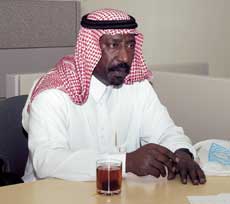 Muhammad Saad Al-Beshi says he is calm at work because he is doing God's work. (Photo by Muhammad Al-Shehry)
JEDDAH, 5 June 2003 — Saudi Arabia's leading executioner Muhammad Saad Al-Beshi will behead up to seven people in a day.
"It doesn't matter to me: Two, four, 10 — As long as I'm doing God's will, it doesn't matter how many people I execute," he told Okaz newspaper in an interview.
He started at a prison in Taif, where his job was to handcuff and blindfold the prisoners before their execution. "Because of this background, I developed a desire to be an executioner," he says.
He applied for the job and was accepted.
His first job came in 1998 in Jeddah. "The criminal was tied and blindfolded. With one stroke of the sword I severed his head. It rolled meters away." Of course he was nervous, then, he says, as many people were watching, but now stage fright is a thing of the past.
He says he is calm at work because he is doing God's work. "But there are many people who faint when they witness an execution. I don't know why they come and watch if they don't have the stomach for it.
"Me? I sleep very well," he adds.
Does he think people are afraid of him? "In this country we have a society that understands God's law," he says. "No one is afraid of me. I have a lot of relatives, and many friends at the mosque, and I live a normal life like everyone else. There are no drawbacks for my social life."
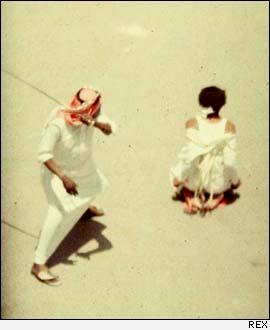
Before an execution, nonetheless, he will go to the victim's family to obtain forgiveness for the criminal. "I always have that hope, until the very last minute, and I pray to God to give the criminal a new lease of life. I always keep that hope alive."
Al-Beshi will not reveal how much he gets paid per execution as this is a confidential agreement with the government. But he insists that the reward is not important. "I am very proud to do God's work," he reiterates.
However, he does reveal that a sword will cost something in the region of SR20,000. "It's a gift from the government. I look after it and sharpen it once in a while, and I make sure to clean it of bloodstains.
"It's very sharp. People are amazed how fast it can separate the head from the body."
By the time the victims reach the execution square they have surrendered themselves to death, he says, though they may hope to be forgiven at the last minute. "Their hearts and minds are taken up with reciting the Shahada." The only conversation with the prisoner is when he tells him to say the Shahada.
"When they get to the execution square, their strength drains away. Then I read the execution order, and at a signal I cut the prisoner's head off."
He has executed numerous women without hesitation, he explains. "Despite the fact that I hate violence against women, when it comes to God's will, I have to carry it out."
There is no great difference between executing men and women, except that the women wear hijab, and nobody is allowed near them except Al-Beshi himself when the time for execution comes.
When executing women he will use either gun or sword. "It depends what they ask me to use. Sometimes they ask me to use a sword and sometimes a gun. But most of the time I use the sword," he adds.
As an experienced executioner, 42-year-old Al-Beshi is entrusted with the task of training the young. "I successfully trained my son Musaed, 22, as an executioner and he was approved and chosen," he says proudly. Training focuses on the way to hold the sword and where to hit, and is mostly through observing the executioner at work.
An executioner's life, of course, is not all killing. Sometimes it can be amputation of hands and legs. "I use a special sharp knife, not a sword," he explains. "When I cut off a hand I cut it from the joint. If it is a leg the authorities specify where it is to be taken off, so I follow that."
Al-Beshi describes himself as a family man. Married before he became an executioner, his wife did not object to his chosen profession. "She only asked me to think carefully before committing myself," he recalls. "But I don't think she's afraid of me," he smiles. "I deal with my family with kindness and love. They aren't afraid when I come back from an execution. Sometimes they help me clean my sword."
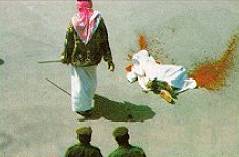
A father of seven, he is a proud grandfather already. "I have a married daughter who has a son. He is called Haza, and he's my pride and joy. And then there are my sons. The oldest one is Saad, and of course there is Musaed, who'll be the next executioner," he adds.
http://www.arabnews.com/?page=1§ion=0&article=27038&d=5&m=6&y=2003
****
Yup, it's all relative. What's good for them isn't necessarily good for us, but it's not our place to impose our values on others. We don't understand their culture and so on till I want to puke. These people, these Saudis, are our allies, and the creatures who support them are our politicians and our Leftist weepers who cry about racism and islamophobia.
I say: "Off with their heads!"
But what do we make of the story posted below by Charles?
****
Kingdom's Leading Executioner Says: 'I Lead a Normal Life'
Mahmoud Ahmad, Arab News Staff
 Muhammad Saad Al-Beshi says he is calm at work because he is doing God's work. (Photo by Muhammad Al-Shehry)
JEDDAH, 5 June 2003 — Saudi Arabia's leading executioner Muhammad Saad Al-Beshi will behead up to seven people in a day.
"It doesn't matter to me: Two, four, 10 — As long as I'm doing God's will, it doesn't matter how many people I execute," he told Okaz newspaper in an interview.
He started at a prison in Taif, where his job was to handcuff and blindfold the prisoners before their execution. "Because of this background, I developed a desire to be an executioner," he says.
He applied for the job and was accepted.
His first job came in 1998 in Jeddah. "The criminal was tied and blindfolded. With one stroke of the sword I severed his head. It rolled meters away." Of course he was nervous, then, he says, as many people were watching, but now stage fright is a thing of the past.
He says he is calm at work because he is doing God's work. "But there are many people who faint when they witness an execution. I don't know why they come and watch if they don't have the stomach for it.
"Me? I sleep very well," he adds.
Does he think people are afraid of him? "In this country we have a society that understands God's law," he says. "No one is afraid of me. I have a lot of relatives, and many friends at the mosque, and I live a normal life like everyone else. There are no drawbacks for my social life."
Before an execution, nonetheless, he will go to the victim's family to obtain forgiveness for the criminal. "I always have that hope, until the very last minute, and I pray to God to give the criminal a new lease of life. I always keep that hope alive."
Al-Beshi will not reveal how much he gets paid per execution as this is a confidential agreement with the government. But he insists that the reward is not important. "I am very proud to do God's work," he reiterates.
However, he does reveal that a sword will cost something in the region of SR20,000. "It's a gift from the government. I look after it and sharpen it once in a while, and I make sure to clean it of bloodstains.
"It's very sharp. People are amazed how fast it can separate the head from the body."
By the time the victims reach the execution square they have surrendered themselves to death, he says, though they may hope to be forgiven at the last minute. "Their hearts and minds are taken up with reciting the Shahada." The only conversation with the prisoner is when he tells him to say the Shahada.
"When they get to the execution square, their strength drains away. Then I read the execution order, and at a signal I cut the prisoner's head off."
He has executed numerous women without hesitation, he explains. "Despite the fact that I hate violence against women, when it comes to God's will, I have to carry it out."
There is no great difference between executing men and women, except that the women wear hijab, and nobody is allowed near them except Al-Beshi himself when the time for execution comes.
When executing women he will use either gun or sword. "It depends what they ask me to use. Sometimes they ask me to use a sword and sometimes a gun. But most of the time I use the sword," he adds.
As an experienced executioner, 42-year-old Al-Beshi is entrusted with the task of training the young. "I successfully trained my son Musaed, 22, as an executioner and he was approved and chosen," he says proudly. Training focuses on the way to hold the sword and where to hit, and is mostly through observing the executioner at work.
An executioner's life, of course, is not all killing. Sometimes it can be amputation of hands and legs. "I use a special sharp knife, not a sword," he explains. "When I cut off a hand I cut it from the joint. If it is a leg the authorities specify where it is to be taken off, so I follow that."
Al-Beshi describes himself as a family man. Married before he became an executioner, his wife did not object to his chosen profession. "She only asked me to think carefully before committing myself," he recalls. "But I don't think she's afraid of me," he smiles. "I deal with my family with kindness and love. They aren't afraid when I come back from an execution. Sometimes they help me clean my sword."
A father of seven, he is a proud grandfather already. "I have a married daughter who has a son. He is called Haza, and he's my pride and joy. And then there are my sons. The oldest one is Saad, and of course there is Musaed, who'll be the next executioner," he adds.
http://www.arabnews.com/?page
****
Yup, it's all relative. What's good for them isn't necessarily good for us, but it's not our place to impose our values on others. We don't understand their culture and so on till I want to puke. These people, these Saudis, are our allies, and the creatures who support them are our politicians and our Leftist weepers who cry about racism and islamophobia.
I say: "Off with their heads!"
But what do we make of the story posted below by Charles?
Vancouver mayor to drug addicts: "there is no hope for you!"

Is this to become the Canadian approach to reducing crime:
making it a government-run program?
My morning paper declares it is the attitude of one Canadian: Vancouver mayor Sam Sullivan.
Provide drugs to addicts, mayor says
I hold out one thin reed of hope: that, as often is the case these days with our "official" sources of news, maybe the mayor's comments are being slanted so as to sucker readers like me into reading the actual article. This quote from the piece, suggests some yellow journalism at play in order to make for more eye-grabbing headlines: "Mayor Sam Sullivan says he's willing to risk his political career to bring in a program to provide drugs or drug substitutes for addicts in an effort to protect victimized women in the Downtown Eastside and deal with Vancouver's social-disorder problems by the 2010 Olympics." [emphasis added]
Another successful night
This Thursday night, Vancouver was yet again witness to the growing determination of its citizens to meet face to face, without any formal mediation, without pretense of hipness or foreknowledge of some millenial event, without ironic posturing, sincere expertise, or grim resolution, but simply with good humour and faith in our struggle to share as equals in the media by which we know the truth of our experience and the world around us. The young woman who serves us coffee has come to know us and her smile grows more radiant every week; again she was genuinely sorry to have to kick us out at closing.
We discussed our strategies for provoking the government to pass judgment on the bureaucrats in the Department of Foreign Affairs and International Trade who have presumed to initiate an unprecedent relationship with the Umma (if only those public servants reading our blog would drop us a line and let us know their minds!) Charles kept us up to date on the situation in France and our hopes to increase communications with out blue scarf comrades there, and to tell their story here. We pondered the future of this blog, how we might find and engage more readers, find the time and discipline to write the great posts that are presently in the works, and justify your interest in us, hoping that we will hear more from you to guide us in our plans.
We were sorrowed to note the prevalence of anti-American and anti-western sentiment among the young today, and wondered how to fill the vacuum left by the collapse of the millennial fantasies of the trans-national left. How will we be able to communicate a positive vision in an open-ended future of nations and market society, about which we can promise nothing utopian, but only show our faith that out of the inevitable struggles and conflicts of the human condition, we need never lose sight of that which guarantees the inexhaustability of human creativity, our ability to forever refigure our shared sense, both univeral and particularly Canadian, of the transcendent goodness in the world. Such goodness was apparent in those we saw about us tonight, from the old man entranced and reading alone that rumoured-to-be-silly book, the Da Vinci Code, to the legions of students streaming in and out of the library, to the immigrant getting advice on his resume, and the youngsters coming home from training with the British Columbia Regiment, proudly wearing their pixelated camouflage.
We determined that in our fights to come with the ideologies of western guilt that rob us of the moral confidence to quickly defeat the enemies of freedom, we will always keep in mind the need to struggle to act as if we are prefiguring the transcendent signs that will emerge in future from present conflicts and justify our present faith in our religious and political traditions and their inexhaustability. Conflict, unfortunately inevitable, will reward good faith with a strengthened knowledge of who we are and what we may possibly become, and thus help serve the cause of redefining the covenantal signs around which all Canadians will be united in future.
We discussed our strategies for provoking the government to pass judgment on the bureaucrats in the Department of Foreign Affairs and International Trade who have presumed to initiate an unprecedent relationship with the Umma (if only those public servants reading our blog would drop us a line and let us know their minds!) Charles kept us up to date on the situation in France and our hopes to increase communications with out blue scarf comrades there, and to tell their story here. We pondered the future of this blog, how we might find and engage more readers, find the time and discipline to write the great posts that are presently in the works, and justify your interest in us, hoping that we will hear more from you to guide us in our plans.
We were sorrowed to note the prevalence of anti-American and anti-western sentiment among the young today, and wondered how to fill the vacuum left by the collapse of the millennial fantasies of the trans-national left. How will we be able to communicate a positive vision in an open-ended future of nations and market society, about which we can promise nothing utopian, but only show our faith that out of the inevitable struggles and conflicts of the human condition, we need never lose sight of that which guarantees the inexhaustability of human creativity, our ability to forever refigure our shared sense, both univeral and particularly Canadian, of the transcendent goodness in the world. Such goodness was apparent in those we saw about us tonight, from the old man entranced and reading alone that rumoured-to-be-silly book, the Da Vinci Code, to the legions of students streaming in and out of the library, to the immigrant getting advice on his resume, and the youngsters coming home from training with the British Columbia Regiment, proudly wearing their pixelated camouflage.
We determined that in our fights to come with the ideologies of western guilt that rob us of the moral confidence to quickly defeat the enemies of freedom, we will always keep in mind the need to struggle to act as if we are prefiguring the transcendent signs that will emerge in future from present conflicts and justify our present faith in our religious and political traditions and their inexhaustability. Conflict, unfortunately inevitable, will reward good faith with a strengthened knowledge of who we are and what we may possibly become, and thus help serve the cause of redefining the covenantal signs around which all Canadians will be united in future.
Thursday, April 20, 2006
Drive another nail.

Join us at the Vancouver Public Library this evening, Thursday, from 7-9:00 pm at the atrium to help drive another nail into the coffin of Left dhimmi fascism. We'll be the ones wearing blue scarves.
Wednesday, April 19, 2006
A Removable Feast
Write a letter to your congressman, write to your M.P. Let him or her know what you think about this!
Below we see two views on what the public world thinks about the private people: the first story explains that the world of political people is focusing on private people who don't write letters to politicians; the second, from a major Canadian newspaper claims that the MSM is doing just fine and the people are not that important at all.
According to the U.S. government, the government is getting news and views from bloggers. Story two: according to the MSM the bloggers don't know nothing much of interest. Once again, the Canadian establishment infantalises the public and dismisses them as incapable of intelligent consideration, a mere decoration of democracy and good government.
Bloggers and readers are making a new democracy under the high held noses of the intelligentsia-- now more useless and irrelevant than they have been ever before. You, dear reader, are making democracy a living and vibrant thing in itself.
****
CIA mines 'rich' content from blogs
The new Open Source Center (OSC) at CIA headquarters recently stepped up data collection and analysis based on bloggers worldwide and is developing new methods to gauge the reliability of the content, said OSC Director Douglas J. Naquin.
"A lot of blogs now have become very big on the Internet, and we're getting a lot of rich information on blogs that are telling us a lot about social perspectives and everything from what the general feeling is to ... people putting information on there that doesn't exist anywhere else," Mr. Naquin told The Washington Times.
Eliot A. Jardines, assistant deputy director of national intelligence for open source, said the amount of unclassified intelligence reaching Mr. Bush and senior policy-makers has increased as a result of the center's creation in November.
"We're certainly scoring a number of wins with our ultimate customer," said Mr. Jardines....
"I can't get into detail of what, but I'll just say the amount of open source reporting that goes into the president's daily brief has gone up rather significantly," Mr. Jardines said. "There has been a real interest at the highest levels of our government, and we've been able to consistently deliver products that are on par with the rest of the intelligence community."
Mr. Naquin said recent OSC successes have included the discovery of a technology advance in a foreign country. Also, most data on avian flu outbreaks come from open sources, he said.
"Have we got coups out of it? Close to it," Mr. Naquin said. "But certainly we've had more insight than we've ever had before."
The OSC uses powerful computers and software technology to "sift" the Internet for valuable intelligence....
In the past, open-source reports were used mainly by intelligence analysts.
"But now our customer base literally ranges from the president to local police departments," Mr. Naquin said. The Fairfax County police use OSC products, as do police departments in San Diego, New York and Baltimore. The center also provides support to the U.S. military.
A Defense Department official said Chinese military bloggers have become a valuable source of intelligence on Beijing's secret military buildup. For example, China built its first Yuan-class attack submarine at an underground factory that was unknown to U.S. intelligence until a photo of the submarine appeared on the Internet in 2004.
[....]
The OSC is doubling its staff and bringing in material from 32 government agencies that also produce unclassified reports, Mr. Jardines said.
http://www.washingtontimes.com/national/20060418-110124-3694r.htm
****
If you write a letter to your congressman or your m.p. or deputy, you might reach one secretary in some obscure department somewhere. Your letter, along with dozens of others, might go into a pile to gather dust or even a form-letter response sent back at your expense. If you write to the public, if you resonate in the world of people who vote, then the politicians must come to you to beg for your vote instead of you begging them to pay attention to you. Make the rotten bastards work for you. That's what we elect them to do. Politicians aren't leaders, they are our servants to carry out our orders. Politicians are cooks and waiters dishwashers. This banquet of democracy is ours to feast at. We choose the place and the staff, and they carry our our commands. If we don't choose the best, then we must toss them our and fill our government with better people who can do the jobs we expect them to.

We don't tell the cooks how to cook. We choose what we want, and the cooks do their professional jobs or they don't. That's the end of it. They ask us if we like it. We don't beg them to appeal to us.
****
According to Ted McKeough in a special to The Star:
NEW YORK—There have been plenty of commentators arguing that blogs will lead to the demise of "old" media organizations that publish newspapers, magazines and books.
ABC News columnist Michael S. Malone predicted the end of newspapers last year when he saw "the first links embedded in blogs. There was simply nothing in the physical world that could ever hope to match the ability to leap through cyberspace from story to story, file to file, with almost infinite extension." Or as former editor-in-chief of MSNBC.com Merrill Brown put it: "The future of the news industry is seriously threatened by the seemingly irrevocable move by young people away from traditional sources of news."
Yet despite the proliferation and popularity of blogs, the obliteration of mainstream media as we know it is just not happening. Rather than resembling a steamroller, blogs are looking like the cheese on the bread that is mainstream media; or if you prefer, the icing on the cake.
As it now stands, the reason that so many blog links go to MSM is because, currently, the MSM is the dominant gatherers of news and content. No blogger can afford, individually, to, for example, imbed a journalist with the troops in the front lines of Iraq (or as most MSM outlets do, in the green zone). An exception to this has been Steve Marshall of Guerrilla News who produced a Sundance award winning doc while doing this on his own tab.
This will change when there are more bloggers at the places where news occurs. News will be something that is reported in real time, by the participants and direct observers. And the main media for this will be blogs, in real time. And with the use of aggregators and spiders, a second after someone posts something interesting, the world will have it.
Then the MSM will become republishers. And they will die.
posted by Brian Lemon at 4:36 PM
http://canadianbluelemons.blogspot.com/2006/04/death-of-blog.html
****
This editorial is based on two pieces from the MSM. Both came from blogs. You, dear reader, are becoming the media. In time we won't require the MSM for our copy. We will be the ones trained and professional and on the spot who write and publish the news. The politicians will more and more come to us for our commands.
When we meet on Thursday evenings at the Vancouver Public Library from 7-9:00 pm each week we conduct democracy in action. We by-pass the politicians and the MSM in favor of private people conducting their own public affairs. When a Canadian terrorist supporter hires on with the Canadian government it is bloggers and readers who make their opinions known on the Internet. We don't write letters to the editor of the Toronto Star. We don't write letters to our m.p.s. We blog, and the whole world knows in a moment that the Canadian government has a terrorist agitator in it's public office. We have power and we can and do use it. It's democracy.
Please join us on Thursday at 7:00 pm to discuss your views. We'll be in Vancouver, Canada. You, being elsewhere, can do the same kind of democratic agitating we do. Democracy isn't limited to Vancouver. It's for everyone. It's for you. You are democracy yourself. Exercise it. Don't sit at home reading the local paper. Don't sit in watching the news on TV. Walk to the library and meet your fellows. You're free to do that. Vote with your feet.
Join us. Meet us. We want to know your opinions. Write a letter to your blogger. Let him or her know what you think about this!
What's on the menu?
Below we see two views on what the public world thinks about the private people: the first story explains that the world of political people is focusing on private people who don't write letters to politicians; the second, from a major Canadian newspaper claims that the MSM is doing just fine and the people are not that important at all.
According to the U.S. government, the government is getting news and views from bloggers. Story two: according to the MSM the bloggers don't know nothing much of interest. Once again, the Canadian establishment infantalises the public and dismisses them as incapable of intelligent consideration, a mere decoration of democracy and good government.
Bloggers and readers are making a new democracy under the high held noses of the intelligentsia-- now more useless and irrelevant than they have been ever before. You, dear reader, are making democracy a living and vibrant thing in itself.
****
CIA mines 'rich' content from blogs
By Bill Gertz
THE WASHINGTON TIMES
April 19, 2006
The new Open Source Center (OSC) at CIA headquarters recently stepped up data collection and analysis based on bloggers worldwide and is developing new methods to gauge the reliability of the content, said OSC Director Douglas J. Naquin.
"A lot of blogs now have become very big on the Internet, and we're getting a lot of rich information on blogs that are telling us a lot about social perspectives and everything from what the general feeling is to ... people putting information on there that doesn't exist anywhere else," Mr. Naquin told The Washington Times.
Eliot A. Jardines, assistant deputy director of national intelligence for open source, said the amount of unclassified intelligence reaching Mr. Bush and senior policy-makers has increased as a result of the center's creation in November.
"We're certainly scoring a number of wins with our ultimate customer," said Mr. Jardines....
"I can't get into detail of what, but I'll just say the amount of open source reporting that goes into the president's daily brief has gone up rather significantly," Mr. Jardines said. "There has been a real interest at the highest levels of our government, and we've been able to consistently deliver products that are on par with the rest of the intelligence community."
Mr. Naquin said recent OSC successes have included the discovery of a technology advance in a foreign country. Also, most data on avian flu outbreaks come from open sources, he said.
"Have we got coups out of it? Close to it," Mr. Naquin said. "But certainly we've had more insight than we've ever had before."
The OSC uses powerful computers and software technology to "sift" the Internet for valuable intelligence....
In the past, open-source reports were used mainly by intelligence analysts.
"But now our customer base literally ranges from the president to local police departments," Mr. Naquin said. The Fairfax County police use OSC products, as do police departments in San Diego, New York and Baltimore. The center also provides support to the U.S. military.
A Defense Department official said Chinese military bloggers have become a valuable source of intelligence on Beijing's secret military buildup. For example, China built its first Yuan-class attack submarine at an underground factory that was unknown to U.S. intelligence until a photo of the submarine appeared on the Internet in 2004.
[....]
The OSC is doubling its staff and bringing in material from 32 government agencies that also produce unclassified reports, Mr. Jardines said.
http://www.washingtontimes.com
****
If you write a letter to your congressman or your m.p. or deputy, you might reach one secretary in some obscure department somewhere. Your letter, along with dozens of others, might go into a pile to gather dust or even a form-letter response sent back at your expense. If you write to the public, if you resonate in the world of people who vote, then the politicians must come to you to beg for your vote instead of you begging them to pay attention to you. Make the rotten bastards work for you. That's what we elect them to do. Politicians aren't leaders, they are our servants to carry out our orders. Politicians are cooks and waiters dishwashers. This banquet of democracy is ours to feast at. We choose the place and the staff, and they carry our our commands. If we don't choose the best, then we must toss them our and fill our government with better people who can do the jobs we expect them to.

We don't tell the cooks how to cook. We choose what we want, and the cooks do their professional jobs or they don't. That's the end of it. They ask us if we like it. We don't beg them to appeal to us.
****
According to Ted McKeough in a special to The Star:
NEW YORK—There have been plenty of commentators arguing that blogs will lead to the demise of "old" media organizations that publish newspapers, magazines and books.
ABC News columnist Michael S. Malone predicted the end of newspapers last year when he saw "the first links embedded in blogs. There was simply nothing in the physical world that could ever hope to match the ability to leap through cyberspace from story to story, file to file, with almost infinite extension." Or as former editor-in-chief of MSNBC.com Merrill Brown put it: "The future of the news industry is seriously threatened by the seemingly irrevocable move by young people away from traditional sources of news."
Yet despite the proliferation and popularity of blogs, the obliteration of mainstream media as we know it is just not happening. Rather than resembling a steamroller, blogs are looking like the cheese on the bread that is mainstream media; or if you prefer, the icing on the cake.
As it now stands, the reason that so many blog links go to MSM is because, currently, the MSM is the dominant gatherers of news and content. No blogger can afford, individually, to, for example, imbed a journalist with the troops in the front lines of Iraq (or as most MSM outlets do, in the green zone). An exception to this has been Steve Marshall of Guerrilla News who produced a Sundance award winning doc while doing this on his own tab.
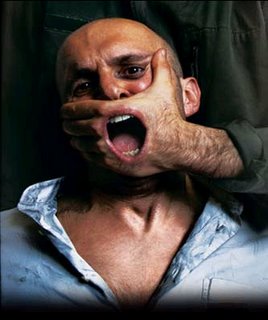
This will change when there are more bloggers at the places where news occurs. News will be something that is reported in real time, by the participants and direct observers. And the main media for this will be blogs, in real time. And with the use of aggregators and spiders, a second after someone posts something interesting, the world will have it.
Then the MSM will become republishers. And they will die.
posted by Brian Lemon at 4:36 PM
http://canadianbluelemons
****
This editorial is based on two pieces from the MSM. Both came from blogs. You, dear reader, are becoming the media. In time we won't require the MSM for our copy. We will be the ones trained and professional and on the spot who write and publish the news. The politicians will more and more come to us for our commands.
When we meet on Thursday evenings at the Vancouver Public Library from 7-9:00 pm each week we conduct democracy in action. We by-pass the politicians and the MSM in favor of private people conducting their own public affairs. When a Canadian terrorist supporter hires on with the Canadian government it is bloggers and readers who make their opinions known on the Internet. We don't write letters to the editor of the Toronto Star. We don't write letters to our m.p.s. We blog, and the whole world knows in a moment that the Canadian government has a terrorist agitator in it's public office. We have power and we can and do use it. It's democracy.
Please join us on Thursday at 7:00 pm to discuss your views. We'll be in Vancouver, Canada. You, being elsewhere, can do the same kind of democratic agitating we do. Democracy isn't limited to Vancouver. It's for everyone. It's for you. You are democracy yourself. Exercise it. Don't sit at home reading the local paper. Don't sit in watching the news on TV. Walk to the library and meet your fellows. You're free to do that. Vote with your feet.
Join us. Meet us. We want to know your opinions. Write a letter to your blogger. Let him or her know what you think about this!
What's on the menu?
Tuesday, April 18, 2006
Life grown young and sweet.

Acts of violence against property and persons is a bad thing, right? Destroying functional edifices and healthy bodies is a sign of rage and hatred in the perpetrator, no? Smashing, burning, killing, these are things decent people don't do in the world. And if by odd chance they do anyway, they don't like it. They don't do it with happy enthusiasm. Do they?
Oh, I say Yes! Smash things, kill people-- and like it. Yeah, even love it and laugh about it. Celebrate destruction and death. Look on this as a happy thing.
There will be some people who don't need any further discussion to find themselves in agreement with the above. They will be the ones we find on death row. The rest of us do need an explanation. Once we have it I think it'll be known and felt as reasonable and necessary and right that we wreck and kill. Crazy as it seems, Bakunin is right that destruction is creation in disguise. War is a right act. Maiming and killing individuals is a proper thing. We should do it and be glad of it. We should hate those who don't join us. Maybe we should even kill them on occasion. We should consider being Enthused! about killing people.
"In my village, all the lawyers are named Kalashnikov."
Humanity is bifurcating, splitting between those who remain primitive and pre-feudal and those who are and are becoming Modern. There are in the world cavemen and spacemen. We cannot continue to co-exist. This town ain't big enough for the two of us, this global village. Somebody's got till sun-up to get out of town. Come sun-up there's gonna be a shoot out on Main Street. First rule of a gun fight? Don't show up with a club. Bring a laser ray-gun.
There are two kinds of people in the world today who will define the future of Humanity for the coming millennium, and none of them are cavemen Muslims. They are the detritus of Humanity, even if their side should triumph in the bifurcation of Humanity. The two sides of the significant world's population are us. We are in the midst of a civil war, and who among us wins will decide the future. There's gonna be some killin' done. The Sheriff and and outlaws are facing off and the townsfolk are hiding behind their doors in the hope that when the dust settles the good guys win. The passivists are useless to us and to them. Forget 'em. This fight is between the raging, hate-filled scum pacifists and the likes of my kind, known here at The Fortress to our mentally retarded denizen Clarence as "war mongrels." Clare might be retarded but he's not stupid. Let slip the dogs of war.
There is a script in this Modern world we live in that most people have a good sense of, even knowing some of the phrases and lines by heart, having grown up with them and having heard them as the way things are. The script is anti-war. Most people recite from it without any real thought involved in who wrote it or what the lines mean. They're extras. The anti-war biggies, the stars of today's play, they are professional actors. The rest of us are a very irate audience. this play sucks. By God, we want a refund and a new show.
Let's sing another song, boys. This one has grown old and bitter.
The sheriff crouches in the corner with the Prozac dealer, the grief
 councillors fluttering around the wings, the social workers ready to take distraught women and children to foster homes and day care centres for trauma treatments. It's a sad, sad story. The sheriff in his space suit cringes, cries, and weeps in the arms of his male life-partner. He consults with his lawyer and assistants. He checks with his accountant. He gives a power point presentation to his fans and unionised staff.
Meanwhile, back at the ranch....
The anti-war fascists have prepared the cavemen, giving them money and filling them up with righteous indignation about the evils of the townsfolk, and especially about the evils of the sheriff. The cavemen pop off by mistake because they don't quite get the mechanics of their bomb-belts, but never mind, there are more where they came from, and besides, this isn't about the cavemen: this is about the anti-war fascists using the cavemen to beat the sheriff. The cavemen are pumped. They are ready to face the cowardly sheriff, and they don't quite get it but they know they must be right about whatever they're doing because all the anti-war fascists have been telling them for a century they should be fighting the sheriff. Oh, who knows why? It just feels right. So off they go.
The cavemen pile into the street, whooping and screaming and carrying on, and the sheriff blows away a few of them, and the cave men return to the anti-war pacifists to rage and beat their chests and to hear how heroic they were and that they should try again. The sheriff and the townspeople all seek counselling. It's the guilt, you know. It's so unbearably hard to live with. We all need Prozac. We send the cavemen a cheque to soothe their woes and to show we don't hold a grudge. Yup, and here they come again. Pass that Zoloft. It's all our fault. Where's my life-partner? I'm going to weep.
What are you going to do? It's right there in the script.
[Uh oh, our friend Dag is about to write something inappropriate. I just have this feeling he's going to do it again.]
Cavemen with bombs?! Good grief, kill them.
[There it is. He did it. Oh, Dag, you dawg.]
Townsfolk and spacepeople, what are we doing? Why are we wallowing in a puddle of sentimentality and stupid self-made guilt? These caveman ain't no friends of mine, and you don't like 'em. They torture people, cut off people's heads, beat and enslave their women, mutilate and rape their children. What's the story here? Name 219 things you like about these people. OK, name 31. Or even one. they're Human. They deserve to live. And so do others, those very people the cavemen will destroy and murder if we don't stop them from it. It's not like the cavemen are going away never to be seen again. We're stuck with them. And this global village town ain't big enough for the both of us. Nope, that ain't gonna happen.
Are we good people or are we evil like the pacifists and anti-war fascists say we are? Well, which? It's an either or question. Are we good and even getting better? Or are we (refer to script....)?
I find that I'm one of those unsophisticated stupid guys, a Rightwing religious bigot no different from bin Laden, which I'll have you know comes as a shocking surprise to me. I'm one of those who thinks there are rights and wrongs, good and evil. Worse than that, (and yes, it does get worse, dear reader,) I am enthused about doing good rather than evil. Oh no, I'm even a fanatic. I like the idea of killing the bad guys till they are so beaten there is no more strength left in them to continue. That's me being a war-mongrel. I'm insensitive.

I'm not the last guy in the West like myself, though it often seems that I'm the only guy who likes myself. In fact, I'm kind of enthused about myself. I even like being alive. I like other people being alive. I like those things so much that I'm happy to go out of my way to kill people who beat up women and who cut off men's heads for religious reasons or whatever. I'm so enthused about other people that I go out of my way to track down and do serious harm to those who explode bombs in public marketplaces to kill at random. I not only like it, I'm not only enthused about it, I go so far as to write that others should do the same until we either subdue for permanent the cavemen and the dhimmi fascists who incite them or till we lose the struggle altogether. I write that we should feel really good about smashing the caves and killing the bad guys. I write that we should as nations make war not consumer products.
We should make waging war on the primitives our reason for living. We should like it so much and feel so good about it that we develop a serious case of war fever. We should stop worrying and learn to love the bomb.
I like that guy, Winston Churchill, a fascist, I hear.
I think a curse should rest on me — because I love this war. I know it's smashing and shattering the lives of thousands every moment — and yet — I can't help it — I enjoy every second of it.
A letter to a friend (1916)
This, friend, is a letter to you. I don't see one hope in Hell of us liking a war waged for the sake of more multiculturalism. Maybe it's just me but I tend to think that waging a war for the sake of more Human Rights Commission hearings into Islamophobia and insults against Islam is going to do us more harm than good. I think we might find something better in life if we look to the positive and get enthused about it to the point we actually go out and make it happen even if we have to smash things and kill people to make it happen. I think that with some real enthusiasm for our mission we might hjust do some good. I know I enjoy it.
And those who don't? They're not nice people actually. They get people killed. They don't do the killing themselves. They set up others to do it for them. How do we defeat them? Look to the past a bit, to Churchill's time:
****
In August 1914, a few months after the start of the First World War, Admiral Charles Fitzgerald founded the Order of the White Feather with support from the prominent author Mary Ward. The organisation aimed to coerce men to enlist in the British Army by persuading women to present them with a white feather if they were not wearing a uniform.
The campaign was very effective, and spread throughout several other nations in the British Commonwealth. So much so that it started to cause problems for the government when public servants came under pressure to enlist. This prompted the Home Secretary, Reginald McKenna, to issue employees in state industries with lapel badges reading 'King and Country' to indicate that they too were serving the war effort.
[....]
Pacifism
In contrast, the white feather has been partially embraced by pacifist organisations as a sign of harmlessness. During the First World War the pacifist Fenner Brockway received so many white feathers he was known to comment that he now had enough feathers to make a fan.
http://en.wikipedia.org/wiki
****
(Let's sing another song, boys, this one has grown old and bitter.)
http://www.leonardcohenfiles.com/album3.html
****
Oh, I could make a fan!
Let's get a new social script and some new actors on the world stage. Let's wreck things and kill people. Let's kick some butt. And let's realise that what we do is the best thing anyone can do. Let's be enthused about it.
Monday, April 17, 2006
Red Lights, White Eggs, and Blue Scarves

An art instructor decided to test the basic observation skills of the new group of students for his Introduction to Painting class. For the initial lesson the teacher chose a still life composition, consisting primarily of white styrofoam cut-outs of various geometric shapes; placed in the center of the shapes, however, was an open carton of fresh white eggs.
The entire still life set-up was bathed in a soft red glow, courtesy of floodlights off to the side, giving white styrofoam and white eggs a temporary crimson hue.
The painting students were left to interpret the set-up unguided by their teacher for this early exercise, since the point was for the instructor to gage the starting skill level of his new painting class.
To his surprise, while each student had chosen to reproduce the styrofoam in the appropriate red, the eggs remained white! When the art teacher attempted to point out the seeming irony to his group, he was surprised yet again, this time by the strong protests of his students: “but these eggs are white!” “Eggs are white, not red”; their belief became their perception, unadaptable.
Despite what they were clearly looking at, the students chose to see something that wasn’t there, such was the unassailable strength of their pre-conceived notions.
Today, most of academia reverses the roles expressed in the previous scenario, as students who are just beginning to learn how to see, are confronted by sophists dogmatically asserting that eggs turned red are still white. The potential chasm of understanding between looking and seeing, is dismissed with a tyrant’s wave of the hand, forbidding scrupulous measurement, vigorous analysis and (horrors!) the admission of error.
The better teachers, announce "I need you" to their students, confessing the limits of their knowledge, and establishing a worthy goal for the students to rise to: teaching the teacher.
The worst teachers declare: "you need me!", blinding themselves to any change to their academic point of view. "You only look, it is I who sees; who are you to challenge me?"
The best teachers are themselves still students, energized by an eagerness to keep learning, humbled by regular testing of their accumulated knowledge, and re-invigorated by placing themselves in a public arena where they can find themselves facing others with the mutual goal of self-betterment.
Every week, in numerous encounters across Canada and the United States, such students gather publicly to learn. Online, we acknowledge each other through our blogs, in person we identify ourselves through the shared symbol of a blue scarf. Inspired by a new movement begun late last year in France, La Revolution Bleue, we meet publicly to discuss the topics we blog about, to learn, to compare, so that we may humbly yet assuredly verify that what we believe we look at, is in fact what others are seeing as well.
This Thursday, 7:00 pm to 9:00 pm, we will be meeting yet again, in the Atrium of the main branch of the Vancouver Public Library.
Where will you be?
Subscribe to:
Posts (Atom)