Thursday, July 06, 2006

Is this a case of women "married to the mob" ? Or is the mob married to a matriarchal jihad?

At Frontpage magazine Robert Spencer makes some useful comments on the recent Globe and Mail investigative reporting into the internet postings that the wives of some of the seventeen recently-arrested alleged terrorists in Toronto have made over the last few years:
But if they are not oppressed, what would possibly have inspired the hatred and contempt these women feel for their own country? When asked what she thought was unique about Canada, Nada Farooq replied, “Who cares? We hate Canada.”

Why would someone who lives in Canada and benefits from its freedom and prosperity hate Canada? Almost certainly because she has been taught to do so. Nada Farooq and the other women who wrote the comments above have no doubt been taught that all non-Muslim society and culture is jahiliyya – ignorance or barbarism, worthless and to be despised.

The Egyptian Qur’an commentator and Muslim Brotherhood theorist Sayyid Qutb (1906-1966), whose writings are popular today among Muslims in the West, emphasized this: “It is not the function of Islam to compromise with the concepts of Jahiliyya [the society of unbelievers] which are current in the world or to co-exist in the same land together with a jahili system….Islam cannot accept any mixing with Jahiliyyah. Either Islam will remain, or Jahiliyyah; no half-half situation is possible. Command belongs to Allah, or otherwise to Jahiliyyah; Allah’s Shari’ah [law] will prevail, or else people’s desires: “And if they do not respond to you, then know that they only follow their own lusts. And who is more astray than one who follows his own lusts, without guidance from Allah? Verily! Allah guides not the people who are disobedient.”[Qur’an 28:50]…The foremost duty of Islam is to depose Jahiliyyah from the leadership of man, with the intention of raising human beings to that high position which Allah has chosen for him.”
[...]
This is a matter of religious conviction. These ideas will not be dislodged by education about Western values, which are all part of the jahiliyya these women and their husbands despise, or by better access to jobs or housing. One primary lesson that authorities should draw from these Internet postings is that Islamic terror is not a problem that can be solved by social engineering. It cannot be assuaged by gestures of good will, negotiations or concessions. There is in Western countries today a large and growing population of Muslims, among whom are many who have no intention of assimilating or adopting Western values and perspectives, and who regard the West with as much or more disdain and contempt as these women show in their Internet postings. The jihad ideology as such must be confronted and combated, or it will continue to spread, and breed terrorists and subversives.
We might begin by noting Spencer's argument that "this is a matter of religious conviction. These ideas will not be dislodged by education about Western values, which are all part of the jahiliyya these women and their husbands despise..." Spencer implies that the western values these Muslims disdain are less those of a high culture, of which they are probably wholly ignorant, and rather more those associated with popular freedoms and the encouragement for everyone to follow her desires as part of the consumer culture. And similarly, the values western governments might wish taught to Muslim immigrants are less those of the philosopher or cleric as they are, say, a carefree tolerance for public displays of sexuality, as in the Dutch video that prospective citizens are forced to watch so as to learn that in Holland women are free to go topless at the beach while homosexuality is out in the open (like it or leave being the message). And this is indeed what we might guess the wives of the Toronto 17 hate most about us. As Qutb put it, "who is more astray than one who follows his own lusts, without guidance from Allah?"

This all adds up to something of a paradox: we have a picture, from the Globe and Mail reports, of a group of women who whip each other, along with their men, into states of hysteria because they feel the westerners among whom they live are themselves nothing but lustful and perhaps hysterical demons who refuse the basis of all reason and wisdom: submission to the will of Allah. And frankly, who could look at much of decadent western culture today with, for example, its deep immersion in pornography and other rough passions, its worship of a cult of victimhood and its attendant self-hatred, and say that the women of the Toronto Jihad are entirely wrong to condemn us?

These women's mixing of a hysterical Jihad with a committment to the restraint of lusts (a restraint, however, we know many Moslem men fail fully to engage), reminds me of an insightful comment made by Salman Rusdie last August:
The Koran was revealed at a time of great change in the Arab world, the seventh-century shift from a matriarchal nomadic culture to an urban patriarchal system. Muhammad, as an orphan, personally suffered the difficulties of this transformation, and it is possible to read the Koran as a plea for the old matriarchal values in the new patriarchal world, a conservative plea that became revolutionary because of its appeal to all those whom the new system disenfranchised, the poor, the powerless and, yes, the orphans.
Rushdie does not seem fully to know what to do with this insight, and little more do I. But let us take a moment to speculate on what we could gain from opening an inquiry that hypothesizes that Islamic Jihad is at root the product of a matriarchal worldview, one not yet fully in harmony with the nascent world of patriarchal law and religion.

Even as western feminists prefer to avoid criticism of Islam in deference to the cult of multiculturalism (since the honour of the victim group known as Muslims has greater authority than the individual rights of the millions of oppressed women in the Muslim world) we have nonetheless been trained by feminist assumptions to think of Islamic terrorists as tough angry "patriarchs", toxic men who keep their oppressed women under many wraps and insure that no Muslim man ever has to be dominated by a woman's opinion. And of course there is much truth in this assumption: all we need to do, for example, is look at how often women in the Islamic world are blamed for adultery and for being raped, and are consequently stoned or imprisoned.

So, given my assumptions about the subservience of Muslim women, it was with a bit of surprise and a laugh that I read in the Globe about the wife of one of the Toronto 17 who declared in one web posting “ if [my husband] ever refuses a clear opportunity to leave for jihad, then i want the choice of divorce.” Just who is boss in these families anyway?

Well I think the men mostly are, but part of the answer to what is going on in these bumptious ladies' web postings may be that we need to stop thinking of the oppression of women as being caused by "patriarchy". It may be just as much a function, if not more, of a matriarchal culture whose boundaries are violently enforced both by men and women; and it may be, as Rushdie suggests, that the problem with Islam is that it does not have enough of patriarchal culture, not that it has too much. It may well be that patriarchal values help liberate both men and women whatever our feminists, who don't seem to be too active in demanding liberation for Muslim women, may think.

But what would the boundaries or shape of a matriarchal culture actually be? This is not the time or place for a serious essaying of this much under-theorized question. But let me make a few preliminary suggestsions based on a Thomas Bertonneau essay I have found most helpful. We might start, for example, with the notion that a matriarchal god or cult is that of a people deferring to a primal group identity; in contrast the patriarchal encourages highly individuated identities such as are constructed in the course of learning the demanding worldly tasks imposed by the needs of human freedom whose expansion, in recent centuries, has required people with many kinds of specialized knowledge engaged in honest and cooly rational essayings of cultural and natural realities and necessities. The matiarchal culture generally turns attentions towards a demanding but all-protecting mother figure (or perhaps a totemic animal symbolizing nature's powers or fertility), a jealous guardian of all her children, of the clan who are to be equally rewarded for their collective submission to her cult. In contrast, the patriarchal God seems to be a rather personal God who demands each of us engage Him in an individuating moral conversation that is separated from the worldly ethical conversation of the human community. Instead of allowing our resentments of the limits to equality or freedom that the pragmatic needs of worldly ethics dictate, to grow into some irrational act of violence, the patriarchal God demands of us a personal discipline and integrity to be maintained whatever our success or failures in this world.

This is to suggest that a key difference between matriarchy and patriarchy has to do with their respective indulgence in, or restraint of, our violent, often irrational, sacrificial or ritual practices, and with the means by which our sacrificial forms perform the essential task of all religion, which is to mediate our resentments and save the community from itself, from the resentments which all human society inevitably engenders. In other words, the test of any religion is its capacity to turn our resentments to productive ends. While the strategy of the matriarchal may be to turn resentment towards a cult of an alternately offended and mollified (by violent sacrifices) group identity, the patriarchal may demand much more of individual responsibility. On the matriarchal, Tom Bertonneau argues that :
Anyone who knows the mythic material... also knows what the reign of the Magna Mater [Great Mother] required. The Chaldean shepherd Dumuzi, like his Syrian counterpart Adonis and his Egyptian counterpart Osiris, suffered being ripped apart by demons to appease her wrath and, as the story tells, to fecundate the fields as an offering to her vegetation cult. The same story appears all over the archaic world, as James G. Fraser showed in the multiple volumes of his Golden Bough. Nor is it mere myth. Gimbutas extols the Minoan civilization of Crete, as one of the final holdouts of the realm of the Earth Mother in her many guises, before the Indo-European onset. In Aegean Civilizations, Peter Warren cites an archeological find at Anemospelia, on the slope of Mount Jukta, near Knossos. In "a remarkable three-roomed shrine… there were four human skeletons, one of which, on a low table, appeared to be a human sacrifice being enacted when destruction [of the site] came, perhaps about 1600 B.C." (6). At Knossos itself, "remains of several children in the basement of the building also appear to be from sacrifices, made at the time of the great Minoan destruction about 1450 B.C." (6). These phenomena date from before the massive Greek (hence Indo-European) presence on the island. In the Near East as well as in Crete, images of the Great Mother in all her varieties are associated, in the iconography, with images of demons. She is either the obese, globular divinity from whom all things are born or the ecstatic virgin celebrating the Matriarchy; and they are the toothy, frightening Nachtpolizei of the realm. In the Greek world especially, a revulsion against human sacrifice appears only with the ascendancy of the upstart Olympian cult of Hesiod and his fellow religious reformers. Robert Graves gives a sense of what the return of the Magna Mater would entail in his amusing but frightening Let the North Wind Rise: the reduction of adulthood to perpetual adolescence; the abandonment of the technical infrastructure; the reintroduction of archaic religious forms. Far from being exclusively nurturing and protecting, then, the Goddess is also savage and voracious. She devours the blood of children.
And then, making a comparison to the west's decadent victimary culture today, Bertonneau draws on the work of psychologist Howard Schwartz in The Revolt of the Primitive to note that:
the roots of political correctness run deep psychically, anthropologically, and historically. The parallelism of the primitive, matriarchal societies with modern intolerance and contemporary hysteria, remains [clear].
While the target of Bertonneau and Schwartz is primarily today's academic culture with its countless rituals in support of the many supposed victims of the supposedly victimizing reason and knowledge of the "phallogocentric" white male patriarchy, they also make a connection to the popular culture with its worship of sexuality and its resentful mass cults, e.g. rock concerts.

And we might see just this decadent pop culture as being what is most hated about Canada and the west by the wives of the Islamic terrorists with whom we began. They may see in today's westerners a conformity, for example, to the lusts of the woman-dominated porn industry or to more "mainstream" fare like the wildly-popular television programme Sex in the City.

But if Rushdie is correct that Islam is as much a matriarchal as patriarchal religion, why should Muslim fundamentalists resent the western return to a primitive matriarchal ethos? Well, it may have much to do with their sense of competition between the two cults for the protection and advancement of one clan over another. Or it may be that Moslems are just patriarchal enough to see the west's return to irrationalism as a distracting threat to their own independent manhood. After all, if Moslem men are seriously to aspire to rule the world, perhaps they too need to improve their personal discipline in order to face up to the harsh and unbending demands that a cold, uncaring, unmotherly reality will impose. On the one hand, the lustful violence of the Jihad may be an essential part of defending the boundaries of a matriarchal group identity, since Jihad is primarily a matter of defeating the other as infidel; on the other hand, the values of Jihad may be of much less use when the other one must deal with is a member of one's own group, or when it is nature that must be turned to productive ends if mother and her children are all to be fed, especially if the Muslims are to compete in a global economy.

It may well be in denial of patriarchal imperatives that we witness the perennial declaration of internecine Muslim wars, as one or another disaffected group seeks to quash what it sees as Muslim decadence, and thus to reimpose the essential faith. Could the seemingly patriarchal critique of urban decadence actually be more a sign of a refusal to take up the patriarchal law and its demands for individual differentiation and pragmatic worldly goals, in favour of a quest to return to the primal equality and belonging of the maternal, as symbolized by the faithful in their daily massed prostrations to Allah?

Wednesday, July 05, 2006

Blue Revolution meeting at the Library

Week after week, we meet.
If you're in the Vancouver area this Thursday evening, please join us at the Vancouver Public Library from 7:00 to 9:00 pm, for our weekly meeting.
Every week we gather together to scan the horizon for answers to the ongoing questions we discuss here at our blog, about what it means to be Canadian.
And, what we'd like it to mean.

With Canada Day's fading light fresh in our minds, it promises to be an even more significant meeting than usual.

You can recognize us by our blue scarves/ bandannas, worn in kinship with like-minded patriots in France.

They meet in France, to save their nation. We sit by the Blentz coffee house, in the Atrium.
To save ours.

Saturday, July 01, 2006

The Right Way to Celebrate Canada Day

July 1st in Canada means Canada Day, Canada’s birthday as a confederation of North American Provinces.

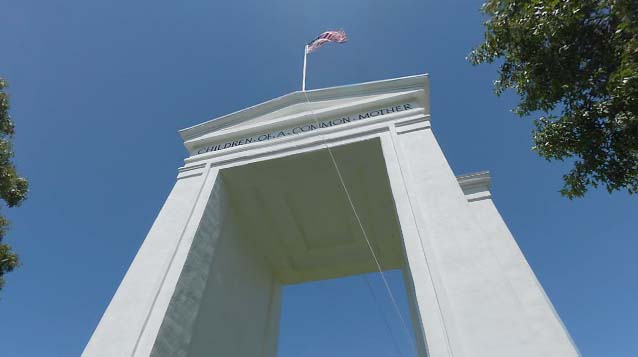
On a recent visit to the border crossing leading to Blaine, Washington, my wife and I took some time to visit the beautiful Peace Arch monument, the centerpiece of Peace Arch Park. I was caught off-guard by how moving an experience I found it to be, and frequently had to choke back a few tears. Canadians are so blessed to be neighbors of the United States of America.

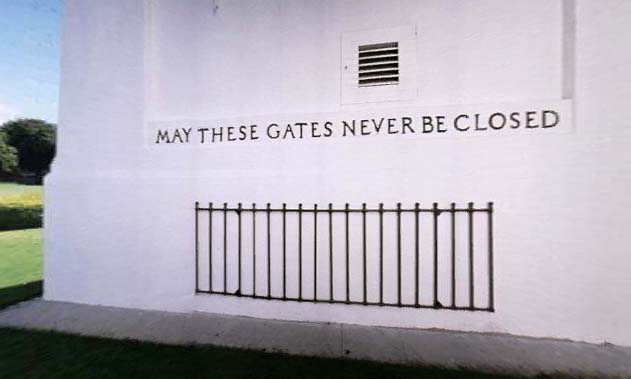
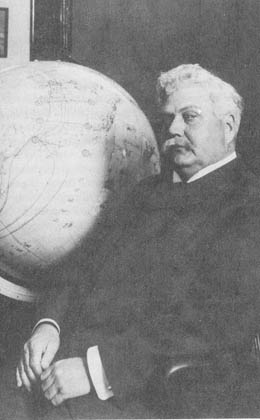
The Peace Arch is the world's first monument to peace. Sam Hill, a prominent American businessman, conceived the idea of the Arch. Mr. Hill laid a hollow cornerstone within which he placed a hammered steel box made from the steel of a captured slave ship. Inside the box, he placed a piece of the Beaver and the Mayflower. The Arch was fitted with two iron gates, leaving them open to symbolize peace between the two great nations.
It’s no secret that many of my fellow Canadians hate the United States of America, and no, hate is not too strong a word. Theirs is not a gentlemanly disagreement, but deep-rooted hate. Nor a sibling rivalry, but outright hatred. It has not always been so; standing in the shadow of the Peace Arch monument, we could see proof that once upon a time, Canada was a good neighbor, and that many Canadians sincerely appreciated the greatness of the neighbor we have on our southern borders.

Two beliefs decorate the top of the monument: on the Canadian side, we can read "BRETHREN DWELLING TOGETHER IN UNITY." On the side facing the United States are the words, "CHILDREN OF A COMMON MOTHER."

These beliefs are currently under attack in Canada, and have been for as long as I've been alive. Living in Canada, it is an ongoing challenge to retain a favorable view of the United States of America. Every day we are bombarded by attempts to convince Canadians that our US neighbor is actually some kind of greedy adversary, populated by unsophisticated war-mongers, plotting to alternatively enslave or destroy the world. The message never lets up; whether you’re a child in school, or an adult at work, every day requires a considerable act of will to resist the siren song that lures us to believe in a monstrous lie.

Dispelling the lie is made much easier by a simple trip to the Peace Arch.

The very existence of the Peace Arch disproves much of the lies that Canadians delude themselves with about the US. America does yearn to live in peace with others, as established by the obvious fact that there are no yank tank divisions camped along our borders. They could grind us into dust, such is their nation's power; yet they do not, and it’s obvious that deep down we know they won’t, because we have no armies on our side to keep them at bay should they try it. For all the braying that Canadians make about US “war-mongering invasions", what nation in the world would be easier for them to invade than our own?

Researching the Peace Arch reminded me yet again of what makes America so great, and why Canada is so blessed to live in its shadow. The monument was only one of a series of accomplishments achieved by Sam Hill, one of those average Americans that no one ever hears about, only because the number of even greater names runs so long:

Samuel Hill [1857-1931] made the Northwest his home for a little more than 30 years, leaving a legacy of philanthropy, monuments, and highways still visible in the twenty-first century. He made a small fortune in utilities and investments and spent most of it on other people, on causes and programs he believed in, and in traveling the world to promote peaceful trade and prosperity.

Like most Americans, he believed in the value of interaction and trade, treating wealth as something that can be infinitely re-created, rather than something finite to be divided. From Wikipedia:

....Much of Hill's attention was devoted to advocating good roads in Washington, a task for which he created the Washington State Good Roads Association. He persuaded the state legislature to create a state highway department, and the University of Washington to establish the United States' first chair in highway engineering.

In order to fulfill his dream to build the Peace Arch monument, Hill didn’t siphon the necessary money through the self-righteous theft of NEA or Canada Council tax money; he earned it the hard way, through personal initiative, making personal appeals to fellow average citizens to band together and participate in meeting shared objectives:

The park surrounding the Arch on either side was supported by donations of schoolchildren from the Province of British Columbia and the State of Washington. Contributions were limited to "a silver dime" during that Great Depression era. Many children could donate but a penny. …

Especially moving are the symbols of the open gates within the arch itself. Part of the exceptionalism of America is its treatment of its northern neighbor. How many nations share even a fraction of the trust that animates US-Canadian relations? We do not scheme of looting each other's wealth, we dream of ways to increase each other's wealth, through mutual advantage:

The Peace Arch commemorates international concord established by the Treaty of Ghent signed Christmas Eve, 1814, in which the desire of the signatories is expressed for a "firm and lasting peace." The portal proclaims the established peace has never been broken.

The Peace Arch also commemorates the Rush-Bagot Agreement e
ntered into by his Majesty King George III and President James Monroe by virtue of the provisions and spirit whereby the line from the Bay of Fundy to the Straits of Juan de Fuca has been neither garrisoned nor fortified since 1817.

What makes a visit to the Peace Arch a bittersweet experience is the realization that the past is not automatically the future. The mutual peace that ennobles both Canada and the United States of America, and has symbolized what makes us so much better than any other neighboring pair of nations, requires an act of will to maintain. This greatness rests upon an act of faith, faith in common goals, derived from a recognition of our common traditions. By "faith" I mean, the act of seeing the unseen, the act of imagining something that does not exist, yet, but could, and working towards its arrival. In the case of our shared border, and shared experiences, Canadians must resist the pressures of the socialist left, who would have us believe that both we and our neighbors are incapable of trade for mutual advantage, partnership built on mutual trust, and accomplishments for mutual good. They project their own lack of faith and lack of ability to trust, onto the US; we must resist their false vision of our partnership with the US, and keep our time-honored bond of national friendship.

It is not a one-time act, having been accomplished in the distant past, now to be forgotten. This common bond must be continually re-created and re-affirmed, so that the increasing cries of the unfaithful left, can be drowned out for the admissions of envy, selfishness and sloth that they truly are.

On Canada Day, the anti-american propaganda tends to be at its highest pitch; therefore I felt it necessary to match it with a song of my own, to defend the greatness of our neighbor, the USA. True to form, the leftists even try to divide greatness, as they do our wealth; for Canada to be great, they believe, America must be made that much less great, in order for one side to be elevated the other must be lessened.

This is one Canadian who resists this temptation, and has the humility to believe in an expanding greatness of unlimited opportunity.

On this day, Canada Day, more than other day, we Canadians can show our greatness by demonstrating our gratitude to our neighbors to the south, for the mutual peace we have agreed to recognize, and the opportunity for independant greatness that America has granted us.

God Keep Our Land Glorious And Free.
God Bless America.

Happy Canada Day

Today is Canada Day, thanks to the ministrations of Pierre Trudeau's Liberal government, which saw fit to change the name of the holiday formerly known as Dominion Day. Did the Liberals think "Dominion of Canada" was too old-fashioned a name for a modern country? perhaps too religious, too monarchical, or just altogether too illiberal? I don’t know; but I’d like to suggest that we can learn something from the original source for our name, and that we might think of our Dominion as entailing a leap of faith into the future. “Dominion” can be read as a sign of a people and their representation simultaneously coming into existence, along with the power and the freedom this requires.

Both the name, Dominion (adopted in 1867) and Canada's motto, A Mari usque ad Mare (From Sea to Sea – chosen in 1921) are taken from the Bible's Psalm 72:8. May I suggest we have a look at this Psalm? for I think it says something important about nationhood.
Psalm 72 KJV (King David prays for his successor, Solomon)

1 Give the king thy judgments, O God, and thy righteousness unto the king's son.

2 He shall judge thy people with righteousness, and thy poor with judgment.

3 The mountains shall bring peace to the people, and the little hills, by righteousness.

4 He shall judge the poor of the people, he shall save the children of the needy, and shall break in pieces the oppressor.

5 They shall fear thee as long as the sun and moon endure, throughout all generations.

6 He shall come down like rain upon the mown grass: as showers that water the earth.

7 In his days shall the righteous flourish; and abundance of peace so long as the moon endureth.

8 He shall have dominion also from sea to sea, and from the river unto the ends of the earth.

9 They that dwell in the wilderness shall bow before him; and his enemies shall lick the dust.

10 The kings of Tarshish and of the isles shall bring presents: the kings of Sheba and Seba shall offer gifts.

11 Yea, all kings shall fall down before him: all nations shall serve him.

12 For he shall deliver the needy when he crieth; the poor also, and him that hath no helper.

13 He shall spare the poor and needy, and shall save the souls of the needy.

14 He shall redeem their soul from deceit and violence: and precious shall their blood be in his sight.

15 And he shall live, and to him shall be given of the gold of Sheba: prayer also shall be made for him continually; and daily shall he be praised.

16 There shall be an handful of corn in the earth upon the top of the mountains; the fruit thereof shall shake like Lebanon: and they of the city shall flourish like grass of the earth.

17 His name shall endure for ever: his name shall be continued as long as the sun: and men shall be blessed in him: all nations shall call him blessed.

18 Blessed be the LORD God, the God of Israel, who only doeth wondrous things.

19 And blessed be his glorious name for ever: and let the whole earth be filled with his glory; Amen, and Amen.

20 The prayers of David the son of Jesse are ended.
This prayer by King David for his son, Solomon, could no doubt be read in a number of ways. Christians, for example, might see in it a prophecy of the coming kingdom of Christ. Freeemasons, who included among their number Canada's first Prime Minister, Sir John A. Macdonald, might see in this some sign of import to their mystic faith, since Solomon and his temple are central to Masonic myth and ritual. For my purposes, it will suffice to adopt the perspective of a Jewish nation that has not always been a politically successful nation, not always united under a king, and that desires a political centre around which a new power and freedom can be organized, with a king who can compare most well in power – but also in wisdom and love for his people - with other rulers. Yet more to the point, what David is praying for is not that Solomon be simply all powerful and able to indulge his every desire; rather, David wants Solomon to become a worthy servant of his people, a gift of God to them, that Solomon may represent Israel in such a way as to bring its people justice, redemption, and tribute from other nations.

In other words, Solomon will belong to Israel, even as Israel will be Solomon’s dominion. Thus, we might ask, when Canada's Fathers of Confederation considered this psalm in the 1860s, and read the words "dominion also from sea to sea..." whose Dominion did they think the Dominion of Canada would be? Were they simply imagining that Canada belonged to a monarch and would be ruled by Queen Victoria in a manner comparable to King Solomon and Israel? Surely not, for while Solomon’s Israel may have been, in its time, on the cutting edge of human freedom and power, times had moved on and the Queen (or her Canadian representatives) as head of state and society, would have relatively little direct political power in the constitution the Fathers were writing. If the Fathers gave the problem much thought, they might have got stuck on the problem of how to conceive the relationship between a nation's representatives - those holding governmental power - and the political, ethical or esthetic representations that are appropriate to the nation, the representations that express what the nation is about and what belonging to it means.

They might have asked, given their status as would-be fathers of a new nation, does the nation come first and then, from out of the body politic, somehow emerge its representatives? Or, must "representatives" first come on scene in order to represent the nation that will then come into being? While the Fathers of Confederation were the duly elected representatives of their respective crown colonies, the Canadian Confederation of the (former) colonies was not yet in existence, the writers and artists who would imagine the new nation had yet to go to work. So clearly, in some sense a new nation needed fathers – it needed Davids - to anticipate what the Solomons might yet achieve. It needed fathers to offer up some signs of the people that the people would later form around.

While the boy may be father of the man, a new nation cannot give birth to its own fathers. But on the other hand, fathers cannot work their magic alone. If would-be fathers are not somehow in conversation with the people they propose to bring into being, the people will hardly be in a position to follow them into being. The fathers may give us the word, but if we are not ready and willing to pick it up and to do something with it their word will not go anywhere. Both fathers and sons must desire to build a new scene. Even in the most totalitarian contexts, power cannot be simply imposed; it is always negotiated with those who will share in it. Yet someone has to go first, out of a faith that the people are ready for, and in need of, a change.

If the politicians of the British North American colonies of the 1860s hadn't had the motivation and imagination to get together and bring a new nation into being, it may never have happened. Now you can find many historical interpretations of what happened: historians will tell you that the Fathers got together to serve the commercial interests (the Fathers’ own interests) of the white male bourgeoisie, or to better fend off American imperialists with eyes on the northlands, or to break the political impasse between English and French in the then united colonies of the Canadas West and East (what became Ontario and Quebec). No doubt there is something to these explanations that is necessary to understanding the scenes of British North America in the 1860s.

Still, we need to be wary of reducing history to questions of self-interested people seeking out power. There were no guarantees that Confederation would work out (after all, two colonies - Prince Edward Island and Newfoundland – at first refused Confederation, seeing nothing in it for them). If successful, a new way of organizing power must entail a leap of faith, faith that present problems can be transcended and a new system can emerge with greater degrees of freedom so that there will be greater freedom, wealth, and power to be shared by all - faith that the whole can be greater than the sum of its parts. And it takes political entrepreneurs to imagine and lead the change, with no guarantee that they, personally, will be one of the beneficiaries.

While it may sound a little silly, what must be considered in an explanation of Confederation is that the Fathers of Confederation were motivated in good part by a desire to be fathers (and not just to remain sons of Great Britain, each to his own colonial domain). The lesson here is that we too must expect of ourselves and our fellow citizens that we go, from time to time, into the Covenant Zone, and there share in representing a leap of faith into a new form of political communion.

Recently, an NDP politician has been campaigning to change Canada’s motto “from sea to sea” to “from sea to sea to sea”. Perhaps he feels he is re-imagining the Canadian covenant as a good citizen should. I imagine he thinks the 1921 motto excludes the people of Canada’s north, the people around the Arctic sea. I imagine he appeals to a victimary politics whose motivation is to seek out and include those who, supposedly, have been so far excluded - symbolically or materially - from the fold. Yet the problem I see in this is that rarely does such a politics have much to say about what we (as fathers, mothers, daughters and sons, and with the national spirit that links the generations) might represent. To the victimary religion that rules our age, it is always a question of who is not represented, and not what is to be represented. The nation is nothing but the sum of its parts. In fact, any active form of representation is deemed problematic because to represent is to imply boundaries, limits; and this is feared even when our representations promise greater degrees of freedom than those made possible by earlier forms of representation.

It is not so important to the victimary politician to remember the source of Canada's motto (where, in the Bible, it is simply sea to sea, like it or not) and the implied idea of the Fathers of Confederation that they were building a new Canadian covenant on the Biblical model of the nation of Israel. No, what is important is that Canada not be imagined in such a way as to exclude anyone, and this entails eroding the old signs of the coventantal purpose we, as political beings, serve; and it means avoiding the task of representing new covenants to suplement the old. But can we last long with a politics that refuses to represent its purpose, at least in some minimal terms? Can our world be mediated solely by a marketplace where everyone is free to pursue her own purposes and where everything desired may be bought or sold as long as everyone is equally empowered in trade? Or is the bottom line of human society always going to be political, about defending boundaries and the shifting differences and asymmetries on which exchange depends?

I think the latter. If some choices will necessarily preclude others, then we have to make political choices and cannot just have a freedom to choose. We must fight over the signs of a common political purpose, e.g. to build greater freedom by excluding ideas and people that are not conducive to what we believe human freedom is all about (both the external freedoms to follow our desires, and the internal, spiritual freedom that requires one remember and connect with the traditions of which he is now a part).

So it is not enough that we have laws to make sure everyone is represented according to rules of political correctness. No, we must also all engage in exchange over what it is we wish in common to represent; for we must each become a centre of representation seeking to model for others the kind of representation we wish to have and exchange. In other words, we need not just the Canadian constitution that the Fathers of Confederation began to write; we need also a nation, without which the constitution has no purpose. If we forget the latter, and rely on liberal rules alone as the basis for our political life, our law will eventually crumble with no purpose beyond its own vain liberality; and then we may see the resurgent claims of an angry nationhood that will have less respect for the rule of law. Our Dominion is not just a land to be liberally ruled and divided up, but a vision of what we hold sacred to re-present and renew.

Have a Happy Canada Day and Don’t Forget to Represent the Dominion!

Friday, June 30, 2006

Another blue revolution meeting in Vancouver

Inspired by the growing Blue Revolution movement in France to stand up for all that is good in our own Canadian nation, we met this night yet again in the Atrium of the Vancouver Public Library (the belly of the beast, sad to say) to talk present Canadian politics, ideas for the future, the crazy things Dag has eaten in his past travels throughout the world... and much more.
(thumbs up for the camel burger, thumbs down for… well I’m having a late supper so I’ll skip the other side of the scale for now)

Truepeers had much to say about yet another sad chapter of the seemingly endless World Peace Forum exercises in western humiliation and self-criticism. The various pamphlets distributed at the event spoke of the left’s ongoing thirst to derive morality from law, and not law from morality.
Leafing through the flyers, seeing testament after testament lamenting “illegal wars of occupation” makes one wonder what the left's thirst to legitimatize its victimary culture might think of the Righteous during the Second World War, breavely defying the Nazis "legal" determination to annihilate the Jews of Europe for the "crime" of being jewish. There was a case of simple citizens, farmers, shopkeepers, doctors, and others, defying the “law”, risking their personal lives as well as the lives of their own families, for the sake of friends, or often as not, total strangers. Law is not above morality, law springs from morality... unless you're set for a cruise aboard the Peace Boat.

Again we discussed the Canadian reluctance to make value judgments, to measure all ideas against each other in order to confirm which merit closer attention and which much be discarded as not fulfilling their stated objectives. (several passersby, mind you, did not seem reluctant to pass value judgments upon the uncommon honesty being exhibited at our little gathering, if their facial expressions are any indication of their inner thoughts)

As ever it is exhilirating and emboldening to meet in public and engage in sincere talk, in public. No sympathetic smiles or encouraging words from passersby this night, but we take it as an act of faith that our continuing presence, whether it is in person at the Library, or virtually in the blogosphere, will lead us closer to the answers we seek.
Success is not what will lead us to act, it is our acts which will lead us to success.
For that is the gift of faith.

Thursday, June 29, 2006

Covenant Zone/Blue Scarf Meeting

Today, and every Thursday, 7-9pm in the Atrium of the main branch of the Vancouver Public Library (in front of Blenz coffee). Everyone interested in our work is welcome to attend and to discuss with us pretty much anything, including how to make this site even better!

Grieving for Victims at World Peace Forum - evidence for the claim of a "hate festival" made by Harvey Enchin in the Vancouver Sun?

Monday night, I attended a session of Vancouver's World Peace Forum, with the vaguely threatening title "No Justice! No Peace!" While the incessant use of the imperative (!!) among the "peace!"-loving left deserves a post in its own right, I will turn my anthropological attention here to the speakers on the evening, in order of their appearance: 1) Miryam Rahid, Interim Director of the Middle East Program of the American Friends Service Committee - Chicago, a middle-class Palestinian-American woman who lived for five years on the West Bank, some of it during the first Intifada and who served the Palestinian side during their peace negotiations with the Israelis in 1998-2000. I assume that Rahid was invited as a replacement for the earlier-announced Mustafa Barghouti, a Fatah or PLO politician and doctor whose more famous brother, Marwan, is currently facing terrorism charges in Israel. 2) Nurit Peled-Elhanan, an education professor at Hebrew University whose daughter was killed by a Palestinian suicide bomber in 1997; according to the official program, she "has turned her grief into a tireless quest for justice: the end of the Israeli occupation which she considers the root cause of her daughter's death". 3) Cindy Corrie, mother of the infamous Rachel who in the words of the program for the evening "was killed by an Israeli soldier driving a bulldozer as she non-violently protested the demolition of a Palestinian home." According to the Israeli government, Rachel was accidentally killed by a bulldozer demolishing homes that were linked to a network of tunnels smuggling arms between Egypth and Gaza.

This event, held at the large downtown Vancouver St-Andrew's-Wesley Churh (the WPF's report claims a crowd of 500; I would say 250) was sponsored by a number of groups: Canada Palestine Association, Canpalnet, the Vancouver chapter of the International Solidarity Movement, Jews for a Just Peace, Stopwar.ca, Palestine Community Centre, Palestine Solidarity Group, Trade Union Committee for Justice in the Middle East, and the Wall Must Fall Campaign. I will leave it to readers to Google these organizations to discover which ones support Palestinian violence against Israel in the name of "peace" (leave a note in comments if you do!). I will only note that Rachel Corrie's ISM is indeed reported as actively supporting Palestinian terrorist violence.

The Chair for the evening was Sid Shniad, a Jewish trade union breaucrat and leftist anti-war activist, who began by denouncing what he called Israel's unilateral redefining of its borders with Palestine - i.e. building a fence or wall to protect itself from Palestinian attacks - in supposed violation of international law, a point to which our anthropological analysis will return later as the frequent appeals to "international law" clearly invoke a sacrality for people involved with this "peace" forum, a sacredness that we need explore if we are to understand where they are coming from. Shniad said many "social justice" groups such as churches and unions were addressing these issues and his naming CUPE (Ontario) for its resolution to support a boycott and divestment of/from Israel received a modest round of applause from perhaps half the audience.

(I might note at this point that on entering the church, I recognized in attendance my Member of Parliament from Burnaby-Douglas, Mr. Bill Siksay of the New Democratic Party; not being a supporter of the NDP, I sat close to Bill so I could report if he revealed sympathies by excessive anti-Zionist applause; however, his applause remained moderate throughout, though there are no doubt many friends of Israel who would consider any applause for these speakers objectionable, as I will explain below. In any case, Burnaby voters should know that Mr. Siksay wore a WPF delegate badge and they might want to consult the WPF website to get an idea of the kind of event that interests their federal representative and others in his party - Bill is a protege of former MP Svend Robinson whom Cindy Corrie thanked last night for his support in writing the US government to pressure Israel over Rachel Corrie's death.)

Sid Shneid closed his opening remarks by denouncing the "highly inflammatory" words of Vancouver Sun columnist Harvey Enchin whose June 21 article, "Let the hatefest begin", anticipated the WPF conference thus:
Vancouver is hosting a major anti-American, anti-Israel, anti-globalization, anti-capitalist conference starting Friday that will draw apologists for terrorism and champions of failed states [e.g. Cuba, Iran, Syria] from all over the world... There is noting peaceful about the message these deluded propagandists are preaching.
Then, giving specific attention to the panel under discussion here, Enchin wrote:
Israel's enemies, those who deny its right to exist, who seek to de-legitimize it at every opportunity, who infuse their hatred of Israel with antisemitism, are given an open platform at the peace forum.

Israel and Jews will be under attack at the peace forum just as they were at its precursor, the [Durban, South Africa]UN World Conference against Racism, Racial Discrimination, Xenophobia and Related Intolerance in 2001, which devolved into a hatefest unlike anything seen since the Nazi rallies of the 1930s.

A session called What is the Relationship between Peace and Justice in Israel [aka, No Justice! No Peace!] presents two anti-Israel panelists. There is no responder from the other side; in fact, there are no supporters of Israel involved in the peace forum at all.

The first speaker is Nurit Peled, Israel's most reviled, self-loathing, anti-Israel activist. After a Palestinian suicide bomber murdered her daughter in 1997, Peled blamed her own government and has been a popular attraction on the Israel-bashing speakers' circuit worldwide ever since.

"We are all in the grip of the same unscrupulous criminals who call themselves leaders of the free enlightened world," she told the European Parliament, "and in the name of this freedom and enlightenment rob us of our children.

Clearly suffering from a perverse version of the Stockholm Syndrome, Peled conveniently omits mention of the culture of death that celebrates martyrdom, a glorious fate many Palestinian mothers not only wish for their children but for which they are financially rewarded.
While Enchin is certainly correct that this was a totally unbalanced panel, with no supporter of Israel and no one giving the audience the slightest idea of how one might respond to the anti-Israel resentments well aired Monday night, I do not think - judging from what i've read - that this panel reached the levels of Jew hatred witnessed at Durban. Monday's was altogether a subtle performance of a deep resentment whose object remained somewhat veiled, the source of the implied evil under discussion remaining somewhat mysterious, underdefined. I will interpret this mystery as being, in fact, all about or around the sign of the Jew, and/or the model of nationhood the Jews first brought into this world; but still, the paradoxical fact that love and hate are usually combined in some degree in our attitude to any object or entity that holds the centre of attention must be taken into account.

Was Enchin thus being "highly inflammatory"? (Sneid's accusation, like Enchin's, and those of many angry letter writers to the Vancouver Sun, were all made prior to anyone actually hearing the WPF events under dispute.) Well, quite aside from the likelihood that Enchin's intent was just that - to combust the WPF's credibility - I think he is correct to suggest that this evening was indeed something of a hate fest. But while Israel, in whole or (perhaps more often) in part, was undoubtedly an object of hate, this is not to say that it was an event filled with obvious antisemitism, or a general Judeophobia (though if the critique of Israel entails a portrayal, whether knowingly or naively, of bad Israelis in terms that remind us of what traditional antisemites consider dirty Jews to be - e.g. evil and selfish conspirators whose actions are a threat to some utopian vision of world peace - then perhaps antisemitism it is, even if the critics are wise to the charge and anticipate it by themselves criticizing, on behalf of some good Jews, the putative evil conspirators as antisemitic; this is just what I think happened last night).

Indeed what is so notable is how often the speakers and audience members felt compelled to reject the accusation of antisemitism or self-hating Jew, and to note Jewish friends, as if the accusation of antisemitism has itself become another unfair tool in the hands of that party of Jews who are indeed oppressors (according to the would-be non-antisemites). For example, this bluffing/double bluffing/triple bluffing .... fetishization of the sign of antisemitism led the most curious, unbalanced, speaker, Nurit Peled, to say that Israel was in fact the only truly antisemitic state left in existence today. So, again, when we turn to our anthropological analysis of this event we will need consider the peculiar form of sacrality constituted around this much disputed sign. The simultaneous fetishization of "world peace", "international law" and "antisemitism" is no accident.

Miryam Rashid

Rashid introduced herself as the middle-class American daughter of Palestinian parents who took her to live in the West Bank during the first Intifada so that she could know better her people and their plight. (One wonders if that is all the parents wanted.) She had in many ways the manner of a middle-class American, a university-educated woman, a competent practitioner of the academy's victimary religion; she spoke in a somewhat breathless, rapid, staccato, swinging back and forth between, on the one hand, bold authoritative statments on the nature of life in the West Bank, and on the other, setting up scenes of the horrible and brutal conflict in such a way that passionately asked for and generally received the nodding concurrence and sympathy of the predominantly female audience. "Military Occupation" she said was for her just another intellectual abstraction that people bandy about, when she lived in comfort in America; once settled on the West Bank, its horrible reality was revealed in a life-transforming manner.

We were told of how the Jewish settlers steal the Palestinians' agricultural land, leaving the younger men without work, thus encouraging them to leave and/or to suffer great humiliation at their impotence. While the Jewish settlement of Shiloh on the hill above her new home had all the water and electricity it desired, the Palestinians below received intermittent and limited supplies. Checkpoints and roadblocks throughout the West Bank were a "huge source of humiliation" and a theft of that which is most precious: time. She told of her own guns-aimed-at-her humiliation at a check point which ended with Israeli soldiers laughing at her, and decried the new Israeli wall/fence which she said does more to separate Palestinian from Palestinian than Israelis and Palestinians. Again, the claim is that Israel wants to get a proud people to leave their homes by destroying their economy and lives. Israel's claim that the fence is a last resort in self-defence is ignored. The most appropriate term for "what is happening on the ground" is "ethnic cleansing" she declared.

Rashid invoked Desmond Tutu's affirmation that Palestinians lived in an "apartheid" state. She told of soldiers throwing stones at her and her school mates in a West Bank Quaker-run school. She said the pressure of life on the West Bank, the realization that her male relatives were helpless to protect her, left her with no choice but to turn to God to ask for protection in return for a promise of goodness; thus she wore the veil for one year (given here present work with a Quaker organization, her religious affiliations might have been further clarified, but were not.)

She told us that in her work on behalf of the Palestinians she faces many accussations of antisemitism and Israel hatred, as people refuse to look at what military occupation really is. She claims that on average two Palestinians are killed every day by the Israelis. She said the goal of her opponents is to make people so afraid of the accuation of "antisemitism" that they will give up the fight. Meanwhile, international aid to the Palestinian Authority is being held back, along with taxes collected by Israel from Palestinians on their behalf, all of which is leading to collapsing medical systems and to employees of the PA going unpaid. She said Prime Minister Olmert's plan to withdraw from the West Bank is actually an annexation plan which aims to steal up to fifty percent of the West Bank. He says he will negotiate, but the outcome is in fact a foregone conclusion.

Rashid's speech ended leaving the audience no idea how Israel came to occupy the West Bank in the first place, no discussion of what are the just fruits of a war one's enemy provokes, or why there is a conflict between Arabs and Jews. It was simply taken for granted that Israel's presence, at least in the West Bank, cannot be justified. The facts that Israel's very existence is threatened by its Arab neighbors - who have been warring with Israel since the state's creation - and by a popular understanding of the Islamic faith that claims Israel as Islamic land are completely ignored, as is the impossibility for religious Muslims of sharing a state with Jews and thus being sometimes ruled by Jews in what Moslems consider Islamic land.

Thus the indubitable harshness of life under "military occupation" was not judged in the context of Israel's existential struggle, which has led many to conclude that Israel actually acts with incredible patience and restraint, but rather in the context of North American comfort. The fact that "the Palestinians" as a proto-national identity have only come into existence in response to the Jewish model of nationhood and the presence of modern Israel, is also ignored. Comparisons to violent conflicts in other parts of the world are not made so as better to judge the level of violence Israel might be justified in using in mediating a conflict of this nature. Instead, the underlying message is that the Palestinians are incontrovertibly victims, just because they are clearly the weaker party in this dispute and not themselves in any way to blame for their fates. Despite the fact that Rashid served as a Palestinian negotiator under Yasser Arafat, she made no reference to Arafat's refusal of former Israeli Prime Minister Barak's peace offer, nor to the Palestinian cult of the suicide bomber.

And indeed there was no visible or audible sign that the audience was not disposed to consider the Palestinians as indubitable victims. Each of the many times Rashid described a putative instance of Israeli violence, a woman behind me gasped in astonished sympathy. One wondered how the audience might possibly conceive the source or cause of this apparently astonishing evil; did many leave the church believing some evil conspiracy is at play in the world? Or were they satisfied with the equally question-begging claim of the next speaker that this evil is all a matter of racism and propaganda?

Nurit Peled

Peled began by noting that we are in the thirty-ninth year of the Israeli ocupation of the West Bank, for which she offers no real explanation, since she makes it very clear that she would not desire in any way to justify the conspiracy of racism and murder supposedly behind this reality. The occupation is simply portrayed as an almost unspeakable evil. Peled dedicated her words to the children being killed and to mothers "living in hell", mothers who supposedly make sandwiches when they see the Israeli bulldozers coming to destroy their homes.

Peled queried the title given to the evening's event. No Peace without Justice sounded argumentative she said. But really, she said she has no idea what "peace" or "justice" mean. She said they are just "cover words" for the worst crimes, along with other cover words like freedom, democracy, God and the good of the nation.

As if her refusal of ordinary language were a refusal of the attempt by powerful men to install an evil world order, she also said President George Bush, Prime Minister Olmert, and Canada's Stephen Harper are leaders who send soldiers to other parts of the world so that they can live in "peace" by feeling they are doing justice. And then, in a bizarre metaphor she several times invoked, as if she were in conversation with another realm, she said that only in the underground world of dead children is there peace, as only in children's culture is there the necessary non-judgmentalism towards the other.

Peled gives the impression of a woman living with a great deal of mental distress, a depression that constantly threatens to crush her, and against which she must fight in order to speak with some coherence. The audience watches her pauses, her struggles to compose herself. Her evident suffering would help draw her much applause and a standing ovation. While I thought her somewhat ill and rather deluded (as I will further explain), I also found her the most interesting speaker because she clearly anticipated the negative reaction of a man like me and didn't care, for she is in intellectual pursuit of something else, something mostly foreign to our intellectual life. She isn't trying to play a man's game and probably wouldn't give a damn about my criticisms here. Rather, she has somehow come to explore the interesting problem that human culture mediates two different kinds of relations to the human other, and the kind in which I engage is of little interest to her (not that she can fully avoid it herself). First of all, there is the relation to the external human other, the relation constituted through language and a language's always implied call to its community to bond in solidarity against external rivals. Second, there is the relationship to an internal other, rooted in female biology, though given significance through culture: the internal other that is the child first met in the womb.

Men being without an internal other to protect can and indeed must more fully engage in external rivalries, violence, and hence also the mediation of their potential violence through language (language has the paradoxical quality of allowing us simultaneously to imagine, represent, and to defer our rivalry with the external other - if, e.g., I shout "Damn the British", I am simultaneously letting off and building up steam; I am recognizing but deferring conflict). Women, however, must give relatively more attention to protecting the internal other; and Peled, having lost one of her children to external othering, has made this her mission, i.e. the protection of all women's children, a cause which wins her women's emotional applause irregardless of her many statements that will be justly seen as irrational by those who see it their duty to help order their particular community in defense against external rivals. Shamelessly, Peled couldn't give a damn about the claims men make in declaring what is necessary to protect their community and their women from others. One wonders if the more a woman's extra-rational regard for the internal other, the more she will be irrational and deluded about the external other and thus, when exchanging language, prone to irrational forms of sacrificial othering (howevermuch she professes to be for peace). For example, Peled denounces mothers who "mind infect" their children to prepare them for war.

If my rather masculine sense of Peled's delusion stems from my sense of her unreal understanding of the threat from the Arab other that Israel faces, she wants to reject outright our "racist" understanding of the other in giving priority to the relationship of mother and child. However, this distinction quickly becomes obscured as Peled cannot but simultaneously engage with both kinds of other. The nature of language and logic demands it. She says that the only "we" that she would be a part of is the "we" that supposedly unites all victims, and especially the child victims in their underground world, more of whom wear kaffiyeh than kippah she declares. But in order to make this righteous declaration, she must demonize the supposed victimizers, especially men with political power. Peled then also denounces mothers who "send their children to kill" or mothers who raise their children in the occupied territories. Peled often speaks of the "mind infection" of children by adults in order to explain how children can grow up, enter the army, and become "monsters in uniform" killing children. While this is putting altogether too much blame on mothers - in violent contexts, young people, especially boys, will join gangs and kill regardless of their mothers' feelings (I am sure many of the child soldiers in Africa, for example, are not coached by their mothers to become soldiers) - what is interesting is Peled's vain attempt (is she crazy or lost in some brilliant creative struggle?) to leave altogether the world in which the other is defined as external, in favor of some mystical relationship forged with the child and the underworld of dead, murdered, children.

The fact that mothers need not "mind infect" their children for them to become soldiers, but need only initiate them into the communal world of language and thus expose them to the kind of othering that is an integral part of the world of language, is a logical point Peled perhaps cannot honestly address without first choosing to become truly mad or sane. Her own complicity in the business of othering - her dependence on a victimary religion and her consequent demonizing of the supposed victimizers - was not something anyone challenged her on. If it crossed anyone's mind to do so, they surely decided against it because this was not a forum in which rational, responsible discussions about our accountability in such matters could be pursued. Most in attendance seemed to be in search of that elusive guarantee that their very being was in accordance with "world peace!"

Anyway, the more vile part of Peled's performance was yet to come. Implying that she has conducted a study of Israeli school textbooks, she argued that there are only racist images of Palestinians or Arabs in Israeli textbooks, which apparently call a whole nation (i.e. Palestinians) a problem to be solved. She then - and this is the vile part - inevitably made the comparison to the Nazis' attitude towards the Jews: a problem to be solved. Of course, if the comparison were apt, there would be no Palestinians today. After all, the Nazi final solution killed on average about a million Jews per year (and many others besides) and the Israelis, according to Rashid, hardly an independent observer, kill about 700 Palestinians a year in what looks to me to be much more a continually-cooled defensive war than a concerted campaign of "ethnic cleansing". But if it were the latter, Israel's opponents, when pulling out the Nazi metaphor, could at least admit that the Israelis are rather incompetent.

But knowing how charged the Nazi metaphor is, Peled, the most intellectually ambitious of the speakers, went on to note how "racist" Israelis can be to immigrant Jews from overseas and towards Orthodox religious Jews. She also noted how during the recent Israeli elections one often heard jokes about Arabs having sex with goats. This leads her to conclude that Israel is a "fascist state" where mothers send their children to be "chips in the blood market". Indeed, she went on to declare Israel the last antisemitic state in the world today. I guess she doesn't monitor the endless torrent of unimaginative antisemitism (old conspiratorial ideas largely imported from Europe) in the state media of her Arab neighbors, not to mention the Hamas Charter. In the question period, she said Jews from Arab countries report having good relations with Arabs. This is so much at odds with the reports of Jewish and Christian dhimmitude that I hear about, and the fact that there has been over the last century a great Jewish exodus from the Arab world, that one begins to think Peled is unusually deluded. Israel, she says, has a psychological need for the Arabs to be "the Nazis", another Egypt against which a Jewish nation can define itself; but she says the Arabs have never done much to deserve the label, which may be true, though it is in good part her own provocative labelling, I imagine.

Again, this line of argument left the history of Arab wars against Israel an unexplained mystery. She said, to perhaps the biggest applause of the night, that many Jews think they are being loyal and dutiful in defending Israel; but in fact they are really the enemies of the (peaceful) Jews and Israelis. Clearly, figuring out who are the real Jews and who the real Nazis is very much the concern of these people.

Peled concluded her talk by going into her family history, explaining how the men had turned from being noted soldiers to peace warriors, once they had seen the pointlessness of the military approach. She received a large round of applause for her motto that the death of a child entails the death of the whole world, applause that was perhaps only exceeded by the above-noted statement or the later claim, made in the question period, that we don't teach our children to say no to authority, as we should since authority does not deserve respect.

This last claim received hoots of approval, suggesting to me that the mostly middle-aged audience were hard-core romantics still justifying their youthful rebellions against authority. Of course, simply teaching children to disrespect authority as a general principle is a sure recipe to make them marginal losers in society. Perhaps the peace movement is composed of such marginals trying righteously to justify their having dropped out of an inevitably somewhat violent form of society (inevitable since there is no such thing as a world or society without conflicts and at leat temporary losers).

It seems to me that "World Peace!" is a religious and utopian idea promoted by the therapeutic classes, an idea that can have no stable reference in this world of fallen humans with their constantly mimicing and competing desires. An outright refusal of authority and its means of imposing order, or a refusal of the need at times to take sides, is a refusal of this world and its realities.

Cindy Corrie

Corrie, the last to speak is perhaps the most famous and least interesting of the speakers, so I will say least about her. She declared herself humbled by the testimony of the previous speakers and then talked of other stories of woe she is hearing from Palestinian immigrants to America, the kind of people and stories that were never known to her until her daughter Rachel opened this world to her. Cindy has also met many Jews and come to learn that there is not a monolithic Jewish or Israeli opinion but rather a diversity of Jewish opinion. This, I took to mean, is that she has learned that not all Jews are oppressive.

Her daughter had been born into privilege and could have had a comfortable life, but in taking an interest in local Washington State history, Rachel had come to identify with the strength and heroism of the pioneer Euro-American settlers. Rachel ventured out to explore the local Washington landscape in order, literally, to walk in the settlers' footsteps. Cindy said this with no mention that the American settlers had displaced the aboriginal native-American settlers; Cindy was apparently focussed on making another point, one with which I sympathize: that the pioneers of the American nation can serve as a model of courage, as they did for Rachel.

Then came the familiar, to many, story of Cindy going off to college and getting involved with pro-Palestinian activists, which in turn led her to Palestine and her death by the Israeli-American (built by Caterpillar Corp.) bulldozer. Cindy or Rachel's claim to victim status naturally depends on the Israelis being to blame for the latter's death, a point that is apparently not fully obvious to even this kind of sympathetic audience, since most of the talk was concerned with Cindy's struggle to get the US government to pressure Israel to reveal the "truth" about Rachel's death, a struggle that is failing, supposedly due to the US refusal seriously to challenge its friend Israel. (It appears she has been told just this by a high official in the US State Department, someone perhaps wanting to throw the grieving a mother a bone, or perhaps revealing his real sympathies.)

Cindy made no mention of the Israeli claim that Rachel was actually trying to cover entrances to tunnels used to smuggle arms and terrorists. Cindy only argued that most of the home destruction that the Israelis carry out in the occupied territories is not about punishing terrorists but is rather done in enforcing a building permit system that is designed to keep down the population of the territories. It is "just a land grab" in support of an "apartheid wall".

Cindy spoke of Rachel's Jewish colleagues in the International Solidarity Movement, people trying to "save the soul" of Israel. But since the wall makes a two-state solution impossible, or so Cindy says, this salvation of the Jews depends on all of us building up the international pressure to force Israel to back down and negotiate in good faith with the Palestinians. Again, the long history of PLO Chairman Arafat sabotaging peace negotiations with Israel, the lack of good faith on the Palestinian side, was not mentioned.

Corrie concluded by plugging the new play, "My Name is Rachel Corrie", which was apparently put together under the leadership of the British actor, Alan Rickman, who was moved when Rachel's emails from Gaza were published in the Guardian newspaper. Cindy spoke more than once about Rachel being a writer and asked, isn't it wonderful that we can now go and listen to her words, the words of Rachel the playwright? Cindy comes across as a woman who has found peace in a sentimental form of feminized Christianity. Thanks to Alan Rickman, Rachel is now resurrected, her status as victim put beyond doubt.

Anthropological Conclusions

We have noted that various forms of sacrality are at stake in Vancouver's World Peace Forum: the combined and constant invocations of international law, (anti)antisemitism, victimhood, and "world peace". Perhaps these can all be summed up by a question I was posed recently: why the sacrality of the Palsetinians? Why, it is often asked, of all the brutal conflicts in the world does the Israeli-Arab conflict receive so much attention - especially from those who speak of international law, world peace, etc. - when other far more brutal conflicts are largely ignored by the world's media and activists? A million or two can die in a single brutal war in Africa and go largely unreported; but every killing in Palestine is headline news.

Similarly, many today are infatuated with applying the Nazi-Jew metaphor to condemn social inequalities and to make irrefutable claims on victimhood. But they are not so infatuated with the higher death toll that states in the name of Communism rung from the bodies of "their own people." We are keen to denounce or deny antisemitism, or see its analogue everywhere, but it is still socially acceptable in many circles to be anti-bourgeois, even though anti-bourgeois ideologies have killed many tens of millions, recently.

The Communists' death toll is seen as the tragic and unintended corruption of a worthy dream, while the Nazis' toll is condemned for being, from the start, a frank and undisguised project of racist resentment. Similarly, much of the violence around the world today is written-off as an unplanned human tragedy, the fruit of human stupidity, greed, lust, misunderstanding, etc., while it is the Israel-Palestine conflict that draws the attention of those who would like to claim, "here is the true inheritance of the Nazi legacy of a frank project to shape the course of world history around a project of racial or religious hate."

It is not sufficient to explain the sacrality of the Palestinians by saying that Israel, being a western country, preoccupies western interest and westerners' sense of responsibility to hold their own to a high standard of accountability. Israel is not simply a focus of our loving concern that our own act well in this world; it also attracts a great amount of resentment on behalf of putative victims of Nazi-like behaviour. I believe that what is resented in the Jews/Israel is ultimately that of which they are the world's first and most enduring model: nationhood and the refusal of a people entirely to give up their particular and compact sense of nationhood to join some more inclusive faith, a more liberal, global, unity.

Nationhood entails not just a pact in defense of one's own - something every pre-national tribe already had. What distinguishes a nation from a tribe or ethnicity is that a national culture makes a claim on universal truth in a way that is accesible to anyone, whether a member of the group or not, and yet it is a claim on the universal that could only have emerged from a particular purchase in a particular people's historical experience. For example, anyone can read French literature, not just to understand the French, but to understand how the self-understanding of the French historical experience can be a means of grasping universal human truths. But while we don't have to be French to appreciate the insights of French national culture, only those who fully participate in a tribal ritual order can really imagine or "know" the worldview of a highly ritualized society. The world of a primitive tribal society is a world of doors closed to outsiders as the tribe does not attempt to speak to a universal humanity, and so does not yet distinguish its particular experience in terms accessible to a global community of knowledge. Yet all tribes can become nations - and perhaps most who survive today have become nations to some degree - once they find a way to show the world how their particular experience has value in a global cultural exchange.

But in becoming a nation (as the Palestinians are struggling at present to do) all tribes-cum-nations will sooner or later become aware of the tribe/nation that made this transition first: i.e. the Jews who first discovered or invented monotheism in order not just to champion their God as the greatest or truest God (what other tribes in the age of Moses already did) but rather to say, look, this - the revelations into the divine that are recorded in our holy book - is what God has shown us he is. He is what he is, everywhere and for everyone, though he has a special relationship with us, the people who first discovered/were given a way to define God's universality. In becoming the first nation to thus combine their particular historical experience with an open conversation into universal truth, the Jews became a target for those who later entered the game and resented the fact that the Jews were there first and claiming a special relationship with God.

Many later nations would also claim a special relationship with God (e.g. Canadians sing, "God keep our land, glorious and free, O' Canada we stand on guard for thee") but the religion (or secularism) of the later nations could never combine the particular and universal in the same way as Judaism. A Christian, or Muslim (or secular) nation shares its faith with many other nations because monotheism can only be discovered for the first time once and so only one nation can claim a special relationship to this firstness.

It is this memory of firstness, what the Jews have and what others cannot have, that is at the root of antisemitic resentment. In situations where Jews are living in a Gentile and religious nation, the question will be raised, why can't the Jews give up their sense of having a special faith, or being a peculiar people, and just join our faith? Do they think their religion is better than ours?! Alternatively, if the situation is one of Jews having their own nation in a world where other leading nations are becoming secular and multicultural, the question will be raised, why must they remain predominantly Jewish in their nation? can't they follow the more inclusive faith of multiculturalism like the rest of us!? Do they think their kind of compact "racist" nation is better!? Do they think like Nazis or what?!

Thus if Israel is to remain Israel the Jewish state, it must answer these resentful questions by making a claim on universal human truth. For example, Israel's defenders may claim that culturally compact nations are superior agents of global order than are postnational multicultual conglomerations - a claim that many today do not want to accept. But what if it is indeed true and that in reality, in contrast to many peoples' hopes and dreams, a truly "inter-national" order is best served by people living in more or less compact nations that do not try to overcome their particular identities in some more "inclusive" entity (because the universal can only be approached from within a particular tradition, and the attempt to discount the particular in favor of some utopian multicultural unity will actually end up being a recipe for a return to tribalism and the loss of a sense of universal truth). I believe there will always be conflict in this world, and that it is best mediated by having a vision of humanity that comes from admitting to the unendlessness of this fact of conflict, and not hoping it away. Among other things, this entails having nations stand up for their own particular self-interest, negotiating with others from whom they may demand a certain level of moral behaviour in the interest of encouraging reciprocity between nations.

But there are those - shocked by the evident military and economic superiority of Israel in comparison with its neighbours - who would deny the possibility of such reciprocity by demonizing the one nation as Nazi-like, beyond the ken of reciprocity. And, doing this, they allow the supposed victims of the Nazi-like state to appear beyond criticism (anything the victims do to defeat Nazis, perhaps even encouraging a supporter to drop a nuclear bomb on Israel, must be justifiable - they're dealing with Nazis after all). Such I believe is evil, what the anti-Israel and victim-baiting religion of "world peace" is doing.

If there are people, like the leadership of much of the Arab and Muslim world, who refuse to recognize the compact nation of Israel... because they claim Israel is on "Muslim land"; or because it is a state in which Jews are rulers and Muslims subjects; or simply becaue it is a compact nation and not part of some greater political unit atttempting to transcend national self-interest; or because Israel is a state that defended itself in wars and, as a precondition for ceasing full-scale hostilities, occupied some of the land of its enemies in order to create a defensive buffer... then there are world leaders who are refusing a certain kind of moral reciprocity with Israel. The refusal to recognize any basis for reciprocity is the act of the pathologically resentful, and the debate thus becomes a question of whether one's resentments are justifiable, or rather irrational and pathological. Similarly, we must also ask, if one's neighbor is refusing any basis for reciprocity - in the name of his Nazi-like victimization - do we have a right to try and force it on him? - say by assassinating his leaders every time he sends a bomb into our country, in an attempt to force on him the most basic logic of tit for tat? Or, do we have a right to build a wall between us so as to protect ourselves from his resentful refusal to recognize our right to exist?

Now I know of course that the Palestinians' supporters say it is Israel who is refusing reciprocity. I believe the historical facts on the whole betray this argument, though it is not the point of this post to lay out the evidence presented by both sides. What I am presently analyzing in my study is all the literature I picked up at the World Peace Forum, literature that makes a great deal of "international law" that Israel, an arrogant nation, has supposedly broken. So much of this literature seems to assume the existence of an "international community" that can somehow transcend and supercede the sovereign authority of particular self-ruling national identities. And yet, I can see no basis in reality for this assumption. Real political sovereignty can only rest with self-interested tribes, nations or empires; and so international law can only exist as long as these political units see it in their interest to agree to uphold such law or to impose it on others by force. For one institution somewhere to declare an "international law" without the means to enforce it on other parties, is meaningless.

But it is just such futility and unreality - in the dreams of those who would transcend a world of conflict by demanding everyone recognize the supremacy of "international law", when common agreement or force is not forthcoming to back it up - that is the source of so much anti-Israel resentment, resentment of the nation that values its firstness among nations and whose hard realities and whose imposition on the Arabs of a hard logic of tit for tat, remind us of the realities of this fallen world. Of course, some are not reminded of reality but only see Israel, and the kind of national firstness it represents, as the greatest obstacle to a world of peace.

Why can't we just break out of the cold and often brutal logic of tit for tat, many will ask? Why can't we just all love one another and get along? Why can't we just humble nations that claim historical firstness, or that, like the USA, arrogantly seek to be first among equals in the re-ordering of the world today? Why can't everyone just be equals under international law, as defined by the UN, an institution which many will defend as a legitimate body because they so desperately want to believe in a one world order, eventhough the UN has an atrocious track record in resolving conflicts and protecting the weak and is largely composed of representatives from countries that are not very free and democratic and who bend less to the claims of any global unity and more to the realities of the need to defend their own self-interest. And self-interest for many means encouraging the worldwide phenomenon of antisemitism, blaming the Jews for problems, bonding one's own people in resentment of the firstness of Israel and America, and making alliances with the Arabs who have the oil and with the many Muslim nations who are politically so much more important than tiny Israel.

But the obsession with antisemitism today is not simply an obsession with Jewish firstness in the construction of nationhood, but also with the people whose undoubted, unquestionable victimization in the Holocaust provides the model for the completely inequitous "Nazi/Jew" asymmetry, the model of an unacceptable difference that is foundational to postmodern victimary politics. It is the model that allows people today to denounce every asymmetry, however pragmatically fair or understandable it may actually be, and thus advance their own righteous claims as beyond question.

The Jews' status as exemplary victims - something few Jews' embrace- has come to be deeply resented by those who think it is a status used in the self-interest of the Jewish nation. The fact that the Israelis' treatment of the Palestinians is in no way akin to the Nazis' treatment of the Jews does not stop the resentful from resenting, given the power of victim status today. While Iraelis would mostly like the Palestinians to grow up to be a responsible nation that can defend its own interests without engaging in a pathological hatred of its neighbor, countless "peace" activists declare the Palestinians to be like victims of the Nazis, helpless before evil. This provides license, in western eyes, for the irrational, self-destructive violence of the Palestinians, which complements the license for unending violence against an occupier of supposedly Muslim lands that is provided by the Islamic idea of Jihad.

Of course not everyone can justify the cult of suicide bombers that now recruits children into its ranks. The horror of such violence drives a woman like Nurit Peled into rhetorical gymnastics in an attempt both to decry all those who kill children, and to denounce aggressive Israeli actions conducted in the name (and reality) of self-defense. Recognizing that he who claims the other is antisemitic, is in fact saying that the other is irrationally resentful of one's firstness (it's irrational because someone has to make the first move to bring about any new idea or order, or humanity would not progress; progress thus requires asymmetries in human relationships, a denial of a perfect or original equality), Peled turns the tables and says that Israel itself is antisemitic. She thus goes beyond those who merely claim they are not antisemitic in criticizing Israel (even as they portray Israelis as Nazis, i.e. all-powerful Jews - which is just what conspiratorial antisemites have always alleged Jews to be).

To the Utopians of the western left - those who have not yet been held to account and made to take responsibility for their promotion of resentments in the name of the victim - the Israeli-Palestinain conflict is something nasty that just won't go way. What halts the progress of "world peace" is this "shitty little" western nation that has yet to give up its old-fashioned ideas of nationhood and join the new multicultural order. The fact that this new multicultural "order" is actually bringing about a collapse of social purpose and morality around the western world, especially in Europe where traditional nationhood and democracy is eroded and people are increasingly ruled by unaccountable extra-national bureaucracies, is a fact not yet registered with the Utopians. The idea that in their self-righteous appeal to a victimary religion they are actually undermining the realistic and responsible basis for inter-national order is beyond their conception. They are for "peace!" and against brutality, so how can they be wrong? But those who would make absolute victims of the west's others, so as to erode the others' responsibilties to share equally in mediating conflict even when they are the weaker party, are doing evil. And since they are acting primarily from resentment, and not love, I say that Harvey Enchin is basically right: from what I have seen and read, the World Peace Forum is at least a resentment fest, if not a hate fest. Yet hate is a perfectly fair description for many of the peoples' attitudes towards the state of Israel, the only serious democracy in the Middle East where the rule of law is supreme.

Sunday, June 25, 2006

a visit to North Korea

A fascinating glimpse of North Korea, courtesy of a visiting russian web designer.
(HT to the french blog bafweb, France's answer to the Drudge Report)

I'm hoping that some of the delegates to the World Peace Forum we chatted with Saturday, can take the time to follow the link and go through these several pages of photos. Will they ask themselves how their landmines lapdance and nuclear abolition chants could possibly be of help to the poor people trapped behind electrified fences, with an iron fist at their throats?

The translator comments that the fences surrounding the beaches are all electrified, to keep anyone from leaving the country from that direction.

Downtown Pyongyang, North Korea's capital city.
"The whole Pyongyang is like this, when he asked the guide about the old houses the guide said that old people didn't want to move out in the new ones and like it that way."What part of North Korea is this photo from, WPF delegates? Kanggye? Hamhung, maybe? Could it be Kaesong?
It's actually from Seoul, South Korea, a city "occupied" by the United States of America.
Of the two Koreas, WPF delegates, which nation's citizens are the one living in the kind of "peace" you have in mind?

More thoughts on World Peace Forum

I discussed our Vancouver Covenant Zone protest at the World Peace Forum in my (John's) second comment here, to which Adam of the GABlog gave an interesting response.

Saturday, June 24, 2006

Protesting the World Peace Forum

This morning Vancouver saw a different kind of Peace Protest than it's been accustomed to: a modest stand for realistic peace, protesting the standard Utopian peace protestors.

Utopia–seeking delegates attending the morning presentations of the World Peace Forum at Vancouver’s prestigious Orpheum Theater will hopefully have been tainted by second thoughts for their dogmatic belief system, courtesy of three simple souls daring to think differenly from them, and to say so in the street, in public, with signs.

Dag, Truepeers and your humble correspondant planted ourselves outside the World Peace Forum’s venue this morning, carrying signs with various slogans, and had quite a memorable time engaging curious (and not so curious) delegates in dialogue that ranged from pleasant to antagonistic. The most offensive was probably the guy who hit my sign. Then in descending order: slurs and insults, sneering condescension, sympathy for our supposed mental retardation… the real dialogue ended up being with people who were genuinely curious about how we could be apostates to their utopian religion, and politely asked legitimate questions to which they patiently listened to our point of view. If any of you are reading this, thank you for your civil debate; we may agree to disagree, but I certainly respect the courtesy you granted my perspective, and I hope I matched it as I listened to yours.

The looks of amazement we got from so many of the delegates suggest how rarely they must actually encounter alternative points of view challenging their agenda. Growing up in Canada, we've had more than enough occasions to get used to hearing their view passed off as *the* view, but seemingly they've never heard ours, so we must come across as mysterious aliens from another planet. I can sympathize with their puzzlement, for I find myself as completely baffled by the world view that they painted for me, as they likely were by my recounting of current events as I see them.

Trying to encapsulate three hours of experiences like this morning's, into a tight little blog post is daunting. I'm going to tackle it in two posts, this one in more stream of consciousness fashion, then hopefully find the time to write a second one seeing the day from a more detached perspective.

First, meeting the various delegates. The three of us engaged in a series of dialogues with Israel-hating jews, business-hating wealthy suburbanites, anti-american americans, and a certain lady whom I shall always remember for sincerely describing to us how the New York Times is a terribly Right-Wing media outlet. She also went on to confess to having killed “one million Vietnamese”, and I-can’t-remember-how-many Iraqis. “America killed them, in my name, so I killed them”, was her heartfelt explanation.

When Dag offered her our blog address to read, she stopped him in mid-sentence to honestly admit she wasn't interested in reading anything we might have to say. Yet we are the ones who are "close-minded", you see.

This was the first time I had ever done any protesting or picketing of any kind. Even during my (short-lived, thank goodness) rite of passage as an anti-american Canadian, I never did anything like I did this morning. No wonder the left do these things so frequently, it is definitely an exhilarating experience. In retrospect, I realize I wasn’t prepared to engage in such basic debate and dialogue as was required. I’m not in practice anymore at explaining why Bush isn’t evil, for instance, that caught me a bit off-guard, and so I regret I may have fluffed my response once or twice.

What made the morning so fascinating, however, was the number of average people just passing by on the street on their way about town, who read my “God Bless America” sign, stopped to thank me, and explained why they agreed with me. Their simple eloquence, mixed with gratitude for my sign's bold yet simple statement, really made my day; and unlike the activist delegates quick to brandish their “peace studies” university degrees as their rationale for their point of view, the pro-US Canadians passing by on the street managed to briefly phrase the common sense of the common man in a way that has truly inspired me. What a thrill it can be to meet like-minded people sometimes. Just one of the approving smiles I got from these fellow citizens more than made up for having to wake up at 5:00 AM on a Saturday morning to talk to so many grumpy people wearing name tags.

Looking back, it was interesting how those talking to us expected us to be in absolute lock-step in our philosophy, chanting mono-syllabic verses just like in the usual left-wing protests nowadays, whereas in reality we were all there for somewhat different reasons. We are three distinct individuals, with sometimes radically different beliefs on certain issues, yet we can readily come together around a common cause and find a way to negociate through each other’s differing points of view, to act in united ways towards shared objectives. (hm, kind of reminds me a country I know...) We seemed to be encountering people who were more used to protestors incapable of holding a range of motivations and belief systems, and it probably led to quite a bit of confusion. (I noticed a particularly confused expression on one delegate’s face as he read my “God Bless America” sign while listening to Dag’s atheistic justification for intervention in the Middle East.)
It was genuine fun seeing how surprised the peace activists were by Truepeer's articulateness, I don' t think they were expecting that degree of intellectual firepower from "conservatives". Many would start off talking to us as if we were children; one sentence from Truepeers would usually put an end to that kind of tone.

Final thought for now... a comment echoing in my memory comes from the start of our morning, as a loudly sarcastic peace activist established her math skills by revealing that there were only three of us, compared to "four thousand" of them, as if that in itself should disqualify our existence. So symbolic of the left: undisguised contempt for the value of the individual, despite all the rhetoric of valuing "diversity".
Madam, sometimes it only takes three people to make a difference.
Sometimes it just takes one person.
You should try it sometime.

Thursday, June 22, 2006

Blue Revolution meeting notes and urgent news on lip-service people

Choice. Action. Resolution. Isn't this what the civilized world is waiting for? What keeps more citizens from taking control of their own lives and blaspheming that they should have a say in their destinies?

Every week we meet at the Vancouver Public Library to review the choices that present themselves before us. What needs doing? What can be done?

This week's main topic centered around the disgraceful presence in our city of some abomination called the "World Peace Forum".

Corrupting our language is the least of the left's sins, and calling the objectives of this organization "peace" is par for the course these days.

Some of the events include presentations on a "Global Campaign for the Abolition of Nuclear Weapons" (a panel discussion to be chaired by Mayor Derek Corrigan, of Burnaby, B.C., no less!), "Climate Change" and the Landmines Treaty.

Wanting everybody to live happily ever after is, certainly, a worthy objective. It is the means to that end, with which sensible people part company with the World Peace Forum.

Surprisingly, one participant at the related World Urban Forum, also taking place this week, does seem worth courting, as he urges the slum dwellers of the world to unite:

.....Jockin Arputham challenged delegates to join the slum-dwellers movement that is saving its own members.


"We will no more be taking it lying down. You are trying to design our lives. We are not going to quietly sit and say, 'Look at us and try to decide the way we should be living,' " said Arputham, a tiny man who has received awards for 30 years of work in his own slum neighbourhood and others to improve services, education and housing.

"That is why we decided we will no more take the help of these kind of lip-service people."
.....
Arputham urged governments and non-profit groups to get behind what slum dwellers are doing instead of just having conferences, which he said appear to be designed mainly to keep the poverty-conference industry going.

"What are all these words? Two hundred conferences, 600 documents, 700 seminars," he mocked, provoking laughter among the 2,000-some people in the ballroom at the Vancouver Convention & Exhibition Centre. "While you are doing this, our people are poorer and multiplying a hundredfold."

Every week, we gather at the Vancouver Public Library to echo M. Arputham's lament against the left: we will not let those that do not have our best interests at heart, decide for us the way in which we must live. We will participate in that choice, by taking the actions we deem will result in the kind of nation we wish to be living in.
We were there again tonight, and will return again next Thursday night.

Where will you be?