Friday, February 16, 2007

Caeser and the Coolness of Stones.

[I]t seems to me that the there are many furious Brits out there who are ready to explain things the bricks-and-baseball-bats way to the Muslim recalcitrants, judging by all the comments on U.K. blogs and news sites. Phew! The rage I sense is positively volcanic. The working and middle classes are joining the far-right, white nationalist British National Party in droves. When civil war in the U.K. begins, what will other Western countries do? (a) Take in the Muslim refugees and exacerbate the Muslim problem in their own countries or (b) hang them out to dry and risk starting nasty civil wars in their own countries between the naive left-wing do-gooders and Muslim fifth columnists on the one hand and the anti-illegal immigration, anti-Muslim camp on the other hand?

Sunday, February 04, 2007 8:53:12 PM

http://ibloga.blogspot.com/2007/02/articles-and-bricks.html

****

When we look at the number of people who can organise their personal lives well enough to go to the public library for a couple of hours once a week to talk about the threat of jihadi Islam it's too obvious that fewer still will find the means or the will to do anything like riot in the streets and act out violent phantasies against those who might or might not be Muslims.

Even in a full-blown riot, according to my sources, only one in ten will actively participate in the action itself. Riots are not a big concern to us at this time. Not yet, but what about when they are? Then what are you going to do? It'll be too late when one in ten people is out on the streets rioting and destroying and killing. Your finer feelings might well be offended, and so what? What are you going to do now to make sure the innocent are left in peace tomorrow? Those who do nothing now are creating a vacuum for the demagogues some of us complain of now, and they aren't even ready yet to do their damage. They will be. They will come, and they will kill. Friend, you can take partial credit for that when it comes if you do nothing now to prevent it. People are angry, and if no one acts now to guide the wrath of the people constructively in the future, the future is murder. Don't bother washing your hands.

The simple question we all ask is "What is to be done?"

And the worst question, as simple perhaps, is "Who is to do?"

Our Rational law makes our civil societies civilized. If we lose our civility because we refused to be rational, then we will suffer and the innocent around us too will suffer. Try fixing it after the fact.

We can, and we must, if we are moral, rational and decent people, prevent the murderous from taking our right place as leaders of Modernity. Our Modernity is participatory and egaitarian, democratic. If you throw that away, others will take your place and throw bombs instead. You won't come away unharmed, if only because you will forever live in shame.

What great thing must we do to prevent maniacs from going postal in our democracies? We must sit in libraries and talk to each other openly in public. We must do as our French friends do: We must meet to show our public animousity toward dhimitude and jihad and sharia.

For some it's partly a matter of machismo that brings a man to the public table, he being willing to risk the danger of possible attack from jihadis and Left fascists, perhaps more likely the simple scorn of ones neighbours who conform to the dhimmitude of our time. For most of us it's simpler, the doing of the right. And for at least some it must be a matter of prudence: thaat to do nothing will give rein to the crazies who will destroy randomly in an orgy of unrestrained nihilism when they get they chance. And some refuse to move because they are cowards. They will die.

CAESAR.

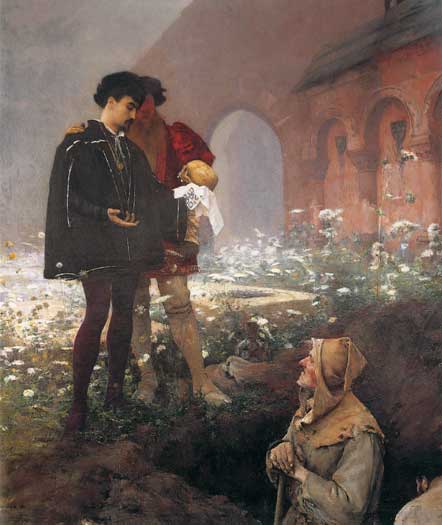
Cowards die many times before their deaths;
The valiant never taste of death but once.

My friends are dying of heart attaks in offices. They're as dead as heroes.

Of all the wonders that I yet have heard,
It seems to me most strange that men should fear;
Seeing that death, a necessary end,
Will come when it will come.--

Too many fear they'll die of embarrassment if they show up at our library meetings, preferring instead to live in fear at home in the dark to die in offices in the morning later.

CAESAR.
The gods do this in shame of cowardice:
Caesar should be a beast without a heart,
If he should stay at home today for fear.
No, Caesar shall not: danger knows full well
That Caesar is more dangerous than he:
We are two lions litter'd in one day,
And I the elder and more terrible;
And Caesar shall go forth.

—William Shakespeare, Julius Caesar (II, ii,)

Caesar will come, and he won't be the nice guys we are if we don't take his place and make our democracies strong enough to resist his calls to madness. Stand up and sit down. Even the French so many despise know that much-- and they act. It's amny yeaars since I studied Camus, but I do recall this:

"It is better to die on one's feet than to live on one's knees."

Albert Camus.

We will let our democracies go to the demagogues if we sit in the dark doing nothing but nothing at all. If we lose our laws wed will be no better than the Muslims and the left dhimi fascists we fight. go to your library and sit with your friennds and show yourselves to the world. Stand up and sit down before there is nothing left but hate and smoke.

Nothing discourages thought so much as this perpetual blue sky. Here any exertion is impossible, so closely does pleasure follow desire. Surrounded by splendour and death, I feel happiness too constant. I lie down in the middle of the day to deceive the dreary prospect of time and its intolerable leisure. I keep here, look! some white pebbles that I leave in the shade to steep, then I hold them a long time in the palm of my hand, till the soothing coolness they've borrowed is ... used up. Then I begin again, alterenating stones, putting them back in the shade the ones whose coolness has been exhausted. That's how the time passes, and evening comes....

Andre Gide, The Immoralist. Trans. Richard Howard. New York: Vintage; 1970, p. 170.

Gide is French too.

Local library, Thursday evening, 7-9 p.m. Be there-- or lie in the shade.

School Teachers with Guns

Does the state have a right to intervene in the life of the family to enforce laws favoring the life of children in contradiction to the beliefs and customs of the family? Of course, and it flows across the planes of Left, Right, Green or Islamic. Oh, damn, that's true but it depends on the situation and the group the state intends to interfere with, the Modernist state being the evil figure intervening in the family affairs of sharia Muslims and being the good guy in intervention into the lives of home-schooled Christians.

There is a line that is so obvious that only the most sophisticated of intellectuals at our local cappuccino bars can't see: When a family harms the life and mind of a child directly, such as by disallowing vaccination against polio, a contagious disease preventable by care from the medical state, the family endangers not just the child but the larger community of children. Fascist apologists will cry-- and they do-- that we cannot intervene in the cultural practices of Others. Yeah, and I have a store of rope to deal with such objections. Kids are kids, whether Islamic or no, and they do not deserve to die or to be destroyed by disease to indulge the phantasies of sentimentalists and philobarbarists in the modern West. It's criminal to prevent state intervention that might save children from harm and death by the hands of parents, whether from denial of polio vaccinations or from parents who mutilate their children's genitalia or any other damned thing. There's no room in the world for the sophists to delay or to deny care to those in danger of harm at the hands of parents. It requires direct and immediate intervention in the lives of families who harm and destroy children. The only question is where to draw the line and who should intervene. Deny your sick child a blood transfusion, and then hang for it. Fair is fair. Kill a doctor providing polio vaccinations, and then stand up to be shot to death. It's just fair.

Manifest Destiny provides Western man with all the theoretical background one needs to organise the mind to formulate and activate a plan of colonialism for the propagation of universal Modernity by filibustering. Polio destroys children, cripples them, and often kills them. Some parents refuse vaccination to prevent that harm to their own children and allow the spread of polio to other children. Those parents who make polio possible are not necessarily evil but they are harmful to the lives of children; and they must be stopped at all costs, even at the cost of being shot to death on the streets in broad daylight without benefit of trials and courts. Just shoot them. Is it right? Is it moral? Are we foisting our own unproven medical model imperialist ethos and capitalist meta-narratives on authentic peoples? Do I give a shit? Shoot them.

Again I argue that there is a bifurcation of Humanity taking place, that there is a move from the usual fascist state of Human existence into a world of Modernity, and that not all will willingly move from the past to the future. We, revolutionaries of Modernity, will prevail in the move to universality of Modernity; the question is only how many we will kill as we do so. It is prudent to kill the fewest if only to prevent the plagues that arise from the bodies of the unburied. It is moral to prevent our descent into hatred and genocide by acting wisely now to prevent ourselves from acting in a condition of enraged madness later that might well result in our creation of a sand diorama of the primitives. We will prevail, and the question is one of the number of the dead we will leave in our wake. Conquer now, take no prisoners, and impose Modernity on the universal condition of Man.

School teacher: Take up thy books and hold your gun high. Go forth and kill parents who interfere in your glorious work. School teachers with guns: Protect your charges.
****

Bomb kills polio health official

A senior health official has been killed and three guards injured in a bomb blast in Pakistan's tribal region bordering Afghanistan, officials say. The dead man, Abdul Ghani Khan, played a key role in a polio immunisation drive in the Bajaur tribal region. Dr Khan was returning from a meeting of tribal elders to persuade them to end their opposition to the campaign. It is not clear if he was targeted because of his work to eradicate polio in the area. No one has admitted to carrying out the blast. Officials said the assailants used a remote-controlled bomb.

Endemic

The government is facing resistance from some tribes in its campaign to vaccinate children against polio. Some tribal leaders say the vaccine is a part of a US conspiracy to reduce fertility and reproduction rates.... Pro-Taleban militants are known to be active in the area. Pakistan is one of the few countries in the world where polio remains endemic.

It is a highly infectious viral disease which mostly affects children under five-years-old. The virus attacks the central nervous system, causing paralysis, muscular atrophy and deformation. It can ultimately lead to death. Pakistan last year confirmed 40 cases of the crippling disease, the World Health Organisation (WHO) said.

http://news.bbc.co.uk/2/hi/south_asia/6368505.stm

More on polio in Islam:

http://nodhimmitude.blogspot.com/2005/11/polio-in-islamic-countries-is-said-to.html
****

Is the Melian Dialogue an exercise in right morals? Not hardly. Are we modernists of the West the ultimate in moral right? Not likely. Should we impose our values on others simply because we can? Yes. And we should and must kill those who harm and kill there own children because those parents are violent and ignorant and vicious. We, school teachers with guns, have a duty to go forth and to shoot those parents who would otherwise kill their children in accord with primitive cultural values and religious hatreds. Just kill those parents and adopt the children as your own. Life is tough. No more talking. Kill people with your guns. Spread our Modernity to all through the barrel of a gun. Everywhere an America of the mind. Friend, go do some great thing. Raise a healthy child.

To Stand. To Sit.

Canticles 2: 9: Behold he standeth behind our wall, looking through the windows, looking through the lattices.

The point is epiphany.

Many years ago, years back when I was still little more than a boy, I walked down a dusty street in a sun-baked village off the map, and there in front of a store I stared at three men sitting in chairs, their arms and trunks bound, their smiles stupid and disturbing, the look in the eyes of one making me quake and tremble. I stared at the man till a fly crawled across his upper lip and then crawled inside his nostril without the man flinching or twitching or moving at all. Now, I knew he wouldn't move, that being obvious from all the bullet holes in his chest, he being as dead as his mates in the other chairs beside him; but I don't care how dead he was: the problem was that he looked straight at me without seeing me, and the fly went into his nose and stayed there.

I realised this evening, maybe not for the first time in my life, that I'm not groovy. I don't know what the average reader thinks of me as a man but I'll let you know right now so there's no further confusion: I am not a hep-cat, daddy-o.

I manage to live with these bits of self-awareness of my flawed character. I don't even want to be a cool dude. I couldn't be even if I wanted to be because I drink too much coffee. I have to face uncomfortable truths about myself sometimes. I make tomorrow's lunch the evening before. I'm a boring guy. I'm square.

I see myself as I am, and I see that I'm a boring guy. I've seen many things over the course of a long life-time: death, murder, massacre, torments that kill; torments that drive me to my knees, some of them torments from el Greco, some torments from grief indescribable. That makes me pretty ordinary. Not different from most men my age. Like other men, I too have known the heights of Heaven's loves.

There have been times in my life when I have looked at things as obvious as the nose on a man's face and I just didn't get it. And there are times when I have looked at the most painful personal failings I have and I have managed to survive the shame. Some things are easy: We in the Modern world are at war with the primitives of dar al-Islam and the fascists of our own kind in this time. They're ordinary people too. They do evil things to other ordinary people. We sit. We sit and we plan for war and struggle to defeat the primitives and the fascists.

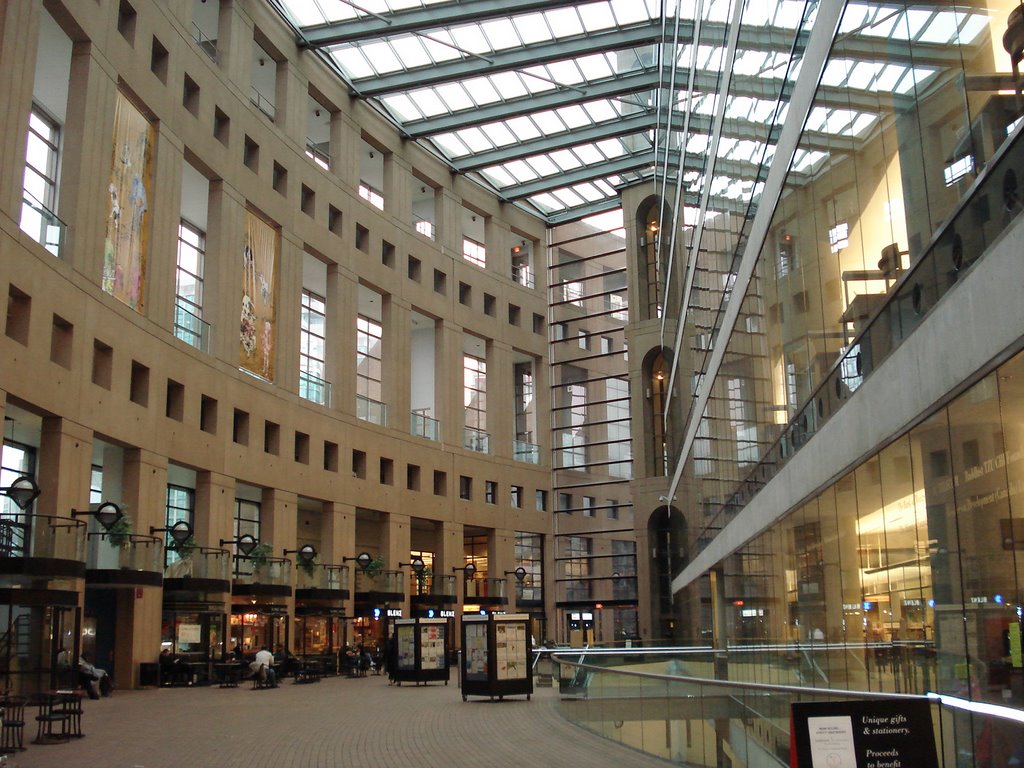
This is the epiphany: we sit at the library in the atrium each Thursday from 7-9 p.m. outside of Blenz coffee bar; we wear blue scarves to announce ourselves to you; you can see if you look, and you will know.

We talk about you. We say: Behold he standeth behind our wall, looking through the windows, looking through the lattices.

Stop impersonating the cool and join us in the work of ordinary people sitting in chairs.

Wednesday, February 14, 2007

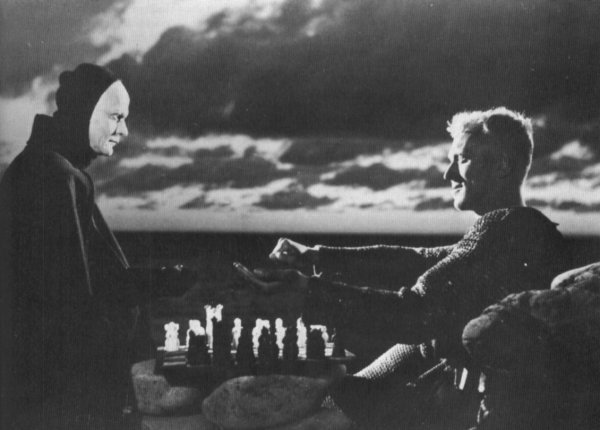
Your move....

Thursday at 8:30 a.m.: He opened his office, sat at his desk, turned on his computer, and banged his head on his keyboard. End of story.

Gray was in his mid-50s.

If I'd dreamed this up I would have made a penalty box, for sure; but death is beyond my imagination. I'm just here playing the game. I didn't make up the rules. To complain about that you'll have to talk to someone other than me.

You're going to go, too, friend, so consider it a matter of how you play it. It's not that bad, all things considered. We're free to choose how we live and how we don't. We get to make up our attitudes toward how we deal with the things we live with. I like to laugh and celebrate the morning sun. I like to think of myself as a fighting man, ready to take on the odds against me and to try, at least, to win a day. The gods don't care, and I don't care. I laugh, and we all die. I've lost another friend. I shoulder this burden. I'll take myself and my grief to our meeting tomorrow, Thursday evening, to the library at Vancouver, Canada, and I'll sit with others in the atrium outside Lugz coffee bar; and we will sit and talk, a thing fighting men and fighting women do. I'm not going to talk about my friend. His story is over. We'll talk about life and the living. I want you to join us. We'll join my friend later. For now it's for us to meet. We, the living.

VPL, atrium, 7-9:00 p.m. We wear blue scarves. Sit among us. Be alive with us.

Wake up, sweet prince.


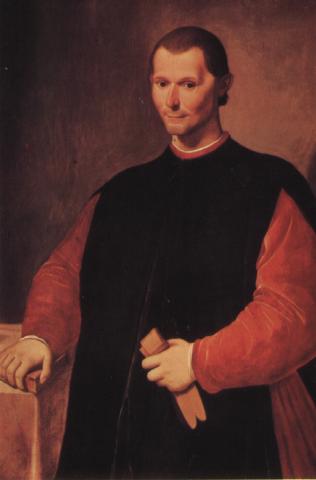
Machiavelli advised the prince to garrison mercenary foreigners to keep order among the locals, the foreigners having no reason to care at all about the lives they might be required to take if called upon by the prince to keep order among those they do not know. But even given the low nature of civilized behavior among the princes of the Renaissance it's doubtful they would have demanded or allowed the hostage-taking of children to protect their paid men. However, if the mercenaries are not bound by loyalty to family or clan or tribe or even by common humanity, if they are, as below, Muslims, then it seems that anything goes, things even to shame Machiavelli. Not that grabbing children to use as human shields to save Taliban terrorists will shame the Death Hippies who find any excuse to praise them and to demean the efforts of the Modern world to defeat the killers in dar al-Islam. Foreign Muslims in Afghanistan grabbed Afghan kids and used them to run away from death at the hands of Western and Afghan forces. Find an excuse, Death Hippies, for that.


KABUL (Reuters) - Taliban fighters used children as human shields to flee heavy fighting this week during an operation by foreign and Afghan forces to clear rebels from around a key hydrolectric dam, NATO said on Wednesday.

The Taliban have used human shields before, but never children, local residents say.

The fighting occurred during Operation Kryptonite on Monday, an offensive to clear insurgents from the Kajaki Dam area in southern Helmand province to allow repairs to its power plants and the installation of extra capacity.

"During this action ... Taliban extremists resorted to the use of human shields. Specifically, using local Afghan children to cover as they escaped out of the area," Colonel Tom Collins, a spokesman for the NATO-led International Security Assistance Force (ISAF) told reporters in Kabul.

[....]

The fighting occurred in an area where 700 mainly foreign fighters, including Chechens, Pakistanis and Uzbeks, arrived from Pakistan this week to reinforce Taliban guerrillas targeting the dam, according to local officials.

Taliban flee battle using children as "shields"
Reuters.uk


There cannot be normative rules of engagement any longer in a struggle against those who use children as Human shields. No rules no more.

Is America the world's greatest terrorist? Do we kill more children every day than all the murders of history combined? The Death Hippies would have us think so. So, what do we do? What voice do we hear, and who calls?

Last day a Muslim shot to death six peaceful shoppers in store in Utah. Civilians died because they were alive. You cannot hide from Islam. It will come at random and kill because it is a sickness. You cannot know. You can only know that doing nothing is a sickness worse than death.

Tuesday, February 13, 2007

Treasure beyond measure


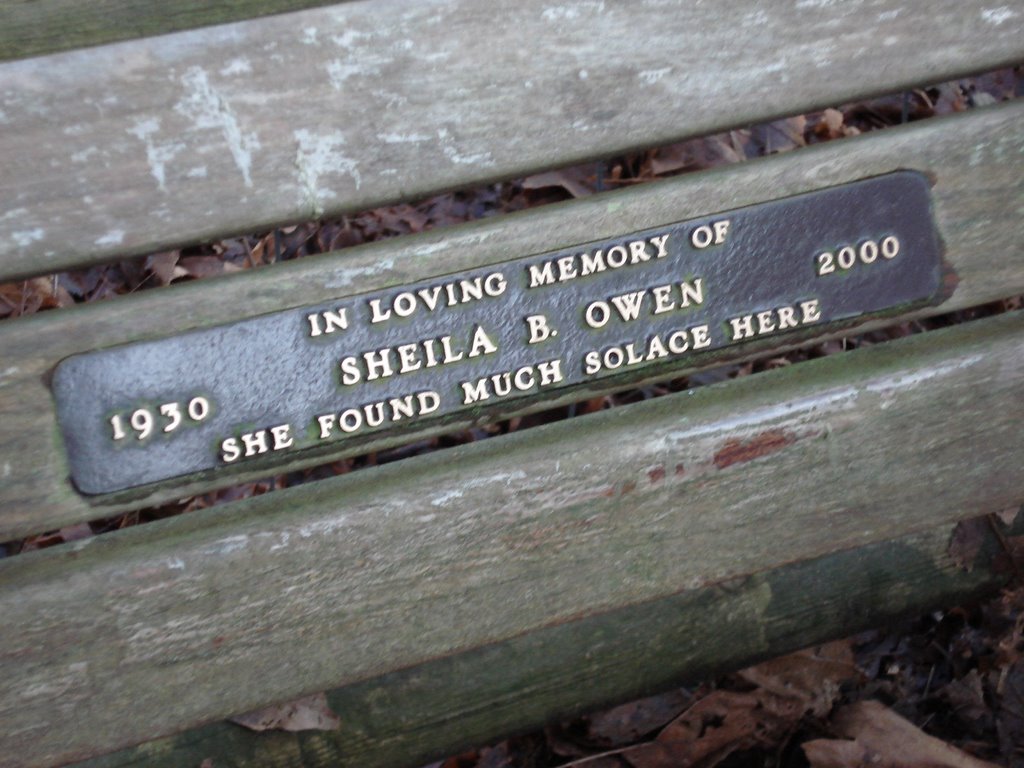
There's always a mix of emotions at play when a weary traveler sits to rest and study the surrounding beauty of Vancouver and its suburbs. Many of our parks and trails are decorated with modest memorials in the form of park benches such as this one, reminding us of all that love can build, and how one's love can live long after the lover may be gone. They are all strangers to me, strange names in little corners of my country I never imagined I'd ever see. Yet the discovery of these touching mementos will probably be one of the more warming memories I'll take with me, should I ever move on from Canada's west coast. They're a testament to the power of love, a gentle reminder to appreciate the blessings that fill our lives, and not to take such blessings for granted.

I try to take a moment to read these many tributes among our many park benches, and always find myself renewing the same commitments, time after time: I will think of all the embraces that can no longer be shared, and linger in my own hugs just a little longer. I will remember the kindnesses that these benches speak of, and try to prove myself more worthy of the bounty of kindness as comes my way from she whom I love. I will rest my weary legs as my wife and I watch the river roar by, while the trees bend their branches to the wind, and be grateful for the tender hand that holds mine; for there will come a day when my hand reaches out, and there will be nothing but memories to hold on to, only memories to find solace in.

Then it will be time for a new bench to teach the lesson for another traveler, so that the civilized circle may continue, nature's beauty serving as useful opportunity for conveying the most important message of all, towards understanding the most beautiful gift of all:
the glory of True Love.

To everyone who is, or has ever been, in love: Happy Valentine's Day.

No! Not the BED BY THE DOOR!

I was ill in the mountains. That surprised me almost endlessly, my usual susceptibility to jungle fevers being overthrown by a sickness from the heights, landing me in the back seat of a taxi as my girlfriend of the time sat in the front threatening the driver with dire consequences if he did indeed stop to toss me in the nearest ditch rather than have me die in his car, threatening his livelihood by bringing the police to his car wondering why the dead European inside. She insisted the driver get me to the local hospital; and by some miracle I did make it, landing in the hallway some age later, writhing and agonizing and screaming from the pain in my innards, not, for once, worried about having been overcharged for the taxi ride. No, the dollar paid was of small consequence. I felt that I was paying with my life for having made yet another absurd foray into the heart of darkness, my own, as always. I recall lying in the corridor of the hospital, groaning, twisting from the pain, fairly sure I'd finally reached the end of my own long and winding road. The pain was more than I could bear, and I can bear a lot without screaming, as I know from terrible experience. And there I laid on the stone floor of the hospital while a woman looked down at me, she holding a clipboard, tsk-tsking, my girlfriend negotiating a price for my admission to a bed and treatment of some sort.

I came to wakefulness some nightmare time later, done up in i.v. bags and laid out like a patient etherized upon a table, a couple of local girls checking out my parts, laughing and giggling at the sight of unfamiliar color and such, not bothering further to go through the pockets of my already rifled pants pockets, my loose change having gone the way of all flesh long before. My girlfriend returned, telling me I needed more things from the local pharmacy, that she'd go buy them and would return later, that I should amuse myself as well as I was able till then. The girls left, and my girlfriend left, and I turned on the bed to face the door, seeing in the bed next to me a man laying on his back, Don Ernesto, pale and wheezing, his face collapsed from sickness and age, he being perhaps forty or so, past his time. So we chatted as well as he was able, no one else of his being able to take the time to visit, work-needs prevailing in the world of the living.

"Yes, don Ernesto, the pathetic story of my tragic life began when I was born at an early age; and it became ever more fascinating as the day progressed," I think I told him, hoping to keep him happy and entertained. But it didn't work. Don Ernesto didn't make much response other than to give a long wheeze as he died. I called out to the nurse, calling out that don Ernesto had died, that she could come and wheel him away from me, that she should take him from the bed by the door and down the hallway to anywhere but next to me.

The nurse finally arrived to find out why I made so much noise for a sick man. Motioning to don Ernesto I told her he was dead, it finally occurring to her that he was dead. I found that bit of information at least vaguely important, if not to don Ernesto, then to me and the orderly running of the ward I was in, four beds in a row from the doorway down. "Ah," she said, "he's gone." But no, he wasn't gone, he was right there beside me, stone dead and too damned close. The nurse beckoned a mate and together they twisted a sheet around the body and hauled him like a fish out the door and out of my life, thank the gods. And when I awoke, finding my girlfriend returned with morphine, I saw another man in don Ernesto's bed behind her. "He's dead," she said. "I know," I replied, "I saw them take him out just a few moments ago." But I was mistaken, the corpse being a new guy, one I'd missed as I was passed out from a shot of dope. My girlfriend told me the low-down: "You fall asleep and they come and steal the things I have to buy for you at the pharmacy! They return to sell it. Why should I bother if you won't protect your medicine?" Yes, that charmer is my ex. Lovely girl in many ways. Not overly sensitive. She did manage to get the staff to remove the new stiff. I looked nervously at the empty bed by the door. I could see a pattern emerging. It was black and carried a long scythe.

I woke a number of times over the next three days, each time as bad or worse than the time before, sometimes a body in the bed, sometimes not, the bed being empty, waiting for the next guy not going home again. The other beds beside me filled up with guys who had injuries not so bad, from what I could see, except for the guy who came in burned to stumps and who died. And then another died. And then the bed by the door filled up and I went to the emptiness of a deserted dreamland, waking to find I was subjected to an enema, my girlfriend explaining impatiently that she would not go again to buy the same things if I let this batch get stolen like I had the others. She said that if I didn't get my innards x-rayed they couldn't see the trouble, and therefore I would die. It was up to me. So I fought to stay awake through the morphine drip and the motor vehicle accident guy's demise till the enema came washing out into a bed pan, filled to the brim. I feared to move. The nurse returned, took up the pan, and part way across the floor, slipped, sending the pan and contents sloshing across the remainder of the floor and up the wall. Ever the professional, she whipped the sheet off the nearest body, being mine, and used her foot to wipe the sheet through the muck, kicking the result into a corner with the panache of a Pele. Soon after I was wheeled into the x-ray room, and from there, sometime later, I heard the medical staff, boys and girls, discussing my problem with my girlfriend: "It's that big round white thing there," said one doctor. And then another said no, it had to be the small black thing over there. They all agreed that whatever the problem was the only way to fix it would be to open me up and take a look so they could be sure. I didn't see any chickens in the operating room but something must have tipped off my girlfriend that something wasn't quite right because she said no, they would not operate on me at all. Back to the ward. To the bed by the door!

I have this fear, not of death but of dying in a bed. I don't want to do that even once. It just ain't for me. So I got up and walked out. My girlfriend complained the whole way to the marketplace where we stopped for coffee and mangoes and a bowl full of fried bugs. I hadn't eaten for a week, so the bugs were mighty tasty. I kept on going. I survived because I'm strong and fairly healthy, because I have an attitude that keeps me away from the bed by the door, and that make me get up and leave that bed when I land in it anyway. I also have the twenty bucks a week that I need to pay for first-rate medical attention in a Third World shit-hole hospital. Them as don't dies.

I don't know what it was that got me there that time. I survived and carried on to further adventures that brought me close to death. Those other encounters were from people bent on violence, not simple things from Nature. I shrug. Death is all around us all the time. It's only a problem for me when I see clearly that it takes those who needn't really go. It bothers me deeply when I see people dying because they don't have clean water to drink, to bathe in, to wash their clothes in. It bothers me when I see two foot long coffins daily, often clusters of them, bobbing down the street atop the bent-over backs of the sick and the dying. It bothers me when I see a mosquito land on a child, knowing as I do that disease is sure to follow, and from that a needless death. I survive because of cleaning products and alcohol wipes and anti-biotics and enough knowledge of germs that I can avoid most of the things that would otherwise kill me within weeks, the things that carry off peasant kids and old folks and those too sick to survive a common cold. I survive because no matter where I am I still live in the Modern world. I know about Lysol and Tidy-Bowl. I want my sister to marry Mr. Clean. Mother Nature? Nope, ain't no friend of mine. Gas that bitch.

Last summer we encountered a death hippy who claimed to be personally responsible for the death of a million Viet-Namese, her moralistic hubris not making her at all sickened; she didn't do enough to stop the war in Vietnam, or something, or whatever. She emoted righteously on the sidewalk for us so we would see her sincerity. She's probably on television if you care to watch. Or perhaps she's now on about the evils of environmental destruction. Today she's likely protesting about the use of fertiliser and pesticides and synthetics. When I clear away the visions of dead peasants I see in my fascistic mind that woman hanging from a lamp post. She, and not just she, is responsible for the death of far more than a million people. Anyone who denies the right of the quality of life Modernity provides to the rest of us is guilty of the murder of billions. Anyone who cries out against the use of Lysol is a killer of children. No, I have no sympathy. I have only hatred for those who sit in the clean well-lighted cappuccino bars of modern suburbia while they pose and preen and condemn the world to death by disease eradicable by TidyBowl.

There are many who would condemn the world to death to satisfy some phantasy about the beauties of Nature and harmony therewith. They assault me with hysterias on global warming and mining and oil exploration and conspiracies of capitalist nature. Yes, I want to choke them to death. I want to see Mr. Clean and Aunt Jemima stomp them into the ground. Be at one with Nature, you rotten self-satisfied Body Shop bastards. I've been close, and I've seen people placed in the bed by the door. They're there because they are denied global warming and Lysol. Kill them, Mr. Clean, kill the dhimmi fascists who condemn the world's ignorant to disease for the sake of a pose and organic breakfast cereals.

Every night when I go to my bed by the door I roll over and run my hand over the ceramic tiles of my bedroom floor. I laugh. Fuck me, I laugh till I fall asleep. I dream of my beautiful flush toilet. My Modern world. My clean bed by the door.

Monday, February 12, 2007

Save Our Souls


David Warren had some thoughts Saturday on the theme of environmentalism as bad religion raised in our previous post by Charles. Warren begins by quoting Alvara Vargas Llosa:
“For half a century, Western guilt made the lives of the poor even worse by propping up despots and corrupt bureaucracies through foreign aid. A new form of Western guilt, environmental fundamentalism, is making the lives of the poor even worse in Mexico after triggering a huge rise in the price of corn -- the chief component of the tortilla -- thanks to a government-induced increase in the demand for ethanol in the United States.”
Warren adds:
Ethanol was, and is likely to remain, one of those cosmetic products, that masks our abject dependency on hydrocarbons, by creating an illusory association with lush fields.
The screwing of the world's poor, as the (dare we say, unintended) consequence of the environmental movement is something many Canadians, in all their evil niceness, like to forget. What, for example, do we think the world's poor will do if their nations trade away their carbon credits under some Kyoto-like emission reduction plan? In many cases, they will return from cities or hopes of joining the modern world to the destructive slash and burn agriculture and the chimney-less miserable hovels that Dag often talks about.

In any case, misanthropic human-blamed global warming fears are either over-stated (as we noted here) or they are going to turn us into a bunch of millenarian hysterics who can't think straight and adapt to the climate change that has always been a part of our planet's natural history.

For example, David Suzuki thinks it's "wonderful" that, according to a pollster, 72 percent of British Columbians "believe life as we know it will end in another two or three generations unless drastic and immediate action is taken to curb global warming." Why is this wonderful news to Suzuki? Because it allows him to "[urge] individual Canadians to "start screaming at our politicians" to effect the changes we need to stop climate change, both federally and provincially..."If 72 per cent of British Columbians are alarmed about this, then that is a huge kick in the ass for politicians," Suzuki said."

But there is nothing wonderful about mass depression and apocalyptic screaming. Does anyone really think that people who think our way of life is doomed, that we must make radical changes, make for the kind of people with whom we can reasonably adapt to any climate changes without destroying the social and economic order, the consumer society, that has evolved historically to keep us from continually being at war with each other? Is it human or societal self-hatred, or respect, that is necessary for people to come together and forge new covenants, to take control of their lives and change in tandem with others? To my mind, what Suzuki thinks wonderful is a sign of people who have given their sovereign authority to rule themselves to the guilt mongering of gnostic demagogues who know that to garner attention for one's own career and celebrity as world saviour in the postmodern age, it is necessary to play a victimary game, to claim the centre of attention in the name of a victim; and there is no victim greater than Mother Earth. By the way, Suzuki has recently been promoted within the Order of Canada, showing that those in charge of the nation's highest honours think his work is wonderful, or at least they recognize it is in the interests of their elite bureaucratic class to pretend to do so, for they, not the producing and consuming and exchanging and gifting masses, not shopping, not God, are the real saviours in the secular "expert", study-writing, logic of our times.

Expanding the theme of environmentalism as mass murder, Warren moves on to Rachel Carson and her campaign to ban DDT:
The claims made in Carson’s book proved laughably false -- though few people today realize this, and Carson herself remains a canonized saint of the environmental movement.
[...]
Much of that book may even have been knowingly false. Not that Carson herself would have intended any evil: for she was sincerely convinced DDT was the secular equivalent of “the work of the devil”. Her faith in that idea could therefore justify any “pious fraud”. Her love of nature, so articulately communicated, was perfectly sincere. Yet in a sense one could say that, “Rachel Carson killed millions.”

Over the years after, quite literally, tens of millions of people died, all over the underdeveloped world, from epidemics that could easily have been prevented by DDT spraying. It is a shocking fact that to this day, the environmental movement has not acknowledged that reality, let alone accepted responsibility for it. It is a faith-based movement, a kind of religion, and much of its power comes from its ability not merely to deny, but to ignore, the rational consequences of the actions it advocates.

I say, “a kind of religion”, because genuine religions are much more responsible, and more inclined to learn from their own mistakes over time. In Christianity, especially, reason has always been granted an exalted place -- and on theological, not empirical grounds. The environmentalist credo is a crass parody of the Christian cosmological scheme. It postulates a primitive Eden that never existed (our tribal ancestors were in fact violent and immensely destructive of ecology), the sinful works of industrial man, and a return to grace through environmental action. It demonizes its apostates. The parody is more elaborate than that, but I sketch these chief points to make clear that we are dealing with an outlook on life that is based on faith, and excludes reason. I am hardly the first writer to notice it.

We are in the earlier stages today of a worldwide population crash, that was largely triggered by environmentalist fears about “overpopulation”. By mastering the arts of propaganda, and using the leveraged power of United Nations agencies, incalculable damage was done not only to the planet’s demographic order, but to the moral structure of family life in country after country. All on the basis of the Malthusian faith encapsulated in Paul Ehrlich’s 1968 tract, The Population Bomb. A book that predicted inevitable planetary famine in the 1970s and ’80s, thanks to rising population and falling food supplies. A crackpot book, but nevertheless, another of the founding scriptural texts of today’s environmentalist religion.

I have limited space: we could go on and on. But in light of environmentalist demands that we take precipitate, gargantuan steps to “solve” the “problem” of “climate change”, it is important to remember just how much carnage the movement has already wreaked. Far more than the most fanatical Muslim ever dreamed.
And then, in an article yesterday, Warren continues his march with an attack on the global-warming high priests and propagandists of the UN's Intergovernmental Panel on Climate Change, and on the credulous journalistic profession that, in most cases, has lost the means critically to analyze what "the scientists" are saying, what they really know and don't know. (Well here is one journalist who sees through the IPCC's corruption of science, even as he believes in man-made global warming, to some degree.) Warren concludes with a similar analysis of today's scientific profession:
So far as I can make out, there has been similar “progress” in the scientific world. The academic researcher, like the broadsheet beat reporter, was once a rather grey man who feared overstatement, but could give you a straight answer to a straight question, even if it was, “I don’t know.” The best were (in both cases), broadly grounded. That is, a researcher in some arcane area of, say, climatology, would have a good general science background, including the history required to contextualize his own work. He was therefore not naive.

The decay of standards is not subtle. The academic science world, persisting on tax money, has been intellectually flatlining. It becomes increasingly a closed camp of ideologues whose job security depends on their avoidance of apostasy. In a word, science is being swamped by an almost religious scientism. Whereas serious, open-minded research has retreated almost entirely into the corporate research labs, where a different ethos prevails.

This is the environmental scare that should worry us. That we are becoming, increasingly, the prey of sensationalism in the service of scientism.
I agree. The only way we are going to save ourselves and our potential victims around the world from the evils of our often misapplied sense of guilt is to renew the humanistic and covenantal disciplines that can provide the mix of reason and faith that our times demand of us. I am not a Christian; but as I was telling my Covenant Zone colleagues at our meeting last week, the present Pope impresses me for the way he mixes reason and faith, keeping the doors open to the endless new possibilities of the future, even within a religious fold premised on an eventual apocalypse and a return of Christ whose message, regarding our nature and violent sins, many would presume already to know, having read the Book of Revelation, David Suzuki, or some such. Human cultural and environmental change is unending; shouldn't that mean our theology, or its secular substitutes, must remain open-ended, non-millennial too?

Sunday, February 11, 2007

Blaspheming against the new religion

The National Post has an article this weekend, on Vancouver-based author and mathematician David Orrell's new book, Apollo’s Arrow: The Science of Prediction and the Future of Everything.


... in its myths of the Fall and the Apocalypse, its saints and heretics, its iconography and tithing, its reliance on prophecy, even its schisms — the green movement now exhibits the same psychology of compliance as religion.
...
“The track record of any kind of long-distance prediction is really bad, but everyone’s still really interested in it. It’s sort of a way of picturing the future. But we can’t make long-term predictions of the economy, and we can’t make long-term predictions of the climate,” Dr. Orrell said in an interview.
...
“If you go back to the oracles of ancient Greece, prediction has always been one function of religion,” he said. “This role is coveted, and so there’s not very much work done at questioning the prediction, because it’s almost as if you were going to the priest and saying, ‘Look, I’m not sure about the Second Coming of Christ.’ ”
...
...many religions, environmentalism included, continue to struggle with the curse of literalism, and the resultant extremism.
“Maybe I’m wrong, but I think all this is wrapped up in our belief that we can predict the future,” said Dr. Orrell. “What we need is more of a sense that we’re out of our depth, and that’s more likely to promote a lasting change in behaviour.”
Projections are useful to “provoke ideas and aid thinking about the future,” but as he writes in the book, “they should not be taken literally.”
The “fundamental danger of deterministic, objective science [is that] like a corny, overformulaic film, it imagines and presents the world as a predictable object. It has no sense of the mystery, magic, or surprise of life.”
The solution, he thinks, is to adopt what the University of Toronto’s Thomas Homer-Dixon calls a “prospective mind” — an intellectual stance that is “proactive, anticipatory, comfortable with change, and not surprised by surprise.”
...

One of the major tenets propping up the new religion of environmentalism, is the sacredness of recycling. "Recycling lets us do our part as individuals, to save the environment! It cuts down on pollution! We're running out of space for our garbage, so recycling helps the scarcity of landfill space! Especially recycling paper: we get to save trees! And it creates jobs while cutting manufacturing costs, all the while helping preserve the environment!"
We have become so endoctrinated into believing these dogmatic assertions, that it requires almost an act of will to imagine them as dogmas in the first place.

Helping us to place the religion of environmentalism in its proper perspective, here are those irrepressible iconoclasts, Penn and Teller, in two hertical 30-minute episodes from their cable series "B*****t!", dedicated to exposing some of the migsuided, unprincipled and self-serving priests of this new faith.

[profanity warning for these two videos]

http://video.google.com/videoplay?docid=-4480559399263937213&hl=en-GB

http://video.google.com/videoplay?docid=7734998370503499886&hl=en-GB

Saturday, February 10, 2007

Showing off British Columbia

Or a piece of it, to be precise..!

Thankfully the mid-week weather forecasts for the weekend were wrong, wrong, wrong, and we were instead treated to one of the best saturdays of the year.
I took advantage of the unforeseen sunny skies to venture back up to the Upper Capilano River Park, my favorite place to hang out.


Still a lot of reminders of the windstorms that hit us earlier this winter... trails closed here and there, and the occasional fallen giant..


More photos throughout the week, as either a supplement to our usual blogging topics, or a substitution for it, as time permits.

Thursday, February 08, 2007

Covenanting tonight

Another Thursday and so another meeting in the atrium of the Central Branch of the Vancouver Public Library.

It's now been over one year since Vancouver bloggers and readers decided to take a chance and seek out allies in public places. It was with undeniable hesitation that the first step was taken, but once through the doors it was easier to continue, and one meeting became two, then ten, now over 50.

What good does it do? One might as well ask, what good does it do to get out of bed in the morning, what good does it do to hold down a job, to provide needed service to other Canadians, to better oneself morally, intellectually, financially. We live until we die, and since the end of the road is the one predictable truth everyone can agree upon, it may be within the wiring of human nature itself to doubt the usefulness of elevating one's life along the way, since it ends with an ending so final and so complete. One day there is no tomorrow, so why work towards a better one?

While it may be natural to feel those temptations, it is certainly not civilized to fall to them.

The important step is to connect to others, and embrace something bigger than ourself. In this embrace, a part may fall off but the whole keeps going, and it is to support the ongoing journey of the larger whole that we as individuals steel ourselves to rise to the occasion. As we support the ongoing progress of the group, so too will we be supported by the next generation who add themselves to the march.

Watching the various wildlife with which we share our city, we can learn much about how similar we may be to them, yet how vastly different as well. We can reach out to fellow members of our species and connect with them in ways that Vancouver's ubiquitous seagulls never will. We can share experiences, build upon the labor of generations past, we can work not as a flock, nor a group, but as a TEAM, and inside that difference lies all the value of civilization.

Museum curators who can heap genuine praise on brutes like Stalin can only do so by disconnecting themselves from vast numbers of fellow countrymen, to the point where suffering is only suffering if it happens to them. Newspaper editors can label stories of women being burned and beaten to death as "wacky" only if they disconnect themselves from the female half of their species, and see this half as an "other", equal to that of any other animal.

Connecting to others does not mean blind agreement, it does not involve total submersion of self, a denial of the individual within the group; it does not mean disagreements will evaporate, never to return. The embrace of others must also be accompanied with the agreement to disagree, and to somehow forestall the disagreement from leading to seperation. The easiest way to settle a dispute, is to eliminate the person with whom we disagree. The ease of the choice is not license to select it; such natural, animal-like instincts must be suppressed and negotiated. This struggle is part of the connection, part of the agreement, part of the Covenant.

As human beings, we seem to be born not knowing how to make these connections, only possessing the nagging intuition that such Covenants could be made. Some people spend their whole lives on the outside of such teams, looking in, walking around them, yet never breaking the circle and the welcoming embrace of those within. The longer the time spent on the outside, the easier it becomes to silence the faint whisper that such attempts to rise above nature are valuable, indeed glorious, as they reflect the potential of the human animal to rise above our world's other creatures.

Wearing blue scarfs, in solidarity with France's courageous members of the Blue Revolution, we meet again tonight from 7:00 to 9:00 pm, in the shadow of a celebration of learning, the main branch of the Vancouver Public Library.
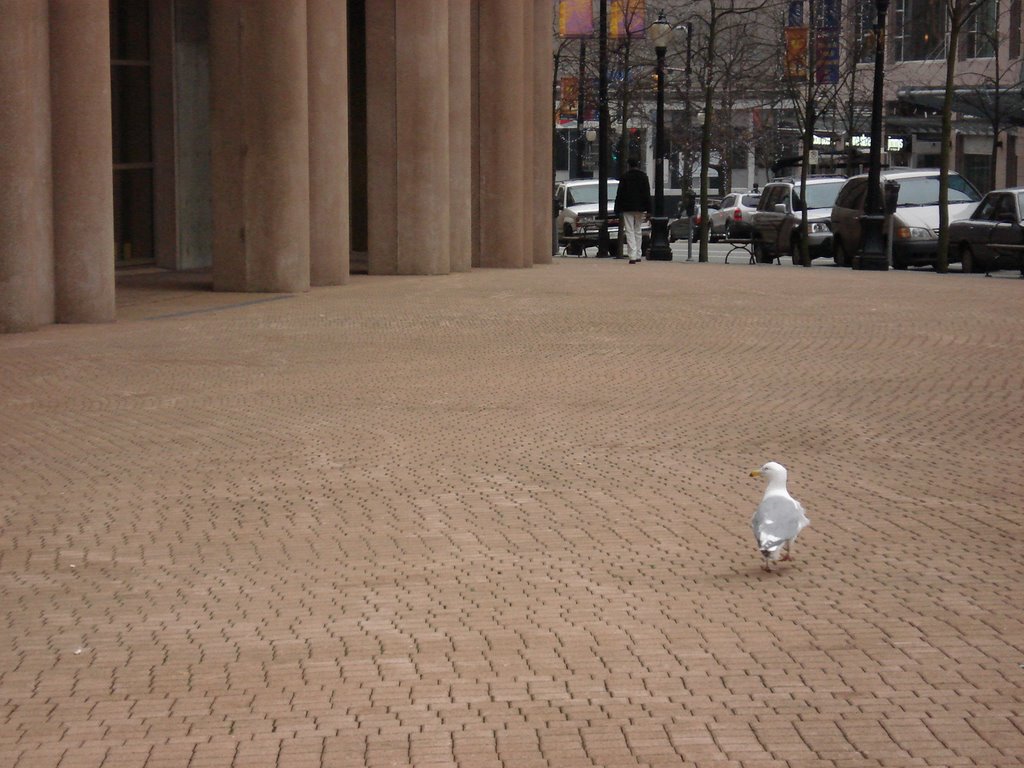
Don't be like this hesitant seagull: join us.

Wednesday, February 07, 2007

Only in Egypt... Believe It Or Not!

As a rowdy and rampaging kid you could shut me up pretty easily by handing me a copy of a Ripley’s Believe It Or Not paperback, and apart from occasional giggles or gasps I would be silently content for the next hour or so, captivated by the parade of weirdness Mr. Ripley had to share.

From that youthful experience comes, I’m sure, my lifelong fascination with following the "oddly enough" stories available in most newspapers and magazines, now in such plentiful supply through online media. Truth being infinitely stranger than fiction, what novelist can top the bizarre gallery of oddball behaviors, unbelievable coincidences and infinite strangeness that all make up the dramatic stories of the bemusing folly we call "real life".

There’s always a fine line to be drawn in presenting such stories, as one person’s awful tragedy is too easily turned into another person’s "funny item of the day". Ripley’s Believe It Or Not books and comic strips, as I remember them, seemed to know how to show respect for the misfortunes of others even while parading those tragedies before us. Generally I feel a similar humane tone to the various online groupings of these stories that I follow through Yahoo and other sources.

Can we really say the same, for this equivalent feature from the Middle East Times: "Only in Egypt!"
It’s billed as a "…collection of weird and whacky news items…"; can something be getting lost in the translation…?

Unidentified assailant knifing Maadi women
EGYPTIAN POLICEMEN are intensifying their efforts to arrest the unknown assailant responsible for stabbing women in Cairo's Maadi streets.
"Even in broad daylight and teeming metro-stations, any girl might be stabbed by the Maadi butcher," said Nahla, 20, warning the district's female population after having caught a glimpse of the attacker.
Over the past two weeks, similar tales of a hooded attacker carrying a small knife and targeting women in Maadi have spread like wildfire.
"I saw him in one of Maadi's quiet streets, hitting a girl wearing tight jeans, [after which] he tried to stab her in her back with no objection from the few passersby," said Ahmed, 17, himself a Maadi inhabitant.
….
61 ways to leave your lover
THE NUMBER 61 has recently enjoyed great popularity in Egypt's courts having featured significantly in two rather grotesque marital suits.
The first case concerned a husband who had sued his errant wife 61 times to oblige her to return to him.
She had always refused, wishing to dissolve their marriage instead. ...

The second case had to do with the murder of a wife by her husband after he suspected her of infidelity. His decidedly sadistic way of revenge was to burn her all over her body with 61 cigars, while hitting her until she expired. The offender is now serving a lengthy jail sentence.
….
Egypt's cyber-scribes blog at their own risk
EGYPTIAN BLOGGERS are having to re-think the cost of adding new content to their online forums, or even having them up in the first place.
Abdel Karim Suleiman, a 22-year-old former law student detained in police custody since November 6, 2006, faces up to nine years imprisonment for posting articles critical of Islam on his blog. His trial began January 25 in Alexandria.
The first blogger to be prosecuted in the country, Suleiman has since added Egypt to the 2006 Reporters without Borders list of the 13 nations most culpable of suppressing Internet freedom.
While the official reason for Suleiman's arrest was posting content accusing Muslims of savagery, the main cause for his detainment was his online denouncement of President Hosni Mubarak, comparing him to ancient Egypt's tyrannical Pharaohs.
Suleiman's prosecution comes as a sharp warning to other bloggers considering posting on such "dangerous" issues.
….


One reason to blog is to test your views through measurement against those of others. And so I pose the question: am I alone in thinking it in rather bad taste, to say the least, to label such stories as "weird and whacky"? That heart-breaking story of a poor woman being tortured to death by cigar burns is "weird and whacky"? To who, a fellow psychopath??
This final story about the imprisoned blogger is repugnant on a whole other level, and to place it within a gallery of stories labeled as suposedly "weird and whacky", surely adds to the disgrace. A poor soul accuses his government of tyranny, and they comply by promptly attempting to jail him for nine years; what is the expected reaction from readers, to find such a story listed among "weird and whacky" news.. are we expected to chuckle and turn the page, muttering under our breath, "ha-ha those wacky egyptians, always silencing their critics..! Only in Egypt!"

To be fair, I would concede that the other stories at this round-up could be labeled as traditionally "weird and whacky" without comment from me. Here’s a story I feel is much more appropriately weird for such a column:

41-hour flight delay, passengers just plane uneasy
MANY EGYPTIANS are known for their pessimism with calamitous results.
Recently, seven such doom-laden Egyptian travelers caused a flight delay of almost 41 hours.
While their Egypt Air flight to Hurghada was boarding, the seven said they heard a suspicious sound emitted from the plane's engines, and immediately asked the captain to allow them to disembark.
Despite their departure, however, the seven's foreboding proved infectious, and the rest of the now-highly-perturbed passengers compelled the captain to perform another engine check.
Even though maintenance staff later pronounced the plane to be technically immaculate, the drama continued with passengers pressuring the airline to replace the plane entirely.
The flight finally took off on a different aircraft, but the original seven doom prophets decided to cancel their trip completely.


Only in Egypt!

"There were atrocious repressions, BUT..."

A report from the Middle East Times on Stalin's Black Sea resort of Sochi being turned into a classy hotel, ends on a troubling note. When materialism rules one's values, it probably becomes easier to make statements like, "Stalin was a mass murdering tyrant, BUT... he gave my dad a job!"
The massive dacha, where time seems to be fixed forever in 1937, the year of its construction, is now a hotel where visitors can stay in the one-time holy of holies of Soviet power for up to €300 ($390) a night.
One can eat in an imposing dining room adorned by the dictator's portrait, swim in his swimming pool, and even sleep in his bedroom.
Joseph Stalin came here almost every summer. From this peaceful house with shaded verandas, the mustached tyrant supervised socialism's triumphant march, as well as mass repressions and purges.
"Here he used to work, smoke, think. From there he would look out to the sea," Valentina Menalan, the villa's manager, said with enthusiasm as she walked from one room to the next.

Nothing has changed, she said - the heavy curtains and light wood still recall the 1930s, with only the furniture replaced in 1960s and 1970s when the villa became a guest house for the Communist Party's foreign visitors.
The villa was turned into a hotel after the Soviet crash in 1991.
The swimming pool on the ground floor is still functioning. "Stalin did not like swimming in the sea, so they built him this pool filled with seawater," the guide said.
...
The improvised museum holds several personal objects and a billiard table, as Stalin was a great fan of the game. One room has a full-size wax statue of Stalin seated at his table before a silver ink pot presented to him by late Chinese communist leader Mao Zedong.
One thing the Stalin hotel will not remind guests about, however, is the nightmarish side of a totalitarian regime that imprisoned millions of people in the Gulag.
"There were atrocious repressions, but Stalin also developed industry, space programs," said Vladimir Shishkin, deputy director of the Zelyonaya Roshcha (Green Grove) hotel complex, which includes the villa.
For many Russians, Stalin is mastermind of the victory over Nazi Germany, source of great national pride, and ruler of an empire that stretched from East Berlin to Vladivostok.
Nearly half of Russians - 47 percent - view Stalin in a positive light, with less than 30 percent thinking badly of him, a poll published last year by the FOM institute found.

He kept the trains running on time... to the gulag.

Monday, February 05, 2007

Walking in the rain

It may have rained all weekend, but the scenery was still spectacular at one of Vancouver's most secret of scenic parks.
I hope I never get to the point where I can walk over this bridge and not be stopped dead in my tracks by the beautiful scenery. Charlie Chaplin once said, "the most terrible sin is to grow accustomed to luxury"; visiting this park regularly as I do, I keep that sentiment in mind.
You can always tell when you're sharing a moment at the park with someone who is visiting here for the first time. It is their speed of movement that gives them away; how long they spend standing still, compared to those, I guess those like myself, who visit the park more frequently. We tend to walk right past sights like the one pictured here, having seen it time after time.
What must these first lingering visitors think of me, as I pass them on my hasty stroll? That we take this scenery for granted? I can only offer, in my weak defense, that I am in transit towards another point, elsewhere in the park, in order to stop and marvel at the enchanting scenery I missed during my last trip...

Are the manifold findings of climate science best synthesized by politicized committees like the IPCC, or by the talented individual mind?

Lawrence Solomon, executive director of Urban Renaissance Institute, a division of Energy Probe Research Foundation, writing in the National Post, has recently completed a series of ten articles on leading scientists who are skeptical of the greenhouse effect as a cause of global warming. While I don't pretend to know the causes of climate change, I'm pretty sure that no one at present should be confident on the subject, given the paucity of our science. Thus, the series is a must read for those who suspect that the international consortia of experts and bureaucracies that rule much of our opinion are increasingly unable to interface with any reality other than a fantastic creation of their own tired rituals of institutional and professional self-justification as scientific resisters to the evils of free market society.

The first in the series, with the links to the other nine articles is here.

UPDATE: Mark Steyn gets in some licks on the "the [global warming] science is solid" crowd.

Technorati Tags:

Sunday, February 04, 2007

Sense and Gnosense

Karl Augustus Menninger (July 22, 1893 - July 18, 1990) was an American psychiatrist and a member of the famous Menninger family of psychiatrists who founded the Menninger Foundation and the Menninger Clinic in Topeka, Kansas, is to the general public an obscure thinker today who was in his day significant as a public intellectual. There's the problem: that a man who influenced society deeply a mere 50 years ago is now more or less forgotten as a force in public opinion making but who is still influential -- because he is forgotten. The lessons taught by Menniger are now more or less irrefutable, right or wrong, because his theses are not accessible to the lay person to consciously critique, laying buried in obscurity, foundational nevertheless, and dangerous due to the hidden influence that lingers, influence like a leeching poison that sickens, like miasmas, like night-gasses. Menninger wrote in condemnation of "common sense," and now common sense is considered to be the approach of philistines and the great falsely conscious, the proles, the Rightwing Religious Bigots who are not sophisticated enough to grasp the gnostic Truths of the elite. Menniger is one man who destroyed the validity of common sense in the minds of the masses, and now those who have learned his lessons have forgotten where such and idea came from, assuming that "they have always believed...." Not to gratuitously trash Menninger, the point is to point out here that many of our common assumptions are foundational not because they are intelligent, reasonable and true but simply because the originators are obscure and unexamined because they are culturally subterranean. When we can't see the foundations of our assumptions we can't critique our supports properly.
****

Menninger was a prolific writer. Among his books were The Human Mind (1930), which brought psychoanalytic understanding to the lay public, Man Against Himself (1938), in which he explored self-destructiveness (and made a compelling case for the validity of Freud's death instinct), Love Against Hate (1992), which examined the human capacity to overcome self-destructiveness, and his magnum opus, The Vital Balance (1963). He was also intensely interested in the penal system, and in his book The Crime of Punishment, he suggested that many convicted criminals needed treatment rather than punishment (1968). His volume, Theory of Psychoanalytic Technique, was one of the few books to examine the theoretical underpinnings for the analyst's interventions.

Menninger spent his life as a champion of the under-dog. He was a crusader for a variety of causes, including the American Indian, nuclear nonproliferation, neglected and abused children, and penal reform. In 1981 he received the Medal of Freedom, the United States's highest civilian honor, from President Jimmy Carter.

http://www.answers.com/topic/karl-menninger

****

"The theoretical underpinnings" are of concern to all of us, and that so in view of our assumptions, that "We have always believed...." Our theoretical underpinnings are usually completely and utterly unknown to us, being the underpinnings we build our assumptions atop, not knowing how shaky and perhaps how rotten they are. Karl Menninger condemned mere "common sense," and our public intellectuals today, not knowing or perhaps having forgotten where this thesis originated, assume they have always despised mere common sense, all right-thinking people knowing it is essential to delve down to the theoretical underpinnings of ideology, regardless of how little they see of it once there in a Gnostic fog. Hubris and ignorance replace common sense in favor of gnostic moralisms and self-righteousness and murder by socialism. All this because once a man told the smart that common sense is beneath them; and the smart were impressed enough to abandon it in favor of mystic awareness of the cosmic truths known only to them. Not no dog-kickers them, the smart took up the theoretical underpinnings and ran with them into the mists of the unknowable in pursuit of glory and utopia and feel-good. I can't count so high as to number the dead I've witnessed due to the lack of common sense emanating from our public intellectuals. We must excavate our intellectual foundations. We must be archaeologists of our public intellectual culture. We cannot assume any longer that the Gnostics know anything of value. We have to rip up the planks of desolate edifices to examine why we live atop such a crumbling culture. Menninger and thousands like him lay at the bottom of our ill. We have to expose these men and women to the light of conscious analysis, opening up our own assumed "theoretical underpinnings" so we can resume the natural position of mere common sense.

To know is delight.

To know why is divine.

To know that common sense is common sense is just normal. To miss that is too usual. We have to point out the reality and benefit of common sense to those, our Gnostic superiour intellectuals. And we have to show them why they assume the idiot "theoretical underpinnings" they live for. Then we move on. Common sense dictates it.

Sarkozy the saviour of Europe?


Conrad Black sizes up the two main presidential candidates in France's upcoming spring election, and gives a (reluctant?) nod to the UMP candidate, Nicholas Sarkozy.
In this article in Canada's national newspaper, the National Post, Black frames his choice with a good summary of the scope of Europe's current challenges:


Europe is in a torpid dyspepsia, with a shrinking population, and the problems of trying to replace the unborn with immigrants, many of them enemies of the venerable cultures of Europe. Even today, scores of automobiles are burned almost every night in France by disaffected Muslims, a practice that the French, with their often admirable, shrugging, sangfroid, officially ignore.


The dream of European integration and federalism has collapsed. The Western Alliance, largely because of a vacuum where American leadership existed under Truman, Eisenhower, Kennedy, Nixon, Reagan and the elder Bush, has gone from a coherent association to a coalition of the willing, to a slovenly group of countries that will accept an American security guaranty, but do nothing in return for it.

The social democratic model for Europe's main economies, except for Britain, has produced a high unemployment/minimal job creation recipe for stagnation. The bold Euro dream of challenging the United States for world leadership has withered even more abruptly, and less remediably, than the prestige of the United States. China, India, Japan and even Russia advance in the esteem of the world while the West wallows.


This could be a decisive moment in the current history of Europe. Only the French can lead Europe out of its despondency. The British are respected but are not considered European, by the Europeans or by themselves. The Italians are liked but not taken seriously politically. Germany is self-conscious, and it has no panache to lead. Historically, Germany has had only the crudest methods for leading Europe. Only France has the material importance, political credibility, and flare and style to lead Europe, but not try to dominate it. The continent awaits leadership and the French never doubt their aptitude to provide it. Royal makes a splendid advertisement for liberated motherhood, but Sarkozy should win the presidency. He could be only the third French leader since Napoleon, after Clemenceau and de Gaulle, to change Europe. His continent needs him.


[image courtesy of http://www.discosarko.com/, the website built by Sarkozy's campaign team to persuade the youth of France into arriving at the same conclusion as Lord Black]

Saturday, February 03, 2007

Constitutionalism and the Global Intifada

Adam Katz has written another brilliant essay to encourage conservative amateurs like ourselves to get off our duffs, start covenanting, and take back our culture from the "progressive" elites who collude - in the name of the supposed victims of Western history, and in the self-righteous reality of their own institutional power - in the aristocratic networks of academe, media, and judiciary.

Katz begins the essay with a masterful analysis of how a "Global Intifada" has been created on the model of the Palestinian refusal to negotiate with Israel, in an honest give and take in recognition of Israeli and regional security realities, by those favouring instead a "hologram" of the Palestinians' (or analogous victim group's) unquestionable victimization and necessary redemption by the "world community" and "international law". He then moves on to discuss how a new American politics might organize itself against the "Global Intifada" in which many American elites now collude in a parasitic corrosion of their own nation. This new politics can emerge through alliances among conservatives, libertarians, and constitutionalists, focussing on how to make constitutional amendments that would limit the role of victimary culture as dictated by our expert class. Our opinion makers and judicial elites, acting from institutional self-interest and imperialistic antagonism towards popular Western and national histories, make and enforce calls to put recognition of our supposed victims centre stage, while detaching themselves - and, by extension, everyone else - from any actual responsibility and accountability in the real world where hard decisions need to be made in defense of our national covenant against its internal and external erosion. This denial of elite accountability - e.g. by scapegoating the likes of George Bush for everything under the sun, including global warming - unfolds our historical national attachment to a democratically-constituted reality as so much of our political and cultural debate now takes place in a world of politically-correct holograms.

As a matter of cause and effect, human reality can be created through moral or physical coercion, or through covenanting. Most simply, the job of covenanters like ourselves is to network and act so as to make and reattach ourselves to the kind of shared human reality that serves our true spiritual and intellectual needs:
Such an amending politics would help inaugurate what David Brin has called the “century of amateurs.” Mark Steyn has surely been right to claim that if there is one thing that our post-9/11 history has revealed, it is the complete uselessness of “experts.” Every power granted to some expert (everything, that is, outside of the circumscribed sphere of client and professional, a specific skill or delegation and the practical task to which it is applied) is one taken away from someone on the ground, someone who might reasonably be held responsible if we give him enough space and who has the best chance of dealing with the situation intelligently rather than formulaically. And the Global Intifada draws its strength, like a postmodern Antaeus, from our formulas. To take one example, racial, ethnic, or religious profiling can, indeed, become formulaic, once it is turned into a “checklist” of “things to look for.” But it can never be nearly as destructive a formula as one forbidding all such profiling, because the former is inherently open to input and the empirical (yes, terrorists can start to draw upon Western converts, and have them keep their original names—but that will just give us something new to look for, the point is that we are looking)—the latter, though, which is the type of counter-intuitive formula that most perfectly marks today’s expert, closes off the give and take between reality and the intellect. And it is only that give and take, which we are now, after a century of totalitarian unreality infecting our own, able to see as extraordinarily difficult to sustain, which provides us with all we need in our current war; it is examples of that give and take, what we can call “iconic intelligences,” that must be sanctified as our constitutional order draws new life from the amateur, he or she who acts out of sheer love for the activity.
Read the whole thing...

Thursday, February 01, 2007

Meeting tonight

Well, January is over, thank goodness. What a month that was, full of personal bad news, technical problems and financial nightmares. Still, the clouds are lifting (literally and figuratively), and February promises to be much, much better, for which we're grateful.

Everyone has been very patient with my new indulgence of regularly posting photos taken during my weekly wanderings in order to bask in the beauty of my city and its surrounding scenery. It's been good therapy, in fact it is surprisingly invigorating. You've got to admit, Vancouver has some breath-taking sights to see! I always feel rewarded and renewed from every walk undertaken to connect with my city and its environs.

Tonight, we meet in one of the nicest places to meet, the atrium of the Central branch of the Vancouver Public Library. We've met for a full year now, to talk about the challenges faced by our little piece of the world. It's been quite an education, a fitting result for meetings taking place in the shadow of such a monument to the celebration of learning.

I will confess to a ritual that I had developed back in the 1990s: I stand in the atrium of this library, and make a point of looking up at the towering 7 floors of books, while asking myself how much I know about the knowledge and ideas contained in those thousands (tens of thousands?) of books. Not much, would come the honest answer; then I could off and not take myself and my little problems too seriously for the rest of the week, for how could I deny the comparison I had just put myself through? At the same time, that comforting humility was balanced by a yearning to try and fill the hole, climb that tower of knowledge and feast on its banquet of ideas and experiences.

Similar experiences color each and every meeting we've undertaken since last January.

Connecting to the fellow Covenanters, those who come regularly and those who only come once in a while, not to mention those who have only come once, all such connections leave one rewarded and renewed, seeing our world through new eyes, understanding it as rife with new opportunities.

If you are reading this, you are invited to participate as well. Our meeting starts at 7:00, lasting until they kick us out at 9:00 pm. We wear blue scarfs to make ourselves recognized, a symbol of peace worn in solidarity with like-minded fellows in France, who meet in equally beautiful places of their own.
See you there!

Tuesday, January 30, 2007

The world according to ducks

There's something about watching ducks that I find endlessly amusing. They are nature's comedians. It's said that the subtle difference between a clown and a comedian, is that a clown does funny things, but a comedian does things funny. Meaning, a clown may get a laugh for, say, falling down stairs, while a comedian may get a laugh by how they walk up stairs.
Ducks, therefore, are nature's comedians.

Ducks do everything funny. They swim funny, they talk funny, they walk funny, particularly since the busybody duck seems to take himself so seriously all the time; their incessant quacking puts you in mind of someone who finds fault with their surroundings at every haughty step.
I propose that a careful observer can learn much from frequent study of the ever-present duck: we can learn that constant criticism can win us little sympathy, that lacking of a sense of humor almost invites people to mock you, and that while our problems may seem important to us, we should be wary of assuming they dwarf the challenges faced by others.
Ducks can teach us how to become better human beings... just sit back, watch, and let the smiling begin.