Wednesday, October 18, 2006

Bravo Mr. Harper!


Prime Minister Harper once again amazes me with how unlike the rest of the politicians he is. Where countless would hem and haw, blurring differences to gain points in today's Canada where Israel is widely (and wrongly) seen as victimizing its Arab neighbours, a Canada whose present politics is suffused (and hence corrupted) with trade in victim figures, Mr. Harper just speaks plain truth and refuses to trade. His is a commitment to moral clarity that is so refreshing, not the least because he will not pander very much to the many irrational pieties spoken in the name of Canada's pre-eminent, but nonetheless incoherent, ideology: multiculturalism, the ideology in which one is not supposed to favor a strong, western democracy and nationalism over its immiserated Other, no matter how psychotically totalitarian and murderous is the Other's ideology, as is Hezbollah's and much of the Arab world's.
Prime Minister Stephen Harper has defended his staunch support of Israel's war against Hezbollah militants, in front of a receptive audience of B'nai Brith Canada members.

"When it comes to dealing with a war between Israel and a terrorist organization, this country and this government cannot and will not be neutral," Harper told the Toronto crowd.

Harper came under fire during the war for calling Israel's invasion of Lebanon a "measured response" against Hezbollah militants, who captured two Israeli soldiers in a cross-border raid in July.

"This summer, we were mercilessly attacked by the Opposition for the position we took on the Middle East," said Harper.

"I understand that with the news reports of the day, and the sound of battle, the images of destruction and the suffering of innocents, that it is sometimes difficult to see and keep the focus on what is truly at stake.

"But the fact is this: those who attacked Israel, and those who sponsored such attacks ... seek the destruction of Israel of the destruction of the Jewish people."

Harper has used his staunch support of Israel to attack the Liberal leadership candidates, whom he recently accused of taking "anti-Israel" positions.

That accusation was partly in response to a comment made by Michael Ignatieff. He argued that an Israeli strike on the Lebanese village of Qana, in which 28 civilians died, was a war crime.

Last week, B'Nai Brith called on interim Liberal Leader Bill Graham to distance his party from Michael Ignatieff's remarks.

Ignatieff has since said it would be up to international bodies to determine whether a war crime was committed. And during an impassioned speech in Toronto last Friday, Ignatieff fired back at Harper for what he called a disgraceful personal attack.

"Stephen Harper used my statement that war crimes were committed in this (Mideast) conflict to launch a personal attack on me and on my colleagues running for the Liberal leadership of Canada. Mr. Harper's comments were a disgrace, a disgrace for a man who holds an office that is supposed to represent all Canadians," he said.

"There is no basis whatever for Mr. Harper to suggest that the Liberal party is biased against Israel. The prime minister showed a profound lack of respect to the Official Opposition and a profound lack of respect to the Canadian people who elected them." Link...
Well now, Mr. Ignatieff, the ball is back in your court. How exactly can the pandering in your party, including that of your campaign co-chair, Denis Coderre, to anti-Israel opinion on the question of the recent war not be construed as evidence of a more general anti-Israel opinion? Can you really feign neutrality in a war between a modern western democracy and a totalitarian terrorist organization that hides among civilians whose lives it will sacrifice with little thought, in the name of some apocalyptic fantasy ideology? You say you are a friend of Israel but that you must criticize its methods when Israel crosses some line. So how would you respond to Alan Dershowitz's clear explanation that your calling Israel guilty of war crimes is ludicrous? Let me remind you what Dershowitz says:
Ignatieff has surely seen the videos and other indisputable evidence that Hezbollah was launching rockets from areas near the building that Israel bombed. He surely knows that Israeli intelligence was completely unaware that Lebanese civilians were hiding in the building. He cannot reasonably believe that the Israeli air force deliberately intended to kill the civilians in the building. Why then would he characterize the resulting tragedy as a "war crime?"

There are several possible answers. The first is that he simply misspoke in the course of an interview in which he wanted to make up for his past misstatement. If that is the case, he should be accused only of carelessness. The second possible explanation has far greater implications for his candidacy to lead a great political party.

It is possible that he believes that even if the Israeli killing of Lebanese civilians was an unintended consequence of its efforts to prevent rocket attacks against its own civilians, it was still a war crime. Such a view would reflect a perverse and dangerous approach to international law that would make it nearly impossible for democracies to protect its civilians from terrorists who launch rockets from civilian population centres. It would also encourage other terrorist groups to emulate the tactic employed by Hezbollah in its recent war against Israel: to use local civilians as human shields behind whom the terrorists fire their rockets at enemy civilians. This gives the democracy only two choices: to protect its civilians by destroying the rocket launchers even if that means some civilians will inevitably be killed; or do nothing and allow its own civilians to be targeted. Faced with this choice of evils imposed by the terrorist, every democracy would chose to protect its own civilians, as Israel did.
Finally, Mr. Ignatieff, if you become Prime Minister, how do you propose to protect us from a totalitarian enemy that is growing in this world, even here in Canada? Will you just blame Israel and America and hope the crocodile eats us last? Or will you grow a spine like Harper's once the season of pandering - to what I can only honestly call the anti-Israel sentiment in your party - is over? We might argue over how general is this anti-Israel sentiment, or how specifically it is related to recent events. But to deny that some such sentiment is out there is to deny reality; and to get all self-righteous, as did all the Liberal leadership front runners, that Mr. Harper pointed to this ugly reality is childish grandstanding. Is that what we want in a Prime Minister?

I promised last week to say more about Bob Rae's non-policy on the Middle East. I hope to get to that soon to show that there is indeed a problem general to the Liberal party, and not just to one of its leadership candidates.

Tuesday, October 17, 2006

Worshipping the wrong idol in the Horn of Africa


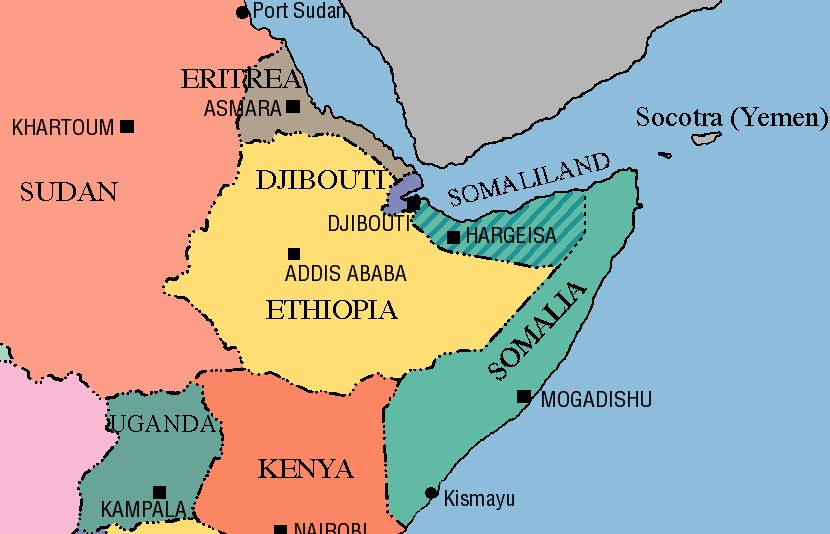
More trouble brewing in the Horn of Africa.
This corner of the world tends to receive only sporadic attention in the western media… maybe it’s time to start paying much more attention.

Courtesy of afrol news:

17 October - An internal document shows that Somalia's new Islamist rulers have decided to send suicide bombers to the neighbouring peaceful self-proclaimed state of Somaliland. Their aim is to topple the elected Hargeisa government. The Islamists have already staged violent demonstrations in Somaliland to destabilise the government.

In a decision signed by Sheikh Dahir Aways, the most radical leader of the Mogadishu Islamists … the Shura Council of the Union of Islamic Courts (UIC) decided to send 30 young assassins to Hargeisa as suicide bombers to kill what they called the Jewish and American collaborators.

"The Shura Council of the Perseverance Alliance has decided to send 30 young martyrs to carry out explosions and killing of the Jewish and American collaborators in the northern regions," the document said.
….
[T]he decision blasts the Somaliland leadership for being apostates who reneged from Islam and opted to work with Jews and Americans at the expense of their nation and religion.

The Islamist council also decided to train 3000 young mujahids hailing from the northern regions, or Somaliland, that are currently living in the southern towns of Mogadishu, Kismayo and Guri Eel. These would later be dispatched to Somaliland, the document reveals.

A number of Somaliland clerics have also issued statements, calling for the Somaliland government to apply Islamic Sharia without any delay.

Somaliland, a former British colony that has unilaterally annulled its union with the rest of Somalia after the collapse of the Said Barre regime in 1991, has since then enjoyed a high degree of peace and stability. It also established a robust democratic system and held internationally observed presidential and parliamentary elections.
Scoffing at Somaliland's peace and stability, [Sheikh Dahir Aways] recently accused the Somaliland people of worshipping the wrong idol. "The Somaliland people forgot to worship Allah and instead worship an idol called Peace," he said in a statement to the media.
…..

Curiously, this sentiment echoes that of an islamist arsonist, fresh from a rampage to curtail Somaliland free speech the day before:

A huge number of issues of Somaliland's independent daily 'Haatuf' newspaper were burned in the town of Buroa by extremists linked to the Islamist courts of Mogadishu in neighbouring Somalia. 'Haatuf' is highly critical on the Somali Islamist movement, terming them "terrorists", and was first to report on their Buroa-based Somaliland link.
….

One of the newspaper burners, Saeed Muse Faras, was also reported to have said after Friday players at a mosque in the Hodan neighbourhood of Buroa, "there is nothing sacred about Somaliland's unity, the only thing that is sacred is the Holy Book," according to 'Somaliland Times'.
…..

Meanwhile the whole Horn of Africa seems to be descending into war:

In what the UN calls a "major ceasefire breach", Eritrea has moved some 1,500 troops and 14 tanks into the UN monitored buffer zone that separates it from Ethiopia […and] is reported to have breached the UN arms embargo on Somalia by supplying weapons to the well-funded Islamists.
...
Analysts earlier pointed out that this was an effort to distract Ethiopian forces from its ongoing conflict with Eritrea and incite a second front in Somalia. At the same time, Ethiopia for the first times in centuries is experiencing violence between Muslims and Christians in what seems to be well planned actions to cause hatred between the country's two major religious groups.

The parading peace-at-any-price protestors might do well to review the sacredness of their "peace", long enough to pay attention to what the forces of radical islam are doing to those who worship Peace and not allah.

UBC Humanities 101 - Reflections on what passes for our intellectual life

As noted in the previous post, last night I attended a panel discussion on the West and the Middle East hosted by UBC's Humanities 101 program for adults. The discussion at the Vancouver Public Library featured four speakers.

The first, Hadani Ditmars, a freelance journalist began by questioning the title for the evening’s discussion. Was the polarity she thought was implied by the title “a false construct”? After all, she alleged, the west has been much shaped in its cultural formation by the Arab and Muslim Middle East; and, in turn, the Middle East has been shaped by the West. She quoted something from Edward Said suggesting that power in such a relationship is all a question of discursive constructs; and so in questioning whether the evening’s title was a false construct she suggested that if we don’t like the realities of power in the world, it is up to us to construct an alternative, as if existential realities and the conflicts they engender could all be made better if only we committed ourselves to the constructs. These vague allusions to the seemingly magical power of discourse over reality were never really well explained.

Rather this speaker showed her facility in innuendo and coy irony, starting what appeared to be arguments only to leave them hanging in the wind, with the mere suggestion that what really matters is noting how power victimizes the powerless. Indeed, the apparent justification for her having a position at the front of the room, while everyone else quietly listened, was that she speaks for victims. The larger purpose of such a stance was not stated, lest it get in the way of what her innuendoes suggested: that the United States is the cause of much evil in the world. The mess in Iraq – what once was a rather westernized country, she claimed, a country that is now in chaos and witness to the growing power of Islamic fundamentalism – is the fault of the Americans destabilizing the country, creating a power vacuum in which insecurity reigns amid the destruction of libraries, museums and culture in general.

She painted herself as a victim at times, as someone who has “toured the belly of the beast” – i.e. America, and had to face down sundry accusations on talk radio, e.g. that she must have supported the reign of Saddam since she is so anti-American in her accounts of Middle East turmoil (one reviewer of her book accused her of a taste for totalitarian chic). What she really believes in terms of how to bring order to this very troubled region is not at all clear. However, she made much of comparing Canada favorably to the US, but with the suggestion that all our distinctive values that make us superior to the Americans are disappearing in the reign of Stephen Harper. Thanks to our positions on Afghanistan and the recent war in Lebanon, Canada is now becoming a target of resentment in the Middle East and we somehow need to rediscover our erstwhile position where we somehow stood above the conflicts of the world as a beacon of decency. Canada as morally righteous force of multicultural neutrality was indeed what she tried personally to represent, without explaining how neutrality is morally righteous.

The very real differences that are at the root of conflict can somehow be mediated if only we have the right attitude. She lauded a recent letter writer to the Globe and Mail who presented himself as a gay leather man defending the right of Muslim women to wear veils in public. Both contributed to the greater cultural mosaic of Canada; the possibility that the value systems behind gay culture and the veiling of women might be at some fundamental level incompatible was not broached. But none of the conflicts she briefly sketched were explored in depth. It was enough to point to the bad guys.

What really matters, it seems to Ditmars, is that we stand for victims and their rights. We were reminded that it was not until the 1940s that various racial minorities received the vote in Canada and that indeed aboriginal people had to wait until 1960. The point being, perhaps, that we are not much better than the countries we presume to reform? Any possible downside to a public culture in which victimary claims dominate was not discussed.

The second speaker, Deborah Campbell, another journalist and an adjunct professor at UBC was introduced as an expert on Iran where she has spent time as a reporter. She argued that the mainstream media has a blurred, narrow lens on the Middle East. Due to media concentration in the hands of a few corporations, we apparently only hear what the owners of media, like Canwest Global (whose Jewish owners she did not mention, though I imagine everyone knew who she was figuring) want us to hear. There are only six major media companies in the US, we were told, and some of them, like GE, are also arms makers with an interest in war. She implied there was some conspiracy at work to keep us from knowing the truth. You must do your own fact checking she told us and recommended newspapers such as the British papers, the Guardian and Independent, which she lauded for providing more than one point of view – i.e. for providing a leftist, anti-American view.

To someone like me who finds the mainstream media, including that owned by Canwest Global, dominated by left-liberal journalists, with a few exceptions, this seemed deluded: there was no evident difference in the outlook of Deborah Campbell compared to what I read in the MSM, despite what she implied. The fact that large corporations don’t really have a moral or political centre but are rather interested in selling for whatever there is a sizeable market – and in North America this means mostly left-liberal points of view – did not occur to her. She sees some conservative conspiracy at work, while I could only wish.

Campbell told us that there was much more to Iran, surprise surprise, that what we hear about in the media with their reports that largely focus on the insane rhetoric of President Ahmadinejad. Whether Ahmadinejad is or is not someone for us to be concerned about was not made clear. Rather we got a few allusions to a history in which the Americans were clearly the bad guys. Did we know that it was the Americans who helped start the Iranian nuclear program in the 1970s, during the rule of the Shah, and that Cheney and Rumsfeld had roles in making this happen, while Wolfowitz (oh the irony) was responsible for nuclear non-proliferation at the time? She pointed out that while the West is obsessed about Iran getting the bomb (I wonder why – might it have something to do with the apocalyptic rhetoric and apparent lust for a final conflict evidenced by its leaders?) they allow Israel, India, and Pakistan, all non-signers of the nuclear non-proliferation treaty, to get the bomb. Hypocrisy was implied. But why we should wish or imagine a world where all nations and regimes are deemed to be the moral equals of each other (with the exception of America), all with equal claim to nuclear weapons, was not explained. The very fact of treating one nation differently from others was supposedly enough to fill us with a sense of victimary scandal. It would be better for all and sundry to have nukes! This suggests a certain unreality in representing the conditions for human survival.

We were told that Saddam was once a friend of the US and that there has already been a regime change in Iran – in 1953 at the behest of the CIA, who overthrew a democratically elected government. This, she tells us, is the reason that the ordinary Iranians that our media supposedly never tell us about, tell her that they say “yes to democracy (and regime change) but no to American intervention.” Young people in Iran are demanding change… but how they are to get it without American intervention was not made clear. We were only told that it would be insane if America were to attempt to destroy the nuclear program or overthrow the Mullahs, since they don’t have the power at present to do it. What’s more, there is no proof that Iran even has a nuclear weapons program – we were reminded that the Americans who supposedly lied about WMD in Iraq are not to be trusted. The point of all this anti-American baiting in the name of their ostensible victims was not made clear. What she believes about demon nations, conflict, order, and the balance of power in the world is anyone’s guess, but she implied her right to speak at the front of the room because she, as a member of the progressive elect, knows the truth about victims that the mainstream media hide.

The next speaker, Hila Russ-Woodland, artist and educator, was quite a contrast to the previous two, for she was meek and had to fight for her words, full of emotion and uncertainty. She was the Jew on the panel, coming to Canada from Israel in 2001, and here finding herself having to defend Israel against critics who made her a personal target for their anti-Israel resentment. But if she is a defender of Israel, she gives the impression that she is nonetheless very much a defender of a left-liberal world view. The fact that so many on the left scapegoat Israel pains her very much, but it’s really not clear to what degree, if any, she accepts that Israel carries blame beyond that which clearly accrues to all of warring humanity.

She spoke of her work in various peace movements. Upon arrival in Canada she met “the peace walker”, Derek Walker, someone who apparently works for peace by going on long walks and engaging people in dialogue. He realized the power of one-on-one contact, and no longer trusting the media to tell us about reality. She invited Walker to go on a peace walk in Israel, and when he said yes, she suddenly found herself having to get busy and organize a walk from Tel Aviv to Jerusalem.

While her semi-depressed tone conveyed the sense of hopelessness she said she often feels, she was ultimately convinced that people can make a difference. She has organized various workshops in Canada for Israeli, Palestinian, and Canadian youth, where teens from the various sides of conflicts can meet and break the stereotypical ideas they have of each other. By working together, making films, etc., they can create fantastic group dynamics and learn about conflict resolution, while being inspired to be more pro-active. Just how Israelis and Palestinians can learn from this workshop model and find common projects together in future was not made clear, but the sincerity of her intent was evident.

The final speaker, political scientist and law professor, Michael Byers was the most intellectually ambitious but the most disappointing for this reason. He began and ended by name dropping, to tell us that his opinion is sought by people who matter. He was recently asked by one of Michael Ignatieff’s managers whether Ignatieff was right to say that the recent Israeli bombing at Qana was a war crime. But before telling us the answer, Byers assured us that he has no vested interest on either side of the recent conflict in Lebanon. He comes at these questions “objectively” you see. Just how it is possible for someone as aware as him to remain morally neutral when many people are dying in a conflict was not made clear, though Byers certainly made it clear that he sees himself as the defender of some higher (international) law whose intent is to defend innocent civilians from the violence of war. In short, he is basically against war. Again, how this position is compatible with reality or morality was not made clear. Apparently it should be obvious to all of us that war is bad, peace is good.

He went on about how he had taught Israeli military officers (great people, members of a “wonderful, surreal country” ) international law in 2004 and discussed with their Commanding Officer, at a luncheon, the right of Israel to bomb Hezbollah rocket facilities. Instead of flirting with the attractive colonel (try thinking about doing that with a Hezbollah commander, Michael), he was forced to answer her businesslike questions. An attack on Hezbollah could only be justified under international law, he said, by the right of self defense, a right which must meet requirements of imminent necessity and proportionality – i.e. pre-emptive attacks were wrong, and any attack that did more than destroy a threatening military target were illegal. Since Lebanon is a sovereign country, Israel could not target anything in Lebanon that wasn’t specifically Hezbollah’s – i.e. there could be no wider attack on Lebanese infrastructure. He insisted that a fundamental rule of international law is that all war must be in self defense and civilians must be protected from harm. Just what was the authority behind this international law was not made clear – but we inferred that it was the product of progressive men like Michael Byers having come together in the past at places like Geneva and the Hague to write and conventions and having government officials sign them.

Anyway, while Israel apparently attacked Hezbollah in a way that met Byers’ approval in 2004, this was not the case in 2006. In the recent war, Israel clearly did not meet the requirements of necessity and proportionality in justifying self-defense. However, he could not tell Michael Ignatieff’s man outright that Qana was a war crime because he did not know enough about that event – unlike Ignatieff, Michael Byers is a politically smart guy and he knows that “the massacre at Qana” has been exposed as, in some good part, a creation of Hezbollah propaganda. Nonetheless, Byers is sure that Israel committed war crimes. However, Byers adds, so did Hezbollah in its indiscriminate rocket attacks against civilian targets.

In any case, Byers was devastated to hear Tony Blair and Stephen Harper defend Israel’s right to protect itself by going to war in Lebanon. International law, the conscience of mankind, must rule over such men. Just why that is so was not made clear. Under what sovereign authority is international law articulated? Is there anyone who can legitimately enforce it, and if there is, under what kind of vision of reality do they claim the right? The fact that the moral suasion of those who shout about international law probably had something to do with bringing the recent war in Lebanon and Israel to a temporary stalemate – but only sure to lead to more war in future, given the lack of a clear victor on one side or the other - did not seem to be a question to raise. That international law might lead to more war, not less, would be a suggestion beyond the kin of Byer’s discourse.

He condemned Canada’s democratically-elected leader for saying that Israel’s approach to the war was measured; and he claimed a staggering failure of leadership that Canada is not involved in the United Nation’s UNIFIL peacekeeping force in Lebanon. Just why Canada should assume neutrality in a conflict between a democratic western nation and a terrorist entity bent on tyranny, chaos, and wiping Israel off the map was not made clear. It’s just that endless ceasefires and peacekeeping is somehow more humane that bringing wars to some final conclusion, it seems.

War is hell after all; and I am very sincere in recognizing this. Byers apparently figures that humanity can realize some dream where there is no hell on earth. But what if this dream only creates more hell by dint of encouraging fantasies that are at odds with reality?

Byers, who writes for the London Review of Books, went on to defend the recent controversial article in that journal by Stephen Walt and John Mearsheimer. The ludicrous anti-Semitic and anti-American conspiracy theories of these two were much criticized and this criticism in turn led Byers to suggest that while there is something of a politically correct climate in which Israel cannot be criticized (is this guy living in the same reality as I, I wonder) he was brave enough to do so, in the name of humanity and civilians who suffer in wars. How this comment squared with his opening remark that he doesn’t take sides in the conflict, I just don’t know.

The moderator for the evening, Am Johal, Director of Public Programs and Outreach, UBC Humanities 101, then posed two series of three questions for the speakers. By asking three questions simultaneously, with the appearance of pointing to various moral and intellectual conflicts and competing imperatives in our discussions of human rights and war, he showed some sign of wanting to raise the intellectual level of the discussion. But what he was really doing was making gestures to the day when universities had serious discussions, but actually allowing the panelists to avoid answering any of the three questions that might put them on the spot, letting them go on with whatever thoughts they felt comfortable emoting. The present-day etiquette in which it is most uncool to challenge anyone (‘cept a Yankee imperialist) directly with tough questions was preserved.

Only three questions – and again, they were solicited simultaneously, so that the panelists could avoid them – were taken from the audience. (Nonetheless the panelists lauded themselves afterwards on a good discussion that avoided the heated debates that often sully discourse on the Middle East). The first question was full of antisemitic innuendo, with Israel portrayed as the world’s greatest human rights violator (tell it in the Congo or Sudan, dearie!). The second was the only somewhat pointed question of the night: a young man asked Byers whether “international law” was somehow naïve or unrealistic since it made demands of Israel that even those on the extreme left of Israeli public opinion deemed unrealistic. Byers didn’t, to his credit, take the opportunity presented by the format to avoid the question. He simply replied with the question, would you rather live in a world without international law? He wouldn’t want to risk it. However utopian the idea of international law might seem, he suggested, at least it put some restraints on the powerful. But just who are the powerful in a world where unelected “progressive” elites like Michael Byers can pronounce on international law and on who is and is not committing war crimes? To whom do international law makers and their media publicists answer? How is this elect group of lawyers who promise to minimize war and protect the innocent constituted? The greater question of whether utopian notions like international law and world peace might constitute a fantasy ideology that actually acts to prolong and exacerbate conflicts was not raised. Rather, the responsibility of the powerful nations to impose order on the world was implicitly denied. The powerful cannot be trusted. Only those who deny they are powerful while monopolizing public venues in the name of defending victims can apparently be trusted.

The panelists all seemed to agree that Canada’s stature in the world is disintegrating. Everyone they know in the Middle East is telling them this. We are now viewed as victimizers. The fact that those who trade in figures of victimization are a vain, uncentred, and unforgiving lot, who will naturally turn on Canada, the minute it chooses to take sides (especially with the USA) in a conflict, does not worry me, but it surely did worry our panelists. To them Canada should not have strong allies and enemies. Canada should rather be some kind of multicultural empire where a special elite, people like themselves, rule with some mysterious ability to find a way beyond conflict among the various groups - thus allowing for multiculturalism by dictating from on high the terms and laws by which all shall be ruled together. In contrast, if all Canadians were to share together in ruling themselves, i.e. aspiring to some common national purpose that any or all might try to represent to any other member of the nation, we would be sure to begin to recognize our natural allies and enemies, and thus come into conflict with non-Canadian peoples other than Americans. So, it was implied that we should have no national purpose beyond keeping ceasefires; we should not really rule ourselves, but would do better to defer to the victim-trading of our post-national elites. Right now we are apparently seen, in the victimary markets of the world, as too much victimizers, and not enough as nice guys. We need again the kind of governing elites who will return us to our lot as peacekeepers, helping keep conflicts in balance, indecisive, with all sides, except America, equally to blame for the war that comes when peacemakers and the UN rule the world’s “moral” stage.

That there may be virtue in some nations being leaders and others followers only occurs to our panelists in the context of nations leading the cause to rid the world of clear-cut winners and losers. The implications of this for those who would take a lead in human creativity (and hence in creating differences and temporary inequalities) – the only real alternative to endless conflict – were beyond the concerns of our panelists.

Byers told us that Canadian soldiers in Afghanistan, while legally bound not to criticize their mission, are nonetheless telling reporter David Grammaticus that they don’t know why they are there and that they want to go home. Those soldiers who we hear saying things otherwise in the Canadian media are, apparently, simply toeing the line of what can be said without damaging your career. What we hear in the media is not the truth; we need a Gnostic elect like our panelists to set us straight for they know the secrets that are hidden to ordinary mortals. Byers closed the night with an anecdote. His friend, Dawn Black, an NDP Member of Parliament, was recently named by NDP leader, Jack Layton, as the party’s defense critic. Apparently, Dawn knows nothing about defense but was named just because she is the smartest cookie in the NDP caucus. So Dawn phones up her pal, Professor Michael Byers, to ask him what she needs to know. “All I know is that peace is good and war is bad” says Dawn. Byers fawningly replies: “Dawn, you’ll be just fine.”

So there you have it: you can be considered smart if you know nothing about war and conflict, ‘cept that war is bad and peace is good. Peace is good, isn’t it? But what if sometimes the road to peace goes through war? What if those whose only thought is that war is bad help create more war than peace in this world by letting conflicts grow instead of allowing them to be fought out, sooner rather than later? I agree with Thomas Sowell, as quoted in the previous post, that that is exactly what our would-be peacemakers often do. This was a panel of people immersed in well-meaning fantasy ideologies in which a vague utopian vision is substituted for a spiritual struggle over our fears of individual and social mortality, and the struggle of human existence as it actually is. No one on the panel actually attempted to suggest what is at the root of our conflicts – ‘cept that the USA or Israel is somehow to blame for everything, ‘cause they are the imperial war lords.

One of the three permitted questioners was a young man who went on about Jungian archetypes and the need to understand the psychological dimensions of our warring nature. He received some reassurance from Deborah Campbell that we really do have to get at the psychological causes of conflict. That fact that conflict and all that is fundamental to humanity cannot be reduced to questions of individual psychology (or similarly, to scapegoats, like the USA), precisely because these are anthropological questions - our humanity is constituted on a shared scene, in a communal reality that prefigures the individual psychology - was the kind of fact that was far from the minds of these people.

Rather, they were lords of postmodern victimary discourse. But of course they did not explore the nature of this discourse itself. They did not raise the question of how it is that people like them who claim authority in the name of victims dominate our universities and journalism. To raise the question would be to locate themselves in history and thus to question the locus of authority they implicitly claim. Is human freedom really maximized - is peace and not war encouraged - when we have elites whose primary care is to trade in figures of victimhood? There exist today many good arguments that freedom and peace is not so maximized. Stay tuned to Covenant Zone to learn more. You are unlikely to hear about it from the folks at UBC Humanities 101.

Monday, October 16, 2006

Thomas Sowell

As part of our continuing program of Covenant Zone interventions in our public life, this article by Thomas Sowell was handed out at the Vancouver Public Library on the occasion of the
UBC Humanities 101: Undercurrents Public Forum on The West and the Middle East
A program for Adults

A wide ranging discussion on the west and the middle east. Speakers: Hadani Ditmars, journalist and author; Deborah Campbell, writer and UBC adjunct professor; Michael Byers, UBC professor; Hila Russ-Woodland, artist and educator.
Speakers will be:

* Hadani Ditmars, journalist and author
* Deborah Campbell, writer and UBC adjunct professor
* Michael Byers, UBC professor
* Hila Russ-Woodland, artist and educator.

The discussion will be moderated by Am Johal, Director of Public Programs and Outreach, UBC Humanities 101.
Since we are led to believe, by a poster publicizing this event, that this will be a forum that will promote "pacifist" and anti-Israel opinions, we felt a need for someone to show up in support of an alternative point of view. Immediately below, I reproduce the Sowell article, and then I'll add some comments of my own. When I return from the public forum tonight, I'll add some thoughts in the comments. (UPDATE: see my comments here.)
July 21, 2006
Pacifists versus Peace
By Thomas Sowell

One of the many failings of our educational system is that it sends out into the world people who cannot tell rhetoric from reality. They have learned no systematic way to analyze ideas, derive their implications and test those implications against hard facts.

"Peace" movements are among those who take advantage of this widespread inability to see beyond rhetoric to realities. Few people even seem interested in the actual track record of so-called "peace" movements -- that is, whether such movements actually produce peace or war.

Take the Middle East. People are calling for a cease-fire in the interests of peace. But there have been more cease-fires in the Middle East than anywhere else. If cease-fires actually promoted peace, the Middle East would be the most peaceful region on the face of the earth instead of the most violent.

Was World War II ended by cease-fires or by annihilating much of Germany and Japan? Make no mistake about it, innocent civilians died in the process. Indeed, American prisoners of war died when we bombed Germany.

There is a reason why General Sherman said "war is hell" more than a century ago. But he helped end the Civil War with his devastating march through Georgia -- not by cease fires or bowing to "world opinion" and there were no corrupt busybodies like the United Nations to demand replacing military force with diplomacy.

There was a time when it would have been suicidal to threaten, much less attack, a nation with much stronger military power because one of the dangers to the attacker would be the prospect of being annihilated.

"World opinion," the U.N. and "peace movements" have eliminated that deterrent. An aggressor today knows that if his aggression fails, he will still be protected from the full retaliatory power and fury of those he attacked because there will be hand-wringers demanding a cease fire, negotiations and concessions.

That has been a formula for never-ending attacks on Israel in the Middle East. The disastrous track record of that approach extends to other times and places -- but who looks at track records?

Remember the Falkland Islands war, when Argentina sent troops into the Falklands to capture this little British colony in the South Atlantic?

Argentina had been claiming to be the rightful owner of those islands for more than a century. Why didn't it attack these little islands before? At no time did the British have enough troops there to defend them.

Before there were "peace" movements and the U.N., sending troops into those islands could easily have meant finding British troops or bombs in Buenos Aires. Now "world opinion" condemned the British just for sending armed forces into the South Atlantic to take back their islands.

Shamefully, our own government was one of those that opposed the British use of force. But fortunately British prime minister Margaret Thatcher ignored "world opinion" and took back the Falklands.

The most catastrophic result of "peace" movements was World War II. While Hitler was arming Germany to the teeth, "peace" movements in Britain were advocating that their own country disarm "as an example to others."

British Labor Party Members of Parliament voted consistently against military spending and British college students publicly pledged never to fight for their country. If "peace" movements brought peace, there would never have been World War II.

Not only did that war lead to tens of millions of deaths, it came dangerously close to a crushing victory for the Nazis in Europe and the Japanese empire in Asia. And we now know that the United States was on Hitler's timetable after that.

For the first two years of that war, the Western democracies lost virtually every battle, all over the world, because pre-war "peace" movements had left them with inadequate military equipment and much of it obsolete. The Nazis and the Japanese knew that. That is why they launched the war.

"Peace" movements don't bring peace but war.

Copyright 2006 Creators Syndicate
Page Printed from: http://www.realclearpolitics.com/articles/2006/07/pacifists_versus_peace.html at October 16, 2006 - 03:30:56 PM CDT
Sowell begins with the distinction between rhetoric and reality because he belongs to a school of thought that believes much of what passes for public debate in the west is today the product of fantasy ideologies (about, e.g., "Global Peace") that would bring violent conflicts to an end by outlawing war and ruling the world through some articulation of "international law". These are fantasy ideologies because they pay little attention to the causes of war in the existential struggles of humanity, and to the hard but realistic means by which these struggles can actually be mediated and deferred.

For example, the need of warring parties to impose and enforce laws of moral reciprocity on each other is often undermined by claims that violence, when performed by leading nations in attempts to impose some order of moral reciprocity on their rivals, violence however rationally measured and focussed as a deterrent to those threatening disorderly violence, only begets an endless cycle of violence. Thus, for example, the violence meted out by the Canadian troops in Afghanistan cannot possibly have the effect of one day, if all goes well, defeating the Taliban's will to fight; it can only have the effect of increasing resentment and hatred and further violence in that country. And to the extent we and other nations that could get involved are thus encouraged to be careful and deny our troops the full support, logistics, and manpower they need to defeat an enemy, we increase the likelihood that the Taliban will again become the only possible source of order in Afghanistan, and that their brutal methods will return to power - ironically, all in the name of "peace" and "stopping the cycle of violence".

The fantasy ideologies that reject the idea that the world's leading nations might impose their power and sense of moral reciprocity on the world is rooted in an equalitarian notion that to do so only victimizes the Other. In the name of victims, the large majority of the "intelligentsia" of the West today deny the need for some nations to be firsts among equals, to take a lead in showing the way to membership in a world governed by the leadership and reciprocity required for free economic and political markets, as an alternative to the will to power of political tyrannies and their strong men. A regionally strong and successful nation like Israel might attempt to impose on its violent rivals and enemies (especially on their leaders) a measure of violence, and a corresponding rule of realistic, "tit for tat", reciprocity that will act as a deterrent to further violence and a reminder of hard existential realities - Israel's insistence on preserving its existence. But today any such violence is only likely to engage the cry of "disproportionate use of violence" from the morally righteous promoters of fantasy ideologies; hence, Israel is likely to back down in face of a global opinion it cannot cross, and nothing is settled.

Terrorist groups like Hezbollah are rewarded for their violent provocations - raids, murders, bombings - against Israel by becoming "partners in peace". The message is clear to the world's "subaltern" peoples: disorderly resentful violence pays, at least as long as there remains some kind of international order that is willing to appease your violence. Of course, in the long term, this refusal of the right of the strong and free to impose order on the world's tyrannies, will not actually promote peace but will encourage chaos and disorder, an endless war that will result from the fantasy ideology that would outlaw war and promote international law, but without respect for the realities by which a law among nations, that are in many respects not the equals of each other, could be realized.

We live in fear of the Other's resentment and do not stand up to it and tell it that it is deluded, and that moral reciprocity requires of it a different tack. No, when the Other shows us resentment we accord him victim status and attempt to appease his anger. The delusions inherent to all resentments only grow and we fall deeper into the fantasy by which the "tools of Peace" become the antecedents to more chaos and war.

As a final note, let me quote how a colleague responded to the Thomas Sowell article:
pacifism (commonly confused with Christianity) seems to be the desire to prolong the phase of peaceful contemplation of the divine/sign forever, and to carry the state of immobility outside the circle [of western liberals contemplating their cultural centrality] to the [global] periphery. All well and good, but it ends up denying the moral law of reciprocity and in fact promoting its violation, as discussed in the column. (That relates to the feeling of godlike omnipotence some westerners feel with respect to violence and claims emanating from the Other. Nothing They do can really hurt us.) Pacifism also tends to erase the difference between the infinite degrees
of violence, which also thwarts the law of reciprocity. Retribution is seen as inevitably leading to a cycle of violence, instead of a deterrent.

To paraphrase George Washington, the way to have peace is to prepare for war. The Greeks and the Romans knew what we have forgotten; that one cannot have peace until one has destroyed one's enemy's desire to fight. In the Middle East, as in other places, malevolent parties take advantage of the current pacifist zeitgeist. They wantonly attack their enemies, then sue for peace as soon as the retaliation begins. By this method, they can do damage to their enemies while mitigating the damage done to them in return. One has only to look at Darfur to realize the fruitlessness of relying on international bodies like the UN to ensure peace.
Much of the intellectual basis for these arguments of Sowell, myself, and my colleague is to be found, I suspect, in the work of Eric Voegelin. See especially The New Science of Politics, chapter six, section two:
The identification of dream and reality as a matter of [idealistic, pacifist, liberal] pinciple has practical results which may appear strange but can hardly be considered surprising. The critical exploration of cause and effect in history is prohibited; and consequently the rational co-ordination of means and ends in politics is impossible. Gnostic societies and their leaders will recognize dangers to their existence when they develop, but such dangers will not be met by appropriate actions in the world of reality. They will rather be met by magic operations in the dream world, such as disapproval, moral condemnation, declarations of intention, resolutions, appeals to the opinion of mankind, branding of enemies as aggressors, outlawing of war, propaganda for world peace and world government, etc. The intellectual and moral corruptions which expresses itself in the aggregate of such magic operations may pervade a society with the weird, ghostly atmosphere of a lunatic asylum, as we experience it in our time in the Western crisis.
[...we must note] the self-defeating character of Gnostic politics, that is, the oddity of continuous warfare in a time when every political society, through its representatives, professes its ardent desire for peace... an age when war is peace, and peace is war...
Get the book and read the whole thing.

Friday, October 13, 2006

just part of the uniform

A fitting story for Friday the 13th: blinkered multiculturalism on the march in England, as non-muslim students will be forced to submit to the religious dictates of islam:

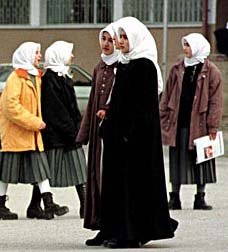
Female students at a new Islamic school will be made to wear head scarves regardless of their religion, it was revealed yesterday.
The Madani High School in Leicester will be required by law to accept 10 per cent of its 600 pupils from a non-Muslim background.
But girls who are not Muslim will still have to abide by a rule insisting all female pupils cover their heads as part of the uniform.
Assistant principal Zainab Elgaziari said he did not regard the demand as a problem - despite the ongoing row over Muslim women's veils.


He said: 'I can't see why if a student wears a head scarf it should be an issue. It's the same as a shirt or tie - it's just part of our uniform.
....

'When you go to any school you know what the uniform will be. Like any school, we will have one - and in our case it will include a head scarf.'
....


When in Rome, do as the Romans do, eh Zainab?
The obvious question to ask, is just how reciprocal this policy might be… am I to seriously expect that Leicester's Christian schools will have the right to make whatever attending muslim children comprising the non-Christian 10%, show up minus their head scarves? After all, "I can't see why if a student doesn't wear a head scarf it should be an issue..."

And just how far does the school have the right to push this policy?
If a non-muslim student’s mother is visiting the school, does she have to bundle up as well? What if it’s career day, and non-muslim female executives drop by to give some encouraging advice; would they have to submit to a head scarf?

From the Daily Mail article:

Yesterday Leicester City Council said it did not believe the scarves would deter non-Muslim parents from sending children to the school.

Looking at Leicester's official website, and seeing the city proclaim itself "The City of Diversity",
I suppose the City Council's prediction just may be accurate. Pity.

Thursday, October 12, 2006

Covenanting this week in the spirit of Stephen Harper


Sometimes it's tough keeping the energy of our little group of new Canadian covenanters going. But we will meet again this Thursday in the atrium of the main branch of the Vancouver Public Library, 7-9 pm, knowing we have a national leader who is alone among the leading federal politicians of this country in having the basic moral sense to stand against terrorism and the Islamic fascist movement of Hezbollah. Yesterday, leading Liberal leadership candidate, Michael Ignatieff, called the Israeli bombing at Qana a "war crime" - an event that was so manipulated by the propaganda efforts of Hezobollah and the Main Stream Media that we just don't know how many died. Nonetheless, we still see the Qana story being reported with no mention that the story, as first and still often reported, was a creation of propaganda. Still, we see no mention of Hezbollah's chief propagandist, and transporter of dead bodies, "Green Helmet" man, whom countless blogs have exposed - just Google "Green Helmet" and "blog" for more information on this.

But despite this sign that so much of our media and political elite are willing to cave in to totalitarians' propaganda in the name of appearing "neutral" witnesses to the victims on both sides of the conflict - instead of finding the moral vision to support Israel, the clear moral good guys in the recent conflict, a nation of western values and freedoms pitted against a tyrannical opponent, a supporter of terrorism, that first attacked Israel and then used civilian lives as shields, only to flaunt the bodies as victims before the victimary troopers of the international media - we should rejoice that we have a Prime Minister who will call a spade a spade, a real leader who won't let the Liberal party's slide into an embrace of Islamic totalitarianism go unchallenged:
Prime Minister Stephen Harper waded further into the debate over Liberal leadership front-runner Michael Ignatieff's charge that Israel has committed a "war crime" in Lebanon.

When asked about the term "war crime" to describe Israel's action against Hezbollah in Lebanon, Harper told reporters at a press conference on Thursday that he found the usage inappropriate, saying "I don't support that view."

But the prime minister went one further, taking a jab not only at Ignatieff, but the entire lineup of Liberal leadership hopefuls.

"This is consistent with the anti-Israeli position that has been taken with virtually all of the candidates of the Liberal leadership, and I don't think it's helpful or useful."

But Ignatieff's leadership rivals may not agree with his choice of words.

"To use the phrase 'war crime,' I think, is most unwise," Bob Rae told CTV News on Wednesday.

Meanwhile fellow contender Joe Volpe characterized Ignatieff's comments as "a rookie error."

In an ironic twist, Ignatieff was attempting to explain a previous gaffe on the same subject when he dug himself into a deeper hole.

In an interview broadcast Sunday on Quebec talk show "Tout le monde en parle," Ignatieff apologized for telling the Toronto Star in August that he was "not losing sleep" over an Israeli air strike that killed dozens of Lebanese civilians in the village of Qana on July 30.

"I showed a lack of compassion. It was a mistake and when you make a mistake like that, you have to admit it," he said in French.

"I was a professor of human rights, and I am also a professor of the laws of war, and what happened in Qana was a war crime, and I should have said that."

Earlier in August, Ignatieff admitted that he made a "mistake" in his comments to the Star; and since then transcripts of his interview shows that he prefaced those comments by calling the Qana bombing a "tragedy" for the Lebanese people.

But the interview in Quebec on Sunday marks the first time he has characterized Israel's actions as a war crime.

Jewish leaders reacted angrily to Ignatieff's latest choice of words and demanded a retraction.

In an apparent effort to make amends, Ignatieff told reporters that while he is a friend of Israel he is a "critical friend of Israel."

He added that "where crimes were visited on Israeli civilians, they were visited on Lebanese civilians."

But the damage appeared to be done. His comments highlighted divisions not only within his inner circle but within the Liberal party itself.

The co-chair of Ignatieff's Toronto campaign, Thornhill MP Susan Kadis, announced Wednesday that she was quitting over his remarks.

Kadis said she found his comments "troubling," given that Israel was defending itself in its conflict with Hezbollah.

Ignatieff so far has the support of nearly 30 per cent of delegates in the battle for the Liberal leadership, with the less than two months to go before the Nov. 28-Dec. 3 Liberal convention in Montreal.

Harper, who has been perceived as pro-Israeli, has come under fire himself for taking sides in the Mideast conflict.

The prime minister even made waves in international waters in September, when members of the Francophonie summit agreed to a compromise on a contentious resolution after Harper blocked the original proposal.

The original wording of the resolution recognized Lebanon's suffering in this summer's 34-day conflict, but not Israel's.

Harper took a strong stance against the Egyptian-proposed resolution, which most of the 72 members supported. He urged the organization to recognize the suffering of both nations.
Link....
UPDATE: I have just seen Bob Rae, Stephane Dion, and Gerard Kennedy on tv, expressing righteous outrage that Harper has attempted to divide Canadians by categorizing the Liberals as the anti-Israel party, which they claim is an outlandish un-Canadian statement, given their and the party's professed friendship for Israel. Of course, not one of the Liberal leadership candidates attempted to explain how, in the context of the recent war between Hezbollah and Israel, it is possible to take a morally coherent position for "neutrality" and friendship for both sides which is nonetheless what they pretend to do. I do not think any such position is possible, though commenters are free to show me wrong. Sympathy for Hezbollah, however mediated by professions of sympathy for Israel, is inherently a gesture towards the antisemitic left and their hatred of Zionism, and a gesture towards voters sympathetic to Islamic self-assertion and recognition of the Umma as a political force in a global politics antagonistic to nation states. At the very least, it is a gesture towards some vague Gnostic fantasy ideology about "neutrality" and "world peace".

Bob Rae is such a smug, self-righteous man, going on about his Jewish wife as if that is a sign that guarantees his soundness on Middle East policy; I will, when I next have a moment, drag up his policy statement on the Middle East from this summer and show what a shallow propagandist he is. Stay tuned. Also note, that no one is bringing up, for public memory, the fact that Ignatieff campaign co-chair Denis Coderre participated in an anti-Israel, pro-Hezbollay rally this summer in Montreal. I will have more to say on this too.

Sunday, October 08, 2006

________________

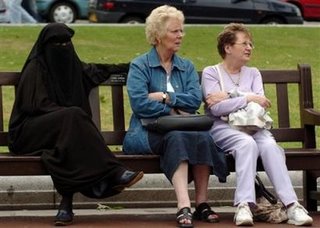
There's no accounting for taste. But personally, I find it stomach turning to see a woman in public, draped from head to toe in some black sack, and being policed by some young man, a brother say, in his sporty track suit or whatever western dress he thinks makes him cool. It makes me sick to live in a "society" that allows this. We (and it is We, all of us, who should be ruling ourselves, not deferring to PC bureaucrats and their patron-client multiculti feudalism) should tolerate no form of religion that does not tolerate the sight of women's beautiful faces or want them to know the feel of sunshine on a crisp autumn morning.

So what to make of the degrading fact that a British paper sees fit to publish a guide to de-humanizing wardrobe practices? At least now you don't have to worry about offending anyone by mistaking the difference between, say, a burqa and a niqab. From the bottom of the linked article on Jack Straw's troubles for criticizing the veil (can anyone give me a good reason why the legitimacy of forcibly - let's not pretend about most cases within the cult of submisison - veiled women is even up for debate?) here's the list of shame, with its oh so flippantly coy pomo title:
UNCOVERED: A GUIDE TO VEILS

HIJAB: Headscarf is most commonly worn in the West. It covers the head and neck but leaves the face clear.

BURQA: Most concealing of all Islamic veils with a mesh screen to see through.

AL-AMIRA: Two piece veil. Close fitting cap with a tube-like scarf.

SHAYLA: Long rectangular scarf wrapped around head and pinned.

NIQAB: Veil leaving eye area clear for an optional separate veil. Attracted Jack Straw's attention.

KHIMAR: Cape-like veil which hangs to waist. Face left clear.

CHADOR: Full body cloak with smaller headscarf worn underneath.

r.prince@mirror.co.uk
(HT: Pastorius)

Friday, October 06, 2006

New paradigm in climate change about to burst on scene?

Recent experiment suggests the real source of climate change may be in the stars, man.

And if it turns out that humans have very little to do with global warming, what might be the effect on the misanthropic victimary ideologies of our time? Could they survive the news that modern consumer man and the leading nations are not to blame? If not, we will certainly be needing a new covenant...

6024 islamic terror attacks since 9-11-2001

No doubt you have seen the buttons at many web sites pointing to the Religion of Peace site and its running tally of Islamic terror attacks. But, if you're like me, you've always wondered what is really represented by this figure and how much of it is a count of the almost daily (and often arguably more tribal than Islamic) bombings in Iraq and Afghanistan. Well, a new blogger in his first post is providing some insightful analysis of the RoP figure. And just six months ago, this guy was believing what the BBC and the Guardian were feeding him!

Thursday, October 05, 2006

Mysterious crime wave in Paris…


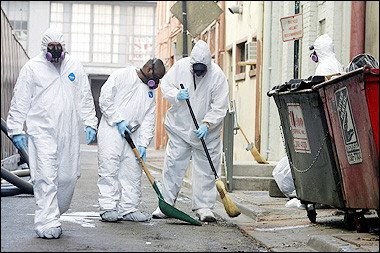
The French blog Le Salon Beige reports that there have been 130 assaults on Parisian garbage collectors so far this year.
Incredibly, french officials are coy about identifying just which parts of the city, are actually the most dangerous.
I wonder if their reticence is prompted by who might live there..?

“Since May 2005, the garbage collectors of the city of Paris have been obliged to work under police protection in one neighborhood of the XVIIIth municipal borough
["arrondissement"]…
This police accompaniment was decided following several violent incidents targeting the garbagemen, said Yves Contassot, Green adjunct to the mayor, in charge of the Environment and sanitation. Mr Contassot refused to name the neighborhood, while specifying that since the beginning of the year the city’s garbage collecting personnel have been the target of 130 “assaults” throughout Paris, ranging from “forceful insults to physical assault”, with around thirty cases from the same XVIIIth municipal borough.”

A laconic commentor at the site sums up the inevitable results of trying to wish problems away:

“In tolerating the intolerable, one accepts the unacceptable”.

I wonder if a reader with more intimate knowledge of Paris than myself, can verify what connection there might be between this northern area of Paris, and the noteworthy riots that took place there late last year?

Covenanting Continues


We meet again this Thursday in the atrium of the central branch of the Vancouver Public Library, 7-9 pm. We will be discussing how to expand and renew our mission here at the blog - how to serve and develop an audience. Please join us if you can. We wear the blue scarves and bandanas and I'll be sporting a new and improved Covenant Zone cap.

Wednesday, October 04, 2006

To be or Dhimmi?

The American Thinker has a story on dhimmitude and redemption in American publishing: a book withdrawn from publication because of fear of Muslims, followed by interest from other publishers.

WC at Infidel Bloggers Alliance tells us about a Jihadist movement to shut down anti-Islam websites. Who's their next target?

And, as Mark Steyn notes, there are many in the west who will no longer defend freedom of speech: "there’s very little difference between living under Exquisitely Refined Multicultural Sensitivity and sharia." And so, soon it will be everyone's choice to play dhimmi or fight.

Australian Prime Minister, John Howard, provides a model for those who will fight:
Howard has launched a scathing attack on Australia's left-wing intelligentsia, questioning its loyalty to the nation over the past decades.

In a speech delivered last night for the 50th anniversary of the conservative magazine Quadrant, Mr Howard said the left had a history of denigrating the nation and was now doing the same with the war in Iraq, describing Islamic terrorism as the new tyranny.

He said Australian universities were still breeding leftists and described pro-communists of decades past as “ideological barrackers for regimes of oppression opposed to Australia and its interests”

UPDATE, a fine example of multiculti oppression, via Pastorius:
Amber Mangum was a frequent reader during lunch breaks at her Prince George's County middle school, silently soaking up the adventures of Harry Potter and other tales in the spare minutes before afternoon classes. The habit was never viewed as a problem -- not, a lawsuit alleges, until the book she was reading was the Bible.

A vice principal at Dwight D. Eisenhower Middle School in Laurel last month ordered Amber, then 12, to stop reading the Bible or face punishment, according to a lawsuit filed Friday by Amber's mother. The lawsuit, filed in U.S. District Court in Greenbelt, alleges that the vice principal's actions violated the girl's civil rights... According to Mangum and the lawsuit, Rainey told Amber that reading the Bible violated school policy and that she would face discipline if she continued to do so.

Saturday, September 30, 2006

Let the world know his words

By now, you have probably heard the story of Robert Redeker, French philosophy teacher, who published an article critical of Islam and is now in hiding for his and his family's lives after numerous death threats along with internet postings of maps to his house. Once again, we see that some members of Islam will protest any slander against the eternal and uncreated truth of the Koran; they will even threaten death to those who they feel misrepresent Islam as a religion of sacrificial violence, an idolatrous cult.

Some westerners, in a hurry to avoid the finger of Islamophobia that is often pointed at them, are insisting that Redeker should have drawn some disctinction between violent Islamists and ordinary Muslims. Once again, the evident fact that there are lots of Muslims who like to live in secular western countries is used to argue that Islam cannot be criticized in general terms. But why is it that we can never escape in our debates such simple category errors? Redeker's target was clearly the Koran and Islamic insitutions, not Muslims as individual people who live and make choices in the world, much of which has nothing to do with Islam.

If the Koran is a text that promotes violence against the unbeliever, the question remains, can the west remain western and free if it allows in large numbers of Muslim immigrants, some of whom, if not the more happy and passive majority, will push for the values of Sharia law in their new lands? The likely fact that many Muslims will not got to war for Islamic institutions like Sharia is to avoid the question no one really wants to answer: for what else can institutional Islam possibly stand, today and tomorrow?

Since Redeker's article has already disappeared from Le Figaro's web site, the newspaper where it first appeared, all bloggers might consider leaving a record of his words. Canada's Judeoscope reproduces the article in French, with a misguided disclaimer that makes Redeker's attack on the Koran into an attack on all Muslims. I have found two English translations: Tiberge at Galliawatch has most of the article translated; there is also a translation by Fausta.

From Galliawatch:
Islam is trying to impose on Europe its rules: special hours at swimming pools just for women, no caricature allowed of this religion, dietary requirements in cafeterias especially for children, a fight to allow the wearing of veils in schools, accusations of Islamophobia against free thinkers...

As before with communism, the West is under ideological surveillance. Islam presents itself to the Western world, as did the now defunct communism, as an alternative to the Western world. Like communism before it, Islam conquers minds and hearts by playing upon a sensitive point. It boasts of having a legitimacy that troubles the conscience of the West: it is the voice of the poor people of the planet. Yesterday, the voices of the poor claimed to come from Moscow, today they are coming from Mecca! Today, once again, the intellectuals are the watchful eye of the Koran, as they were the watchful eye of Moscow. Today they excommunicate for Islamophobia, as yesterday for anti-communism.
[...]
The Koran is a book of unheard-of violence. In the Encyclopédia Universalis, Maxime Rodinson utters some truths that are as important as they are taboo in France. First, "Mohammed displayed in Medina unsuspected qualities as a political leader and military chief (...) He turned to private war, a common institution in Arabia (...) Mohammed soon sent small groups of his followers to attack caravans from Mecca, thus punishing his infidel compatriots and at the same time, acquiring rich spoils."

Secondly, "Mohammed, flush with victory, eliminated from Medina by having them massacred the last remaining Jewish tribe, the Qurayza, whom he accused of suspicious behavior." Finally, "after the death of Khadidja, he married Sawda, a widow and a good house-keeper, and also little Aisha who was barely ten years old. His erotic tendencies, long suppressed, were to lead him into ten concurrent marriages."

Exaltation of violence: merciless war chief, pillager, killer of Jews, polygamous, such is the Mohammed that is revealed through the Koran.
[...]
Continuing, from Fausta's translation:
True, the Catholic Church is not free from reproach. Its history is strewn with black pages, of which it has repented. The Inquisition, witch hunting, the execution of the philosophers Bruno and Vanini, the poor-minded epicureans who in the middle of the eighteenth century were tried for impiety, do not plead in its favor. But what differentiates Christianity from Islam appears: it is always possible to turn to evangelic values, the soft person of Jesus against the drifts of the Church.

None of the faults of the Church are rooted in the Gospel. Jesus is non-violent. The return to Jesus is a recourse against the excesses of the institution connected with the church. The recourse to Muhammed, on the contrary, reinforces hatred and violence. Jesus is a Master of love, Muhammed a Master of hatred.

The stoning of Satan, annually in Mecca, is not a mere superstitious phenomenon. It doesn't only show a hysterical crowd flirting with cruelty. Its rage is anthropological. Here is indeed a rite, to which each Moslem is invited to subject, registering violence like a duty crowned in the heart of belief.

This stoning, where annually some of the faithful - at times hundreds - die from being trampled on, is a ritual which breeds ancient violence.

Instead of eliminating this ancient violence, by imitating Judaism and Christianity, by neutralizing it (Judaism starts with the rejection of human sacrifice, i.e. by which it enters into civilization, Christianity transforms the sacrifice into Eucharist), Islam builds a nest for it, where it will grow from the heat. While Judaism and Christianity are religions whose rites delegitimize violence, Islam is a religion whose very own sacred texts, as banal as some of its rites may be, exalts violence and hatred.

Hatred and violence live in the book in which any Moslem is educated, the Koran. As in the times of the Cold War, violence and intimidation are the means used by an ideology with hegemonic vocation, Islam, to throw its lead cover on the world. Benedict XVI suffers from this cruel experiment. In these our times it is necessary to call the West "the free world" compared to the Moslem world, and in these times the enemies of this "free world", dedicated civil servants of the Koran, swarm in its centre.
What Redeker fails to distinguish, in my view, is the fact that Islam has learned something from the Hebrew faith - it is something of an anti-idolatrous religion that, by outlawing contests over the image of God, goes some way in protecting the peace among those within the fold. But clearly, the Koran does indeed draw a fundamental distinction - on almost every page - between believers and unbelievers. Islam, to the degree it follows the Koran, keeps whatever peace it keeps among the believers by relentlessly scapegoating the non-believers and blaming them for all troubles. It has the utopian idea that if all the world were Islamic, there would be some kind of perpetual peace among men. This, clearly, is at odds with the inherently conflictual basis of human nature that makes religion necessary in the first place; and so Islam, like Christianity and Judaism to some (now much lesser) extent, often indulges in dangerous millennial and apocalyptic imagery to avoid coming to terms with the fact that religion can never banish conflict from this world. Furthermore, Islam, in relentlessly targetting the unbeliever and never taking the blame for its worldly woes for itself, does not make it clear that it is man, not God, who wills this conflict.

And for pointing so much out, what is Redeker's fate? Well, it is a punishment entirely consistent with a utopian Muslim point of view, if not with that of a modrn westerner who can't get his head around the fact that you can face a death sentence for saying that Islam is violent. As Redeker says in a letter to Andre Glucksmann (via Tiberge):
Dear André,

Hello.

I am now in a personal situation that is catastrophic. Numerous explicit death threats have been sent to me, and I have been condemned to death by organizations that are offshoots of Al-Qaïda. L'UCLAT and the DST (2) are on the case, but...I am no longer entitled to live in my own house (the websites that have condemned me show a map with instructions on how to get to my house to kill me, there is a my photo, a photo of my workplace, phone numbers, and the statement of condemnation). But at the same time they do not provide me with a lodging, and I'm forced to ask others for help, two nights in one place, two nights somewhere else...I am under permanent police protection. I must cancel all my classes. And the authorities are forcing me to give up my home. I'm a homeless person. An insane financial situation is the result: I must pay all the expenses, including any future rent for one month or two, someplace far from here, the cost of moving twice, the legal expenses, etc...This is quite sad. I asserted my constitutional rights and I am being punished for it, on the very territory of the French Republic. This affair is also an attack against national sovereignty: foreign laws, created by criminal fanatics, are punishing me for having exercised a French constitutional right, and I am suffering, right here in France, a terrible wrong.
According to Tiberge, there is now a large mobilization of support in France for Redeker, except on the far left and in the government offices:
Let us point out also the dhimmitude of Education Minister Gilles de Robien, who, instead of defending the teacher and freedom of expression, drives the nail in deeper by saying: "A functionary must display prudence and moderation in all circumstances."

These events will reveal who is bowing before the fatwas of MRAP and Al Qaïda, and who dares defend the values of the Republic. The French people will learn a political lesson!

Thursday, September 28, 2006

Make your choice, Vancouver


And then there is us. We are contributing our thoughts to building a new covenant for Canadian nationhood, Thursdays, 7-9pm, atrium of the main branch of the Vancouver Public Library (at least for now, until further notice) - look for the blue scarves and bandanas.

Monday, September 25, 2006

Which is the bigger joke? The jihad for the eternal, uncreated, and singular truth? or multiculturalism policies - Canada's gift to the world?

News from Londonistan is sometimes so strange it seems that the ideology of multiculturalism is going all out to reveal its incompatibility with responsible representative government, or democratic self rule, and with true respect for the human unity that is the basis of all real and meaningful diversity:
POLICE have agreed to consult a panel of Muslim leaders before mounting counter-terrorist raids or arrests. Members of the panel will offer their assessment of whether information police have on a suspect is too flimsy and will also consider the consequences on community relations of a raid.

Members will be security vetted and will have to promise not to reveal any intelligence they are shown. They will not have to sign the Official Secrets Act.
So the Brits are going to tie up their police with enforced consultations with an anti-police, anti-government, anti-American, Judeophobic, pro-Iranian nuke, group and any police actions which do not meet with the Muslim watchdogs' pleasure will now presumably be officially sanctioned as victimizing the Ummah.

When governments bring such non-elected advisors/critics into consultations not only on policies, but on day-to-day policing with all its needs for timely action and control of information, we are surely seeing a prime example of how multiculturalism assumes that the various members of a nation are not fit to govern themselves. Just as the supposedly independent (from political interference) police are here implied to be incapable of governing themselves, of maintaining their own professional standards, practices, and public consultations without need of suspicious and politicized watchdogs, multiculturalism policy assumes that the disparate members of a nation do not have sufficient common interests or any unifying principles that can serve as a rational basis for governing themselves. Instead of a country in which, say, a Muslim or a Christian, a person of Xinjiangese or Basque ancestry, can aspire to the virtue of going into the public sphere and making representations that could appeal to many disparate members of his nation, the ideology of multiculturalism assumes we can only speak for our own, however defined.

What this assumption must leave unanswered is the overall basis or reason for the decisions made by the high officials of state who co-ordinate the various interest groups over which the government - which becomes an imperial hierarchy riding the winds of power - rules. Democracy requires a common purpose or reason that is the basis for the people ruling themselves through their representatives. And staying alive by keeping the system and the diversity it fosters from being ripped apart into competing, warring, camps is ultimately at the root of such common purpose or reason.

But there is no accessible rationality behind the present multicultural order in full pomp; there are only attempts to obscure the fact that a liberal order, trying to serve all the conflicting desires that it pretends to have room for, and without deferring to any unifying principles or respect for a nation's foundational events that give it a particular history of self-representation, will sooner or later fall into a tyranny of high officials negotiating differences in back rooms, without the possibility of publicly accounting for the rationality of such negotiations other than in terms of deferring to competing interests and powers.

Such a "nation" might become a place, say, where police cannot protect against terrorism, from risk of offending those with a right to restrain their investigations. Or it might become a place where dhimmi police trade their powers to Muslim leaders in return for the promise that the latter will control violent trouble makers under some kind of imperial millet system.

On the other hand, maybe it is only when all see multiculturalism reveal itself for the arational and potentially tyrannical system it is, that we will be able to see clearly that the emperor has no clothes. What fun then to read:
COLUMBUS, Ohio — A car dealership's planned radio advertisement that declared "a jihad on the automotive market" has drawn sharp criticism for its content but will not be changed, the business said Saturday.

Several stations rejected the Dennis Mitsubishi spot, which says sales representatives wearing"burqas"_ head-to-toe traditional dress for Islamic women _ will sell vehicles that can"comfortably seat 12 jihadists in the back."

"Our prices are lower than the evildoers'every day. Just ask the pope!"the ad says."Friday is fatwa Friday, with free rubber swords for the kiddies."A fatwa is a religious edict.

Dealership president Keith Dennis said the ad does not disrespect any religion or culture. He said it was"fair game"to poke"a little fun at radical extremists."

"It was our intention to craft something around some of the buzzwords of the day and give everyone a good chuckle and be a little bit of a tension reliever,"he said.

The Columbus chapter of the Council on American-Islamic Relations decried the ad as disrespectful.

Saturday, September 09, 2006

"the going gets tough" for India

"When the going gets tough, the tough get going", was a saying my mom drilled into me as a kid, to make sure I would learn that how I reacted to a problem was going to reveal much about my character.
For some reason, this childhood lesson came to mind as I read this morning of the terrible series of explosions that have occured in Malegaon, India today:

At least 37 people were killed and over 100 injured in Malegaon on Friday as explosions rocked the scene of a Muslim congregation in the powerloom town in north Maharashtra.
The blasts occurred around 1.55 pm — within minutes of each other — after Friday namaaz as the crowd made its way out of a mosque called Rehmani Masjid and a nearby cemetery referred to as the Bada Kabrastan. ....
The casualties included a number of beggars who had lined the streets seeking zakat (alms), which is distributed on the occasion of Shab-e-baraat.

[Compare what happened next to how the United States, and the citizens of New York City, reacted on the morning of September 11, 2001.]

Soon afterwards, mobs went on the rampage through the town which has a history of communal violence, pelting stones and shouting slogans to protest against the incident. Curfew was immediately clamped and the police rushed reinforcements to secure the area.

It seems that the police will be hampered in their investigation of the bombings, by local tensions within the muslim community:

The "secular" parties may have made things more difficult for the law-enforcing agencies in Malegaon.
Malegaon witnessed a bitter electoral battle during the 2004 Assembly polls as six-time MLA Janata Dal (Secular) leader Nihal Ahmed faced off with Congress contender Sheikh Rashid. Rashid pulled out all stops to defeat the socialist veteran, dividing the Muslims like never before. And the bitterness, for all appearances, still lingers.
There was so much of bad blood in the campaign that elders wondered if the tussle was worth it. Rashid accused Ahmed of playing the communal card and supporting Osama Bin Laden. Ahmed refuted the charge and accused Rashid of using unfair electoral practices. The divided Muslim community is now one of the main problems that police face, say officials.
"If we talk to Rashid, the Ahmed camp gets upset with us and vice-versa. It has become virtually impossible to bring about a consensus among local Muslims, many of whom are migrants from UP [the northern state of Uttar Pradesh]. The other problem is that a section of Muslim youth, fed up with the slanging match between Rashid and Ahmed, is increasingly turning towards organisations like the SIMI [Student Islamic Movement of India] ...

The first suspects that authorities have placed on their list of possibilities, are the Bajrang Dal, whose main slogan, according to Wikipedia, is
..."Seva Suraksha Sanskar", or "service, safety, and culture". An integral part of its agenda is preventing the killing of cows. ...
It has also vowed to protect India's Hindu identity, from the dangers of Muslim population growth, Christian conversions, and antinational communists.

Like a certain peaceful religion we hear a lot about, the members of Bajrang Dal are somewhat flexible in their definition of "protection":

The Bajrang Dal is known to have followed a similar pattern in blasts at Parbhani’s Mohammadi Masjid and mosques at Pona and Jalna earlier this year.
"We are probing this angle, though it is too early to hold any group responsible," DGP P S Pasricha said on Friday.
Another theory doing the rounds is that a Jaish-e-Mohammad module could have engineered Friday’s blasts to create communal trouble.
...
Intelligence agencies suspect that the Malegaon blasts were aimed at provoking communal tension as terrorists could not foment trouble during the recently concluded Ganapati festival.
A senior official from one of the central agencies in Pune said similar, subversive acts had been planned during the 10-day Ganapati festival.
However, tight security measures prevented any untoward incident. "There was no specific intelligence input on Malegaon," the official said.
"The motive seems not only to kill people, but also create panic and communal tension in the already sensitive Malegaon," he said, explaining that after failing to cause damage during the Ganesh festival, Malegaon could have been seen as a soft target.

As we approach The Date of another September 11th, it is hoped that citizens of the west will undertake a thorough reflection on our collective and individual reactions to that event. What light has the past five years revealed about our reactions; have we done what we should have, has it been the right response... as tempting as it may be to think in leftist utopian terms of absolute solutions and absolute failures, have we done the most we could have done under the circumstances, should we have gotten more tough; what is to be a dignified definition of "getting tough" in our response to islamic barbarity?
Incidents like this bombing in Malegaon, if indeed undertaken in retaliation for the recent Mumbai train bombings, are a useful reminder that eye for an eye justice is not always the dignified path, that adopting a long-term view (seeing beyond our own life being one of the characteristics that elevates humans above animals) involves measuring more than just material details, it must also include measuring things unseen: one's sense of humanity, one's sense of civility, one's ability to rise about the natural, animal-like tit for tat and embrace one's sense of responsibility to struggle to live with honor. Where is the honor in blowing up beggars? Where is the civility in killing every single muslim, wouldn't that just make us like the fundamentalist wahabbis and their fanatical shia cousins, who think in precisely the same inhumane terms?

If ultimately we are to be judged by how we handle adversity, reactions being the most revealing x-ray of one's inner character, then the judeo-christian heritage animating western civilization exhorts us to renew our ability to measure solutions to the tough choices we continue to face.
Our challenge today remains the same as on the afternoon of September 11: how to find the civilized middle ground between the extreme temptations to become either as barbaric as the jihadis or as suicidal as the left's ongoing determination to remain grazing sheep waiting to be fleeced.
Between the painfully clear extremes of killing everyone and killing no one lies a half-seen shifting ground that will be so tough to recognize, we will need the participation of as many penetrating judgments as possible to adjudicate a tough solution worthy of a human being.

Thursday, September 07, 2006

Covenanting Every Thursday

We meet in the atrium of the main branch of the Vancouver Public Library, 7-9pm, and discuss the renewal of nationhood and the defense of human rights against all evils, including those quietly ignored by the reigning ideology of White Guilt. This victimary ideology of our elites finds ways to excuse the resentful violence of those it considers outsiders and victims of western culture. We do not. We defend those western values that are essential to the progress of freedom around the world, and of self-rule at home. To rule ourseves we need to learn again how to combine individual integrity, the right to own our own lives, with a sense of belonging to a coherent, bounded, constitutional, moral, and rational political community from which a national identity, simultaneously particular and universal, can flourish. We wish to foster social and cultural networks to promote our belief that the renewed national identities will be best represented in the hands and minds of ordinary capable individuals, not cultural or institutional elites. In solidarity with the patriots in France reclaiming their nation from the gnostic empire of the left and its imperial anti-nationalism, we wear blue scarves and bandanas - if you can, please join us at the tables in front of Blenz Coffee, this or any Thursday.

Tuesday, September 05, 2006

Fear of the Sacred

A Hasidic Jew was recently forced to leave an Air Canada flight from Montreal to New York because his praying scared fellow passengers:
The airplane was heading toward the runway at the Pierre Elliott Trudeau International Airport when eyewitnesses said the Orthodox man began to pray.

"He was clearly a Hasidic Jew," said Yves Faguy, a passenger seated nearby. "He had some sort of cover over his head. He was reading from a book.

"He wasn't exactly praying out loud but he was lurching back and forth," Faguy added.

The action didn't seem to bother anyone, Faguy said, but a flight attendant approached the man and told him his praying was making other passengers nervous.

"The attendant actually recognized out loud that he wasn't a Muslim and that she was sorry for the situation but they had to ask him to leave," Faguy said.

The man, who spoke neither English nor French, was escorted off the airplane.

Air Canada Jazz termed the situation "delicate," but says it received more than one complaint about the man's behaviour.

The crew had to act in the interest of the majority of passengers, said Jazz spokeswoman Manon Stewart.

"The passenger did not speak English or French, so we really had no choice but to return to the gate to secure a translator," she said.

The airline is not saying if the man was told he was not allowed to pray, but a spokesperson said the man was back on board the next flight to New York.
Now ask yourself, why would anyone be scared of a Hasidic Jew praying on a flight to New York City? Surely there are few more unlikely sources of terrorism. So, unless we wish to believe that the passengers or crew supposed, with no evident reason, that the lastest ploy of Al Qaeda may be to disguise themselves as pious Hasidim, we have to assume that this is a case of simple fear of unfamiliar signs of religious piety (and perhaps some queer, MSM-influenced misconceptions about orthodox Jews and violence).

And this, I think, is an interesting but disquieting sign of our cultural weakness. For on the one hand it shows that the people involved vaguely recognize, and fear, the power of the sacred over human minds; and yet, on the other hand, it suggests that these same people have little interest in the sacred and no idea what Hasidic Judaism is about. Indeed, we can confidently guess that only people who don't take prayer seriously - in the sense that they don't seriously practice it - would raise objections to a Jewish man praying. Such people would assume that pious, semi-public prayer is a sign of an unstable mind, and while they recognize its power, it may not be for the good.

In other words, if and when this type of person is indeed challenged by people motivated by the power of the sacred, people who see the secular North American as weak and decadent, the under-educated, secular-Gnostic, North Americans are going to run screaming if they can't find authority figures to complain to first. They are not going to be able to feel confident and very superior to the other. Sure they will think the other is crazy, but they will not have the courage to face him down in a fight. They will not be able to say "our faith is superior to yours", because they will only fear the power of faith and not be able to embrace it.

This kind of North American is simply buying time. They know the religious crazies are coming, but like the Spanish voters who responded to the train bombings by voting out a government that was willing to fight Islamic terror, they just want to do whatever it takes to avoid, but not face or understand, the supposed danger, and to keep the jet-settting and partying going for as long as they can, until the fearful power of the sacred triumphs in its return to the scene...

We need to learn again how to promote good faith, and so also an understanding of the sacred, that is suited to our times and needs.

Meanwhile, Concordia University continues to fear Jewish speakers.

While we work on bigger posts...

Here's a thought teaser to keep you anticipating the arrival of the next Covenant Zone posting - whose post will it be? Dag's, Charles's, John's?
NORWICH (Reuters) - Many people have experienced the phenomenon of receiving a telephone call from someone shortly after thinking about them -- now a scientist says he has proof of what he calls telephone telepathy.

Rupert Sheldrake, whose research is funded by the respected Trinity College, Cambridge, said on Tuesday he had conducted experiments that proved that such precognition existed for telephone calls and even e-mails.

Each person in the trials was asked to give researchers names and phone numbers of four relatives or friends. These were then called at random and told to ring the subject who had to identify the caller before answering the phone.

"The hit rate was 45 percent, well above the 25 percent you would have expected," he told the annual meeting of the British Association for the Advancement of Science. "The odds against this being a chance effect are 1,000 billion to one."

He said he found the same result with people being asked to name one of four people sending them an e-mail before it had landed.

However, his sample was small on both trials -- just 63 people for the controlled telephone experiment and 50 for the email -- and only four subjects were actually filmed in the phone study and five in the email, prompting some scepticism.

Undeterred, Sheldrake -- who believes in the interconnectedness of all minds within a social grouping -- said that he was extending his experiments to see if the phenomenon also worked for mobile phone text messages.
Of course, how can you even trust an article from Reuters? Nonetheless, I might note that I have this kind of experience not infrequently - thinking of someone and then meeting them on the street, or receiving their call, or being told when I call that "I was just thinking of you..." but I've never been sure if these seemingly coincidental occurrences happen more than, statistically, they should.