Monday, August 30, 2010

Jumping Jehosaphat - Sockeyes as far as the eye can see


When I last wrote about British Columbia's love and fascination with the mystery of the salmon, this year's returning Sockeyes were but small fry yearlings. How they would this year "know" to return from far out in the North Pacific to the specific creek or stream of their birth, no one knows.

This summer, the great mystery of Creation again reveals itself. After many years with bad news of declining salmon returns, we are blessed with the largest run of Sockeye on the Fraser River in a hundred years. I believe the current estimate is a return of 30 million Sockeye.

I was down by the river on Saturday in the early evening and took the following video, just a little west of Finn Slough. The video may not entirely capture the awe and gratitude I felt as I stood on the bank and watched salmon jumping all over the place. There were moments when I could see three or four salmon jumping almost simultaneously, and stretches of seconds when it seemed one was jumping every second in front of me. But this minute of video was a pretty average minute, and you can have a sense, considering the camera's limited angle of vision (a tiny stretch and moment of a large river), how many fish were hopping.

Tuesday, August 24, 2010

Monday, August 23, 2010

The limits of Darwinian evolution

"Don Lightband", the gay troubador of the Generative Anthropology list writes (in respect of this article: Orang-utans are not remotely like humans | spiked), "Norwegian babe admits herself to the ranks of the Unfooled, seemingly w/out any anthropological assistance!"

Helene Guldberg seems to have endeared herself to Lightband with lines like:
Time and again, we are told that humans are not that special after all: abilities previously thought to be uniquely human are now purportedly evident amongst the great apes. The most recent claim, published in the current issue of the Royal Society journal Biology Letters, is that orang-utans use mime to make themselves understood.
[...]
Ape communications are incomparable with human language. We debate and discuss ideas, construct arguments – drawing on past experiences and imagining future possibilities – in order to change the opinions of others. We pantomime. We create everything from great literature to nursery rhymes that help us make sense of the human condition, and we can pass this on down the generations: some nursery rhymes have survived centuries. We can communicate an infinite number of meanings and develop an infinite number of arguments. We can debate and discuss everything from international politics and economics to the most mundane issues.

I cannot see even the remotest comparison between the beauty, power and complexity of human language and an ape wiping its forehead with a leaf and passing it to another being.
Now Mr. Lightband alleges a lack of anthropology here, because Ms. Guldberg argues for the distinctively human without any apparent hypothesis of what has made the human distinct. Nonetheless, obviously we all have anthropological insights in degrees; we all depend on developing our human self-understanding better to survive the risks and threats we pose each other. And so it would be interesting to speculate just why, at this point in history, there seem to be a number of scientists, as Guldberg reports, breaking with the deeply human tendency to anthropomorphize our animal cousins (a tendency which has wrecked countless "scientific" studies that appeal to specifically human common-sense to explain animal behaviours); and also, by implication, though Guldberg does not spell it out, we seem to be witnessing a time when some scientists are grappling with the over-use of Darwininan-evolutionary explanations, for if human language is something quite distinct from anything our ape cousins practise among themselves (they may well learn human language, in some degree, when interacting with us), then the emergence of human language was quite likely an event that cannot be explained simply by assuming some kind of quiet, "natural" evolution of ape to human. Rather, the creation of the human must have been a distinctive break in biological-evolutionary "time", the creation of a specifically-human kind of time and cultural evolution. This is the hypothesis of Generative Anthropology.

I would begin my speculation on why we now witness this scientific trend away from assuming some close proximity in ape/animal and human "cultures" by suggesting that the recurring human desire to assimilate the human to the natural world has been exacerbated by the phenomena of the post-World War II "white" guilt that has wracked the Western world. To the practitioners of white guilt, our domineering relationships to the non-human "environment" have become, along with our relationships to various human Others, signs of wrongful oppression and arrogance that must be countered by claims that we are not distinctive and must not see ourselve morally apart from the natural order, but rather in all respects indebted to it, such that we have no business posing any "threats" to its well being. In such thinking, the idea that we are quite different from apes is taken to be a mark of arrogance. In contrast, the notion that it is rather the attribution of human traits to the animal and natural worlds (e.g. calling it "Gaia") that is the mark of human arrogance has not been taken seriously by many in recent years.

But maybe we are now seeing signs of serious opposition of the extension of the signs of post-war White Guilt into the natural sciences. If so, it will require interest in new hypotheses of what is specifically human, in short the project of a Generative Anthropology.

Tuesday, August 03, 2010

Back From Ottawa

Inspiring and perspiring; my entwined memories of hanging out in our hot nation's capital during the first real summer vacation I've gotten in the last ten years.
The real purpose behind the visit was to see my ailing father one more time, to give thanks for him having been the dad he's been to us, while I could still deliver such appreciation in person.

Long before his eventual retirement, we used to visit Ottawa on rare father-and-son Saturday trips by train from nearby Quebec. An unplanned ritual emerged: starting with his repeating the workings of the Rideau Canal for the slow-to-learn child who walked at his side, followed by coaching on the function of the majestic buildings greeting us on Parliament Hill, inevitably ending up with being treated to a book at the War Museum gift shop before taking the train back home.
A patient teacher, a thoughtful guide, a proud immigrant, he made each visit a stirring occasion for his oldest son.
These are now my memories more than his, it seems, our private talks revealing that such details have largely faded in the sunset of age and illness. Now it's become my turn to be patient, to be thoughtful...
And to be proud.

Sunday, August 01, 2010

Los perdidos, los olividados, y los muertos

Murder (al)most foul.

Just across the Mexican border into the city of Ciudad Juarez there is a war going on that's taking the lives of thousands of people, most of whom will be buried without ceremony or memorial. They are the lost, the forgotten, the dead. I don't know them, and they ain't no friends of mine. I don't care. Most of the dead seem to deserve whatever horrible fate they meet. But....

http://nodhimmitude.blogspot.com/2010/08/los-perdidos-los-olividados-los-muertos.html

Wednesday, July 14, 2010

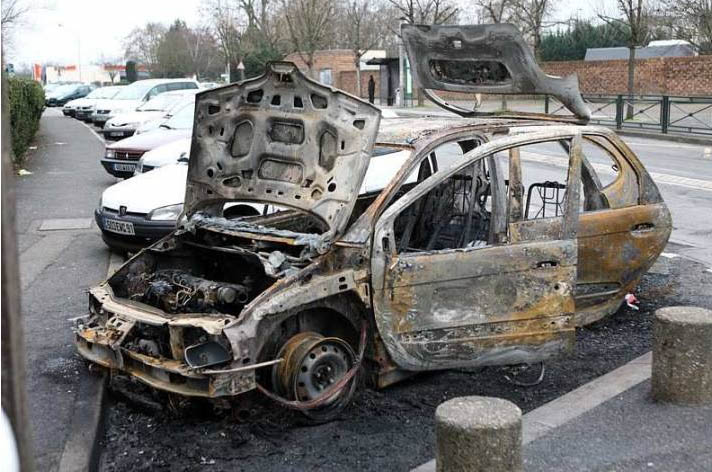
French Minister: "We Won't Tell You How Many Cars Get Burned Tonight"

France celebrates Bastille Day today.

Some French celebrants will honor their FĂȘte Nationale by attending veterans parades and fireworks displays.
Others tend to pursue less noble traditions: 35,000 extra police are being mobilized throughout the country in the hopes of subduing France's notorious generation of uncivilized youth, a show of force to prevent the expected spike in the number of nightly car burnings which, sadly, now haunts the annual French holiday.

Trouble has already begun: the night of July 13th, the eve of the national holiday, the police brought charges against 306 arrested young arsonists and thugs, compared to 190 at this time the year before.

One statistic, however, will apparently escape us this year, according to Brice Hortefeux, France's Minister of the Interior: he officially declared today that there will be no official figures released on the number of cars set ablaze throughout the country on France's Bastille Day:

"[...] no numbers for burned cars will be released for the nights of July 13 and 14, in order to put an end to this unhealthy tradition which promotes, every year at this same time, these criminal acts."

"Instructions have been issued to police headquarters so that they too will not release the number of cars burned in their départements. Hereafter, only annual reports will be made public."
French commentors cynically recommend that the French government adopt this approach to reporting on unemployment statistics and health figures as well, if hiding from the truth can prove such an effective remedy for dealing with their beleaguered nation's social nightmare.

[A tip of the Phrygian cap to the French blog Le Salon Beige]

One of the more pleasant results that has come from years of blogging about this unpleasant mess in France, has been the many inspiring emails, heartening comments (and even face-to-face meetings) we have received from our French readers in France. It's easy to lose sight of the full scope of the truth that there is such a thing as a French Heartland, there are many good and decent people there deserving of support, encouragement and appreciation... deserving a respite from the incessant French-bashing that North American blogs tend to engage in.

We read that the Lord was willing to spare Sodom and Gomorrah if there could be found as few as 50 good people there; well, there's a much higher number than that in France today, so why not put aside the inevitable English-French fraternal spite, and on this day more than most, continue to pray for those within this overwhelmed minority, determined to love family, honor honest labor and engage in social civility despite the surrounding amorality that attempts to seduce them from these values; to pray that they may withstand the folly of their confreres; and that their steadfastness in the face of so much adversity may one day result in a renewal of national spirit, leading to the emergence of a nation more worthy of them.

Tuesday, July 13, 2010

Time for a moderate immigration policy?

Jihadi bloodshed has become so commonplace, it seems to me one is hearing relatively little in the media about the latest murderous atrocity:
74 Killed In Uganda By Al-Shabab

Canadians, however, should take serious note and start making demands for more pro-active policies from our politicians:
From teens to terrorists: How Al-Shabab recruits Western 'martyrs' (HT: Odehad)
Somalia's struggles play out in Canada

And more

Sunday, July 11, 2010

Waiting for Achilles Godot

Erasmus somehow saved a fragment from Aeschyus' Mymidones, a play now lost that deals with Achilles' bodyguards in the war against Troy, known to us as Turkey, a few lines from a Libyan saying about an eagle seeing itself impaled by an arrow:

"Thus not by others, but with our own feathers/ are we undone."

Aeschylus, The Myrmidones.


It's a mad, mad, Mad magazine world. What? Me worry? The only problem is Christians and other rightwing bigots, the racists, the conservatives, the pick your imaginary villain. The problem is whatever is not the problem. That settles it. Everything else is fine and improving. Thank the gods for the government. This is the best in the best of all possible worlds and the government is making everything better. Jihad? It's a spiritual striving, only turned against Western Arrogance when we deserve to be punished for past transgressions, slavery and the CIA over-throw of the Iranian Communists in the 1950s, and so on. If there are any problems in the world, then we are responsible for them, and if we are nicer people, we can change all that so everyone loves us. Jihad? What? Me worry?

"Normalcy bias."
The normalcy bias refers to an extreme mental state people enter when facing a disaster. It causes people to underestimate both the possibility of a disaster occurring and its possible effects. This often results in situations where people fail to adequately prepare for a disaster, and on a larger scale, the failure of the government to include the populace in its disaster preparations. The assumption that is made in the case of the normalcy bias is that since a disaster never has occurred that it never will occur. It also results in the inability of people to cope with a disaster once it occurs. People with a normalcy bias have difficulties reacting to something they have not experienced before. People also tend to interpret warnings in the most optimistic way possible, seizing on any ambiguities to infer a less serious situation.[1]
http://en.wikipedia.org/wiki/Normalcy_bias

Glazov interviews some folks below to see if there is a Muslim/World problem we aren't facing honestly. I think "Normalcy bias." O.K., I think that when I'm on a date. Maybe I worry too much. But what if Geert Wilders is right, that Islam is a serious danger to the world as a place of freedom and safety and relative affluence? What if our intelligentsia comprises fools who are dangerous to us as individuals and nations?

Jamie Glazov, "Symposium: The Fear that Wilders is Right," Front Page Magazine. 9 July 2010

FP: Roger Simon, Robert Spencer and Kevin Levin, welcome to Frontpage Symposium.

Today we witness the blatant desperation in our culture and media for a “moderate Islam” — an Islam that many non-Muslims vehemently insist exists, but that mysteriously eludes them. This moderate Islam will make everything better, we are told, once the “extremists,” who are the “minority” in Islam, will be sedated. This sedation will be most easily achieved, the argument continues, when the Islamophobes stop blaming Islam after Islamic terrorists point to Islamic scriptures in explaining what inspired them to perpetrate their terrorist attacks.

Meanwhile, in terms of the planet that we happen to be occupying, a “moderate Islam” is nowhere to be found; no school of Islamic jurisprudence exists that counsels Muslims to renounce the Qur’an’s teachings on Islamic supremacism and the obligation of violent jihad. And yet, to suggest the truth of this reality in our culture gets one only the accusation of being a racist and an “Islamophobe.”

Roger Simon, let me begin with you. What do you think of this phenomenon? You recently wrote a profound piece at Pajamas that touched on one of its crucial foundations. In analyzing why the likes of Glenn Beck and Charles Krauthammer have attacked Geert Wilders, you interpreted that these conservative individuals, from whom we might have expected something different on this score, are, what it all comes down to it, rejecting Wilders because they are afraid that he might be right....

Simon: [...]

Islam is an almost unsolvable conundrum. How do you deal with a religion with a billion adherents that is expansionist in ideology and threatens to kill its apostates? How do you get a reformation of that religion when its holy book, from which those dictums come, is reputed to be dictated verbatim by God and is therefore immutable? Talk about “inconvenient truths,” these are about as inconvenient as they get. No wonder they are buried from the discussion and ignored. We in the West live in a society that cannot even begin to wrap its mind around that. I know – it’s hard for me.

So where does that leave Wilders? I believe that consciously or unconsciously those who brand him as excessive, or even racist, are living in fear that he may be right. They have to hate Wilders, because if he is correct, their whole world disintegrates. Who would want that?

He and the small group like him have therefore morphed into our clearest contemporary examples of those poor Greek messengers to be killed for bringing the bad news. A salient recent example is Nicholas Kristof’s unhinged attack on Ayaan Hirsi Ali in the New York Times Book Review – a supposed liberal going off on a woman who had a cliterodectomy for daring to dwell on how women were oppressed in the Islamic world. It’s almost pathological. Another recent example are the similarly unhinged attacks on Israel over the Gaza flotilla incident while completely ignoring vastly more horrific acts occurring in the Muslim world on an almost daily basis. We dare not insult them lest they go mad.

It’s almost as if the world has become a giant dysfunctional family, enabling their huge Muslim branch to remain besotted – or drugged out – on sub-Medieval ideology. And the situation is getting worse. The principle bastion of hope of reformation of the Islamic world – Turkey – made its turn back toward fundamentalism years ago now.

So again, where does that leave Wilders? One lonely canary. We have to support him, but I’m not optimistic. I hope my colleagues are.

FP: Thank you Roger Simon.

Kenneth Levin your thoughts? A species of the Oslo syndrome is involved in this phenomenon right?

Levin: I do see a form of the Oslo Syndrome operating here. [...]

The perpetrators of 9/11 and their myriad supporters quickly made clear their objective of imposing their Islamist rule worldwide and their comprehension of doing so as a religious duty. Yet many in America sought, and continue to seek, to recast the threat, to rationalize it, and to urge policies aimed at appeasing Islamist leaders and followers in the delusional hope of thereby extricating the nation from the dangers it faces.

Geert Wilders argues that Islamofascism derives directly from Islamic teachings, including Koranic exhortations. His movie, Fitna, advancing this argument, is unimpeachable in its citations of Islamic scripture and in its images of Islamofascism on the march. That those who oppose him are motivated in large part by a wish to appease the purveyors of the Islamist threat is indicated by the fact that the negative responses to Wilders have focused not on rebutting his arguments but on demonizing him and using anti-democratic means to silence him. As Roger Simon suggests, they are compelled to hate Wilders because they so want to cling to their delusional denial of the threat.

The ugly, perverse, self-destructive nature of the assault on Wilders, and the necessity to defend him, have been articulated by many. ...

Beyond the unconscionable attempts to silence Wilders, there are other indications, both in Europe and America, that the hostility directed against him is motivated primarily by a wish to deny the threats we face and to appease its agents. Thus, in both Europe and the U.S., we have a huge chorus of officials insisting Islam is a religion of peace, They insist that Islamist forces pursuing a war of world conquest have “hijacked” the religion and that the vast majority of Muslims are peace-loving and tolerant. Yet these same officials give virtually no public support to those - too few - Muslims within their nations who at once declare themselves to be believing Muslims and do speak out forcefully against Islamofascism. On the contrary, such people are typically ignored and government outreach is almost invariably directed to individuals and groups linked to Islamist, hatred-promoting agendas.

[....]

One can argue there is often a more venal motive behind this phenomenon. Saudi Arabia is the prime financier of Muslim extremism in the U.S., including of education in bigotry – particularly anti-Jewish and anti-Christian bigotry - in U.S. mosques and Islamic schools, and Saudi Arabia is pandered to because of its oil wealth and its readiness to use its prodigious financial resources to win official tolerance of its intolerant message. But if officials and others looked honestly at the existential threats we face from Islamofascism, the likelihood is they would be less inclined to politics as usual and to being swayed against defensive measures by Saudi blandishments. The impact of the Saudi role is a reflection of widespread official averting of eyes from the nature of the threat.

One can also argue that much of the Western accommodationist reaction to the Islamist threat, and desire to silence Wilders’ message, are a product of Western leftist orthodoxy. The combination of hostility towards the West, moral relativism, and boosterism regarding virtually anything non-Western or anti-Western – all seminal doctrines of the contemporary leftist catechism – inevitably leads to denial of, or excuses for, or even defense of, the Islamist challenge.

But even among those whose ideological allegiances weigh against looking honestly at the nature of the threat, there were many individuals who responded to 9/11, and the additional terror that followed on the atrocities of that day, and the declarations of Islamofascism’s leaders and minions, by reevaluating their leftist ideology and abandoning their old verities for a saner comprehension of the realities we face. Those who continue day after day to cling to their delusions regarding the nature of the threat do so by persisting, day after day – out of a desperate desire to believe reality to be otherwise, to believe the threat can be wished away or rationalized away or appeased away – to continue averting their eyes from the nature of the challenge.

FP: Robert Spencer, your thoughts on the need to hate Wilders so one can cling to one’s delusional denial of the threat we face? What do you think of Roger Simon’s and Kenneth Levin’s perspectives?

[....]

Spencer: Jamie, Roger Simon is quite right that those who call Wilders “excessive, or even racist…have to hate Wilders, because if he is correct, their whole world disintegrates.” [I]’ve encountered this phenomenon many times: people essentially admitting that they don’t want to face up to the truths that Wilders and others enunciate because they believe the implications of those truths are simply too terrible to contemplate. I was told several years ago that the editorial board of a major American publication, when asked to do a profile on me and feature my writing, turned down the proposal because if what I was saying were true, “the U.S. would find itself at war with every Muslim country in the world.”

I don’t accept that as a natural outcome of what I say, but I find interesting the open avowal of the idea that what I say about Islam and jihad simply cannot be true, because if it were, the implications would be too disturbing to contemplate – and so therefore it must be false, or at least should be ignored! I encountered this again in a debate with a professor of Islamic studies at a significant American university, whose opening gambit in response to my initial presentation was to tell the audience that if what I said were true, it would be very depressing – as if that were sufficient to establish its falsity.

Contributing to the persistence of this unreality is something that Kenneth Levin alludes to – the fact that “the negative responses to Wilders have focused not on rebutting his arguments but on demonizing him and using anti-democratic means to silence him.” That demonization is a tested and true weapon in the Islamic supremacist arsenal, as well as that of the Left, ... and it is so frequently employed because it is so very effective. There are so many spineless conformists on the Right in America – they are very easily cowed by charges that someone is a “racist,” or a “bigot,” or even worse, an “Islamophobe,” and maybe even a secret “neo-Nazi.”

It doesn’t matter if there is absolutely nothing to these charges (and in the case of Wilders and others thus charged and shunned, including my colleague and coauthor Pamela Geller and myself, there isn’t); for many prominent mainstream “conservatives,” the charges themselves are enough. They will shun any contact or association with people who have been thus tarred. They are thoughtless and cowardly enough to run in the other direction at the mere suggestion of a taint, often without even investigating the case themselves. They don’t seem to realize that by doing this they’re playing the Leftist/Islamic supremacist game — effectively allowing the opposition to define the terms of the debate, choose the playing field, and make the rules. And that, it goes without saying, is a sure path to defeat.

More at: http://frontpagemag.com/2010/07/09/symposium-the-fear-that-wilders-is-right/?utm_source=FrontPage+Magazine&utm_campaign=806d38e0e6-RSS_EMAIL_CAMPAIGN&utm_medium=email

That's four guys in agreement talking to each other. Leftards aren't going to give up their religion due to that. They cling to their 'normal' and resent any disruptions, sometimes hysterically. Normalcy bias is probably lovely for those attached to it. It isn't, as I know from having seen vivid examples in life, but what the hey? Let's look at it further and see what we can. It won't change the minds of the biased, but for some it might clarify the situation, giving us confidence in our understandings, firming us up, as it were, in this battle against the disaster that is Left dhimmi fascism in practice in our Modern world.

Richard Landes, "The Hidden Costs of Jew-Baiting in England," Pajamas Media. 10 July 2010

London is an amazing place, full of vitality, intensity, foreign tourists and residents, a patchwork of pluralism. Talk to the average person, and nothing seems amiss: this cab driver, having driven in London for 40 years, sees no significant change in the neighborhoods he travels through; this financier sees no signs of intimidation; this shopper, this tavern-hopper, this man on the bus, lives in an interesting and relatively normal world. A superficial walk through the [Regent’s] park gives the distinct sense of normality.

But talk to the Jews, and you get a different story. The International Association of Jewish Lawyers and Jurists held a conference here this week. The topic: Democratic and Legal Norms in an Age of Terror. Panels discussed everything from the Goldstone Report, to the BDS (Boycott, Divestment, Sanctions) movement, to “universal jurisdiction” (lawfare against Israelis brought in foreign courts). Here, in the Khalili Lecture Theatre of the SOAS (School for Oriental and African Studies), Jewish lawyers discussed a grim reality whose only public appearance on an everyday basis is the drumbeat of calumny that a boisterous elite — NGOs, journalists, academics — rain down on Israel.

Perhaps the most startling of the sessions concerned the BDS movement. Jonathan Rynhold, from the BESA Center at Bar Ilan, and Anthony Julius, author of Trials of the Diaspora: A History of Anti-Semitism in England, both presented a picture of British anti-Zionist activity whose intellectual and moral foundations were profoundly irrational, a dogmatic will to stigmatize and destroy Israel that responded to no argument about proportion (what about other places?) or reason (you make no moral demands of the Palestinians). And behind that lies a much weightier volume of negative feeling, a kind of unthinking animosity that expressed itself in its most banal form when a woman explained to Julius: “We all know why the Jews are hated: you marry among yourselves and live in ghettos like Golders Green and Vienna [sic].” In so doing, she put her finger on the most widespread subtext for hostility to Jews – “they think they’re the chosen people.”

Daniel Eilon, an English barrister, explained to me one of the mechanisms. It isn’t real anti-Semitism. In fact, most of the stuff that comes out against Israel is intellectually hopeless — phony narratives based on fantasy “facts.” This is really just good old-fashioned Jew-baiting. It’s saying things in all righteous innocence that you know will hurt the Jews to whom you address the criticism. The problem for the Brits (and the Europeans in general), he pointed out, is that historically, there’s never been a particularly high price to pay for Jew-baiting. Now there is.

What my friend referred to with this last remark is lucidly analyzed by Robin Shepherd in his recent book, A State Beyond the Pale: Europe’s Problem with Israel. The elephant in the room, of course, is radical Islam — the people who interpret being “chosen” by Allah as a charter to dominate the world and submit everyone, willingly or not, to Islam. They’re the people no one dares bait; and they’re the folks who take full advantage of every deference to press for more. Daily aggressions from violent gangs constantly expand the territories where the Queen’s writ does not run. In tempo with the retreat of British law and enforcement, Sharia advances from internal community affairs (explicitly on the model of Jewish religious courts) towards the policing of community boundaries and claims on the state for special treatment. The British — like so many other Western nations –mainstream the extremists and marginalize the moderates. As Nick Cohen put it: “The world faces a psychotic movement and won’t admit it to themselves.”

A documentary filmmaker reveals a double assault on freedom of speech: on the one hand, everyone is terrified of peers calling them Islamophobes; and on the other, anyone who does something negative on Islam puts his or her life in danger. When I respond animatedly to her point, she looks around nervously and signals for me to lower my voice. How often did my British informants tell me in hushed tones about being intimidated!

News agencies send their journalists to special courses in self-defense for how to deal with hostile situations. How much of this responds to the pervasive dangers of doing journalism in Muslim countries, and how often does it come up in those areas where the Queen’s writ does not run? One such journalist who works for the BBC reports that when a mob turns ugly, they are told to stand back to back, palms open, pointing down and out — a posture of non-threat, but also one of subjection.

And of course, the best protection is positive coverage. Most of the time, “but we’re from the BBC” works to allay Muslim hostility: it’s code for “we’re on your side.” But for some crowds, even that’s not enough.

The result of this pervasive intimidation that comes from both peers and enemies is a body politic that feels no pain. Like a victim of CIP (congenital insensitivity to pain), the British public receives only vague hints of the assaults on its body. A widespread omerta operates in the mainstream news media, guaranteeing that many, if not most aggressions go unreported, or in a code — Asian street gangs — that only those looking for clues will notice. Aggregator sites online offer deeply disturbing collections of news items.

As a result, Brits look away while their Muslim communities are taken over by fascist zealots who enforce dress and behavior codes, who silence dissent, and who mobilize a resentful youth with violent hatreds. For these men, infidels are by definition guilty, deserving rape and lethal assault, as part of Allah’s justice. Douglas Murray’s study of twenty-seven Muslims, targeted by zealots, reveals the workings of a community hijacked by thugs.

The trials and tribulations of Afshan Azad, the Bengali Muslim-born actress in the Harry Potter films, beaten and threatened with death by her family, illustrate the depth of the community pressures. Her brothers’ failures to bring her to heel (or kill her) endanger their lives: “We are going to get trouble from the community now. It is bad news for our safety, her safety. My younger brother is going to get harassed at college. All our family is going to be harassed by the community because of this.” The tribal community rules, even in college.

So while a large and growing population falls under the grip of a Mafioso culture with an imperialist ideology of world conquest, the British look away. The “prestigious” London School of Economics disinvited Douglas Murray from speaking, lest his presence provoke violence. Paralyzed by an inability to discuss the problem, they become a train-wreck in slow motion. The lavish expenses that the government has paid out to immigrant families, which has at once increased their numbers and stilled their rage, is now run out. Budget cuts of up to 40% across the board will only exacerbate the frictions, and if the government pours money into appeasing the Muslims, they will alienate the British working class losing their benefits.

Which brings us back to Jew-baiting. As Shepherd explains in his chapter on Islam in Europe, this is a European-wide phenomenon that is directly related to the fear of criticizing Muslims. Anti-Zionism is the key extremist discourse by which jihadis radicalize communities and mobilize warriors for Allah’s armies. The disturbing figures for how many British Muslims support terror, think Muslims did not commit either 9-11 or 7-7, think the law should punish people who insult Islam, and think that apostates from Islam should die should not be read the way we read political polls in the West. These minorities are the dominant voices in their communities, if only because they use their terror tactics against fellow Muslims far more readily than against outsiders.

So while their enemies advance, the British elites are like deer in the headlights, incapable of speaking up for even their own principles of free speech and tolerance. Intimidated into silence about Muslims, somehow, they find their voice in denouncing the “real” genocidal evil empire: Israel. Thus some wax eloquent, like the Methodists with their thinly-disguised, resentful supersessionism; and others wax violent, like the anti-Zionist vandals, who damaged hundreds of thousands of pounds of property and got off scott free to the cheers of a Green MP.

Of course, every sin these brave ideologues accuse Israel of committing is done a thousand-fold by the very people who generate their demonizing narrative — the radical Muslims. It is these zealots who interpret their chosenness as a warrant to rape and massacre, to dominate and humiliate infidels. They are the toxic communitarians who believe in their side right or wrong, to the death — not the Jews, who can’t stop publicly beating their breasts about all their sins. Indeed, one of the mysterious factors in this madness is the role played by Jewish anti-Zionists, who, in Julius’ memorable phrase, are “proud to be ashamed to be Jewish.”

Instead of taking note of such sobering perspectives, Western anti-Zionists shy away from the dangerous and painful but legitimate and necessary criticism of Muslim radicals. They prefer the easy, cost-free baiting of any Jew proud enough to feel that his or her own people deserve a state. Instead of turning to the Muslims and saying “why can’t you express a fraction of the self-criticism of the Zionists?” they prefer to repeat the most toxic accusations against the Jews and claim: “I’m not saying anything that Jews haven’t said.”

They are the true Islamophobes — afraid to criticize Islam, eager to join in its chorus of hatred.

And in this act of demission before the Islamist challenge, British opinion makers and shapers also submit to their own bullies, their own zealots who push the Jew-baiting beyond the weekend sport of the salons, into the professional arena of anti-Zionist activism. When the founders of Hamas in 1988 penned their genocidal charter that explicitly targeted all infidels, little did they suspect that within twenty years, those infidels would chant “We are Hamas!” in the streets of London. Who could hope for a more useful infidel than that?

In the European past, Jew-baiting may have seemed relatively cost-free. After all, humiliate a Jew and the worst he’ll do is hector you. Sure, sometimes the sport got out of hand, and killing Jews en masse, or forcing them to convert, or kicking them out may have deeply damaged the economy and empowered repressive forces, like the Inquisition, to go after other religious dissidents. But who really noticed?

Today, however, the situation has changed dramatically because Europe doesn’t just run the risk of internal failure, but getting vanquished by an implacable and merciless foe. By failing to denounce toxic Muslim communitarianism and instead adopting its shrill discourse of demonization about Jews, Brits feed the monster that devours them. If it continues apace, if the British do not make Muslim civility towards Jews the shibboleth of assimilation to a free and democratic culture, they risk losing that civil polity entirely. As always with real anti-Semites, the Jews are only their first target.

Can Britain wake up in time? And if and when it does, can it swallow the painful price of giving up its addiction to Jew-baiting? Or will it be, as some close observers think, the first country in Europe to succumb to Islamism? Walking through the delightful streets of London, watching a brilliant performance of Henry IV Part II at the reconstituted Globe Theatre, passing by a multi-cultural mass of dancers by the embankment at night, viewing the vibrant energy of the city, one has little clue to the problem.

Or is watching this joyful celebration akin to seeing a fat man with a serious cholesterol problem dine on his deep-fried fish-and-chips and wash down those tasty truffles of moral Schadenfreude that so grieve the Jews and comfort the resentful?

http://pajamasmedia.com/blog/the-hidden-costs-of-jew-baiting-in-england/?singlepage=true

"Normalcy bias" screams out at me here. People are terrified of being afraid. Those of us who aren't afraid of being pissed-off await our hero, which makes me think of Achilles skulking in the background, refusing to come forward to lead our army against the threat we face, the threat we must act against, normalcy bias predominant or not. It's not that jihadis are a billion strong and we can't possibly fight them without nuking the whole world. A couple of well-placed punches and Islam's rotten edifice will fall of its own corruption.

In keeping with the hero Achilles in a mad, mad, Mad Magazine world, here's a bit more to finish this off:

Ulysses:

And 'tis this fever that keeps Troy on foot,
Not her own sinews. To end a tale of length,
Troy in our weakness stands, not in her strength.

William Shakespeare, Troilus and Cressida.
Act 1, Scene 3, L. 133-35

Friday, July 09, 2010

Colour my world

I got an email recently about hydrogen peroxide. I felt compelled to respond. I'll pass it one to the general public here:

[X.], you recently sent me a piece on hydrogen peroxide and its benefits compared to chlorine bleach. Well, in defence of chlorine I feel I must respond with at least this:

In the early 1760s in Britain Josiah Wedgewood was having trouble refining enough blue glaze to keep pace with his pottery production, and worse than that, the wool industry had a bottleneck with the rise of production due to increasing use of increasingly sophisticated looms, and then power looms. Usual production techniques were not keeping pace with the new technologies.

"Traditional methods of bleaching wool involved dipping the fabric in water, boiling it in weak lye water, exposing it to sunlight ofr several days or weeks in bleach fields, and finally 'souring' the fabric by soaking it in sour milk." Richard Olson, Science Deified, Science Defied, Vol. 2. (Berkeley: University of California Press, 1990,) pp. 340-41.

That process is time, space, and resource wasting. The wool industry couldn't afford to wait a few weeks for the sun to process fabric. They needed it NOW. Where there's money involved, yes, we can expect some clever fellow to figure out how to make some.

Francis Home writes in Experiments in Bleaching, (1754) that diluted sulfuric acid is a good substitute for sour milk that also cuts the 'souring' process time by 90 per cent. Still, there was inefficiency. In 1774 Karl Scheel completely transformed the bleaching industry. (Ibid. p. 341.) He produced dephlogisticated marine acid, or chlorine, as we know it today. In March 1788, Joseph Baker took 28 yards of Grey calico, bleached it in the evening, printed it the next day, and sold it to the public on the third day. (Ibid. p. 341.)

Now, as is happened, I was researching something unrelated to chlorine bleach when I got your email on peroxide, and next day read about chlorine. Who on earth would care? Take a man named Walker. Think wool trade, and imagine plump and sexy Italian girls mushing grapes. But not Italian girls, Scots and English wool trade workers. "Walkers" in the wool trade weren't named as such because they traipsed the glens of the bonny Highlands: no, instead, like Italian girls, they trod in vats, these filled with wool and piss. I'm starting to like chlorine much more. It got me curious, so I looked a bit further, and this is some of what I found. I hope it interests you and your friends and makes us all a little more sympathetic to bleach than we might have been otherwise.

Although ancient methods of bleaching remain unknown, historians have evidence that early civilizations must have known how to bleach fabrics. White cloth was produced by the ancient Egyptians, Babylonians, Phoenicians, and Hebrews, as well as by the Greeks and Romans. After the Crusades of the 1100s and 1200s, the practice of bleaching fabric spread throughout Europe. In the old days, people simply spread wet cloth on the ground outdoors and left it to dry in the sunlight until it turned white, which could take weeks or even months. This process came to be called crofting, after the Scottish word for a small meadow (croft). As early as 1322, crofting was practiced on bleaching grounds in England near Manchester. In Scotland and Ireland, some people still bleach their cloth on the grass in this way. High-quality linen that was dried on plots of grass became known as lawn.

By the 1700s, Dutch weavers had improved the bleaching process and emerged as the leaders of Europe's bleaching industry. They discovered that linen, which was still the most common type of cloth, could be bleached more efficiently by first soaking it in lye (a concentrated alkaline solution of potassium or sodium hydroxide). After the lye was washed out, the linen was spread on the ground as usual. After repeating this step a few times the Dutch soaked the linen in buttermilk, or soured milk, then washed it and dried it outdoors again. Although major bleaching operations were known outside Holland, the Dutch enjoyed a near-monopoly on bleaching linen through the 1700s. Fabric produced by the Dutch process was called holland cloth. However, this process was problematic in that it could take several months, especially in northern countries with limited sunlight. Furthermore, it used up large amounts of valuable space.

In 1756, scientists found that dilute sulfuric acid would work better than buttermilk and the time required for the bleaching process was greatly reduced. An even more dramatic improvement in bleaching technology resulted from the discovery of chlorine in 1774 by Swedish chemist Karl Wilhelm Scheele (1742-1786). French chemist Claude Louis Berthollet (1748-1822) discovered that this gas is a very effective bleaching agent. Berthollet, who was director of a French tapestry factory, developed a method of using chlorine to bleach textiles. In 1785, he introduced a bleaching liquid called lye de Javelle and publicized his technique without patenting it. When James Watt learned of the method, he passed the information on to Scottish chemist and manufacturer Charles Tennant, who began using the bleaching liquid in Glasgow. But the chlorine gas needed for the liquid bleaching process was not readily available, so Tennant invented a more convenient bleaching powder and introduced it in 1799. The solid powder, which was made by combining chlorine with slaked lime (calcium hydroxide), was much easier to handle and ship to other fabric manufacturers. When added to a little dilute acid, the powder released the chlorine gas which bleached the cloth very quickly. By the 1830s, factories were churning out huge quantities of bleaching powder for textile use. This abundant supply of chlorine bleach helped stimulate the cotton industry. [More]

I have nothing against peroxide, to be honest, but I do feel some sympathy for chlorine. I care enough about this area of history to spend some time reading a two volume book on the history of science so I can find out about, among other things, chlorine bleach. Why would a man who spends most of his time writing about Islam and Leftist promotion of Islamic fascism care about bleach and the wool industry? Look at yourself at this moment, assuming you're not nekked. You must be wearing something, and it is coloured. It's coloured because of bleach and dye. Nature doesn't throw up coloured fabric from the ground: we have to manufacture it, i.e. we must use our manos, our hands, to factura, to work it. Industrial hands can do so much more than man alone. It makes me love machines and chemistry and sciences I can't begin to comprehend. It makes me decidedly happy to live in a world of bleached wool, for example, that is dyed. Better still, for me, is cotton. I thought about this a bit and took out my camera and went looking for things that, thanks to the wool industry and the revolution in cotton spinning, also lead to colouring it all. I looked for things yellow, red, and blue, which you might recall.

Primarily Blue

And

Primarily Yellow

We can take our modern world for granted because we aren't involved in making much of it ourselves, most of us limited to some tiny fragment of making something that makes a part of something else we don't see till maybe it shows up on a shelf somewhere at Walmart. But all of us together make this greatness of Modernity. We all rely on the whole of production to give us things like "yellow." Some would have us "get back to Nature." We'd have to give up a lot of colour in our world if we did so. Colourful peasant costumes? They come from Walmart. Cf. "Contempt and Authenticity."

I love the Modern world, and in part because it's been bleached and dyed to become vibrant and beautiful. So, if you will, take a moment to thank Chlorine for its part in this incredible journey to what I think of as Paradise on Earth.

Thursday, July 01, 2010

Dominion Day & Canada Day

Today we celebrate Canada Day, known until the progressivism of the 1960s took hold as Dominion Day (the name was legally changed in 1982). Now I have no beef against progress, serious ethical progress. But as we often whine at this blog, our culture is wracked by a false Gnostic cult of progressivism in which our "progressive" "prophets" actually think they have special elect knowledge, an intellectual key that opens all or many doors to some Utopian technocratic future. The appeal to some of us of the original name - the Dominion of Canada - given to this country by the Fathers of Confederation lies rather in the connotations of the religious and ethical tradition from which the name was chosen. "Dominion" was taken from the eighth line of the seventy-second Psalm, which is a prayer in respect of King Solomon. Before reminding ourselves of the psalm, we might attend to the words of the Commonwealth's Chief Rabbi, Lord Jonathan Sacks, regarding the nature of prophecy (just so we don't confuse the hopeful humility of prayer with prophecy):
[W]hat is the Hebrew word for tragedy? Exactly! Tragedia! They couldn't find a word for it. There is no Jewish word for tragedy because Judaism is the principled rejection of tragedy in the name of hope. And I find this extraordinary, that despite the many tragedies of Jewish history, there is no word. There are words for catastrophe. There's a word like asson. There's a word like churban. We have even borrowed a word from sacrificial stuff and use the word shoah. But not one of those words means what the Greek tragedy is about, namely bad things that happen because of the innate structure of reality which is fundamentally blind and deaf to human hopes and aspirations. There cannot be a Jewish tragedy. You can't write it. It doesn't translate.

And, incidentally, of course, that explains the difference between a prophet and - what would be the Greek equivalent of a prophet? An oracle. Yes. What is the difference between a prophet and an oracle? Listen to this. If an oracle predicts that something is going to happen and it doesn't happen - that is a failure. If a prophet tells you something is going to happen and it doesn't happen - that is a success. And that is what Jonah didn't understand. You understand one of the great phenomena that's hit me in the last ten years which I'm sure has struck you: that converting non-Jews is easy. The hard thing is converting the Jews!
In other words, the principle (if not only) purpose of prophecy is to warn us that bad stuff is going to happen, so that we can work to avoid it from happening. In contrast, as I see it, the "progresssivist" actually wants his Utopian prophecy to happen; he wants us to defer to his special semi-secret expert knowledge that alone can save us from our rotten selves.

The true prophet realizes that real progress is what happens when we stop that which is truly foreseeable - violent things - from happening. Real progress, as Psalm 72 has it, is merely the victory of justice and industry and a rejection of the sacrificial violence inherent in the falsely progressive desire to make some special Utopian "prophecy" happen (like the regime of Chaiman Mao killing millions in order to "let a hundred flowers bloom"). Prayer, I imagine, evolved as a substitute for sacrificial acts. Real progress is just what happens, unpredictably, when people are free and well governed, so that we may find progress in the freedom of mediating our conflicts and deferring the bad stuff the prophet warns about. This, at least, is how I read the King James version of Psalm 72:
1 A Psalm for Solomon. Give the king thy judgments, O God, and thy righteousness unto the king's son.

2He shall judge thy people with righteousness, and thy poor with judgment.

3The mountains shall bring peace to the people, and the little hills, by righteousness.

4He shall judge the poor of the people, he shall save the children of the needy, and shall break in pieces the oppressor.

5They shall fear thee as long as the sun and moon endure, throughout all generations.

6He shall come down like rain upon the mown grass: as showers that water the earth.

7In his days shall the righteous flourish; and abundance of peace so long as the moon endureth.

8He shall have dominion also from sea to sea, and from the river unto the ends of the earth.

9They that dwell in the wilderness shall bow before him; and his enemies shall lick the dust.

10The kings of Tarshish and of the isles shall bring presents: the kings of Sheba and Seba shall offer gifts.

11Yea, all kings shall fall down before him: all nations shall serve him.

12For he shall deliver the needy when he crieth; the poor also, and him that hath no helper.

13He shall spare the poor and needy, and shall save the souls of the needy.

14He shall redeem their soul from deceit and violence: and precious shall their blood be in his sight.

15And he shall live, and to him shall be given of the gold of Sheba: prayer also shall be made for him continually; and daily shall he be praised.

16There shall be an handful of corn in the earth upon the top of the mountains; the fruit thereof shall shake like Lebanon: and they of the city shall flourish like grass of the earth.

17His name shall endure for ever: his name shall be continued as long as the sun: and men shall be blessed in him: all nations shall call him blessed.

18Blessed be the LORD God, the God of Israel, who only doeth wondrous things.

19And blessed be his glorious name for ever: and let the whole earth be filled with his glory; Amen, and Amen.

20The prayers of David the son of Jesse are ended.
One might well wonder if it is not the evident and all too particular Jewishness of the Psalm that had inspired our country's original name, that was in part the reason for the "progressive" legislative substitution of "Canada Day" for Dominion Day in the year when Canada cut the last of our Constitutional ties to the British Parliament at Westminster. But on this day of celebration it is not really worth griping about the name change. The proof is in the pudding. And so follows a collection of my snapshots from the last couple of months of weekend day trips in and around Vancouver.

What do I like to photograph? People, yes, but my family and friends will not be of interest to readers here and besides they deserve privacy. Just as much I like landscapes - not usually photos of raw nature, but pictures of nature transformed by human industry. And by "transformed" I don't mean radically changed; I mean added to, layer upon layer, with things that make the Creation more beneficial to humankind. I like the mixing of natural and human beauty and good. I particularly like how lines of transportation and communications do not so much transform as create what is to my mind the quintessentially Canadian vision of "nature". However, I am not a serious photographer and you get what you get below (click on the photos for better resolution). Yet, the point of this little collection is to demonstrate the true applicability to Canadian life of the "Dominion" words of Psalm 72 above. I'll also add another illuminating passage from Jonathan Sacks' talk, on the Jewish concept of time, in among the photos.


Time, as linear time, is not time in which we say ma shehaya hu sheyiheyeh - what happened is what will happen. This is time in which tomorrow can be radically unlike today. Today has to be radically unlike yesterday. In which, unlike the time on a clock, each day is unique because each day is a particular stage in the journey; a particular chapter in the story. And that concept of time generates a whole set of concepts that literally could not have been imaginable otherwise. Concepts like new, like adventure, like surprise, like originality, creativity. Like revolution. Concepts like the key word of the modern age. I mean, from the 17th century onwards, what was the key word of enlightenment? Progress. Exactly.

And another word which I think is much, much more profound, which is for me the key word of Judaism and not by accident did it give its name to the national anthem of the reborn State of Israel, Hatikvah: the concept of hope which I think is far more subtle and powerful than the concept of progress. In fact, all the key words of Judaism - emunah: faith; bitachon: trust; even the concept of brit, of covenant itself - are essentially linked to the idea of linear time.


Let me give you a very small example of how contemporary historians measure the impact of linear time. There is a wonderful book - I don't know if you've seen it; it came out a couple of years ago - by the Harvard economic historian David Landes. David Landes published a book called "The Wealth and Poverty of Nations". A fascinating book about why some nations become rich; why some stay poor. And he said in this book, he asked a good kashe. He asked the following: We know that in the 11th, 12th, 13th, 14th centuries the Chinese had made many, many inventions long before the West - printing, gunpowder, paper, porcelain, even spinning machines - and yet China did not have an industrial revolution. Europe did. Why was it, asked Landes, that China so advanced in these many technical ways and never had an industrial revolution. And one of his answers - it is only one of them - is that the West had what China did not have, namely a concept of linear time.

His argument, in other words, is that before you can have a revolution you have to be able to think revolution. Or you have to be able to think "revolution - good" instead of "revolution - disaster". And that, in other words, in order to be able to make progress you have to have a word that means progress. At any rate that is Landes, and certainly Thomas Cahill - who as I say isn't Jewish. He's very ecstatic in terms of his evaluation of the significance of linear time, and here are his words - I think they end the book.

"The Jews gave us the outside and the inside, our outlook and our inner life. We can hardly get up in the morning or cross the street without being Jewish. (We ought to make him Jewish, don't you think?!) We dream Jewish dreams and hope Jewish hopes. Most of our best words are the gifts of the Jews."


Now, the question is: Why? What was it about Judaism that allowed Jews to come up with or to hear or to respond to this radically new concept of time according to which the future does not endlessly recapitulate the past? And the answer, I think, is simple. Here it is. Until Judaism, God had been seen in nature. With Judaism, for the first time, God is seen as above, or beyond, nature. If God is above nature, then God is not bound by nature. In other words, God is free. In other words, what is interesting about God and important about Him, is His choice, His will, His creativity. God chooses - asher bochar bonu micol ho'amim etc. etc. - God wills. Veyomer elokim yehi - God said, "Let there be". God creates. Bereishit barah. Those are the key things about Judaism and you cannot find them in the universe of myth because choice, creativity and will are aspects of a Being that is somehow above nature, not determined by natural laws.

It therefore follows that if human beings are betzelem elokim - they share the image and the nature of God - then we too, for the first time, were able to see ourselves as beings with the capacity to choose, to will and to create. And that remains the single most striking - and I think most controversial, even to this day - of Judaism's assertions. It is denied by Adam who, when God blames him for eating of the fruit of the tree of knowledge says, "Don't blame me! It's my wife. It's your fault. You introduced me to her!" Etc. etc. Cain, when God says to him, Lepetach chatat rovetz - sin is crouching at the door - ve'elecha teshukato - and it desires to have you - ve'ato timsho bo - but you can master it. When he says to Cain: You are free. And Cain rejects that as well.


And that proposition has been rejected by determinists of all kinds, ancient and modern, be they astrological, sociological, Marxist, Spinozist, Skinnerian, genetic, psychological, neuro-physiological, socio-biological or any other kind of determinist you care to mention. They are all alive and well and all of them - no, at least some of them actually were beautifully lampooned to music by Leonard Bernstein, lyrics by Stephen Sondheim in that wonderful song from 'West Side Story', "Gee, Officer Krupke". You know that song? - 'It wasn't my fault.' 'You're suffering from a social disease.' - You know the kind of thing!

Anyway, every attempt to reduce human behaviour to science or to pseudo-science is a failure to understand the nature of human freedom, of human agency, of human responsibility. A failure to understand that what makes us human is that we have will, we have choice, we have creativity. Every single attempt - socio-biological, genetic etc., and they are published by the hundred every single year - represents the failure to distinguish between a cause and an intention. Between phenomena whose causes lie in the past: those are scientific phenomena - and human behaviour, which is oriented towards the future. A future which only exists because I can imagine it and because I can imagine it I can choose to bring it about. That is in principle not subject to scientific causal analysis. And that is the root of human freedom. Because human beings are free - therefore we are not condemned to eternal recurrence. We can act differently today from the way we did yesterday - in small ways individually, in very big ways collectively. Because we can change ourselves, we can change the world.

And in that capacity, to change the world, cyclical time is transcended by linear time which says that because I can change, the world can change, and therefore I can move from where I am now to where I would like to be ultimately. That is where linear time is born. That is where hope is born and that is the incredible concept, the Jewish drama of redemption.

Wednesday, June 30, 2010

Jewel's Gem

Below is an introduction to some elegant and intelligent writing by our friend Jewel, writing about the difference between a half-naked creep celebrating his nihilistic personal urge to destroy, and the making of a high-precision, high-intelligence piece of work in the form of a musical instrument. This is one of the nicest pieces of short prose I've read in a long time. The link at the bottom will take you to the original.

Is the young anarchist in the photograph proud of himself? Is he? He is all but naked, he is holding in his teeth a pair of very expensive sunglasses, and though frozen for a moment forever, you can make out the swagger of a man who believes he has accomplished something very important with his wanton act of vandalism. He has made a statement, of course.

Death to the police! The law be damned.

But I am not interested in him...he's a piece of wondrous crapmanship, all right. No. It is the trumpet that has caught my eye.

The trumpet was made according to very strict guidelines. The combination of copper and nickel and other metals was exact, the precise width and bend of the pipes were carefully hammered out, and it was passed on to someone else who buffed and cleaned and polished and buffed again and again and again.

http://tastyinfidelicacies.blogspot.com/2010/06/if-trumpet-could-speak.html

Love for sale

50 percent off!

Sunday, June 27, 2010

Search for Gnosis, at the local library

So I'm at the local library trying to get some work done and I'm distracted because I'm sitting next to the "Teen" paperback racks and I can't help but wonder at what the book marketplace is producing... Can the culture that can imagine anything, imagine something?


Thursday, June 24, 2010

France: Chinese Clash With "French Youth" And Police In Belleville

Cries of "Stop The Violence" and "Security For All" rang through the streets of Belleville, on the outskirts of Paris France last Sunday, as over 8,000 fed up and frustrated Chinese residents, belonging to as many as 40 separate business and community organizations, marched in united protest against France's lax attitude towards its feral "french youth". The Chinese community of Belleville are tired of being preyed upon by their city's vandals and thugs, and a crowd that police estimated reached 8,500 people demanded committed and coordinated actions by authorities to bring security to their afflicted neighborhoods.

Violent crime is on the increase in the 20th arrondissement of Belleville, one of the two primarily Chinese communities in the Paris region. The ferocity of the spiraling crime wave, combined with the devaluation of the Euro and Europe's overall economic crisis, is leading the hardworking community to bankruptcy, says local business spokesman Wang Jiaqing, in a Chinese media site originating in France.

The People's Daily also reports that one individual crime proved one crime too many for the besieged Chinese community: the massive Sunday protest was the result of an attack on a Chinese wedding at the Hotel Belleville back on June 1st. A group of "youths" burst in to the hotel's restaurant, barred the doors and tried to rob those attending a marriage ceremony at the hotel. (An alternative account says that the assaults took place outside the building, on the street in front of the party) One of the guests was armed, and he shot and wounded one of the would-be robbers. When police arrived, they made one arrest: the armed guest.

While the French media is well-known for its contorted tapdancing and side-stepping around the demographics of its "french youth" generation of vandals, the protesters stared reality square in the face of French journalism's preferred shadows and fog. One example: Radio France International's interview of a young female Chinese protester on her motives for joining the march:

"There are too many people attacked by Arabs. They steal purses [off you] in the street, they break [shop] windows, we don't feel safe".
As if to underscore the whole point of the gathering, a purse snatching actually took place that day, over on the margins of the protest. The thief was seen, caught through the quick initiative of the marchers, who held him until the police came. Once he was handed over to the police, however, they promptly let the thief go!

"We're not violent, but that was too much", said a witness to the escape and the resulting battle that raged for the next two hours between the summoned riot squad and outraged Chinese protesters. As French paper Le Figaro's describes the reaction:

Friday, June 18, 2010

Terror Works, until you laugh in its hysterical face

More good stuff from LatmaTV, creators of "We Con the World":

Thursday, June 17, 2010

Putting Choices In Perspective

"You have nobody to blame but yourself". In this day and age, is that advice still considered wise counsel?

A small confession. I possess a bad habit that I particularly regret, yet it's a bad habit that I've never been able to shake: I tend to talk over people after I've asked them a question, stepping on their answer instead of being patient and polite enough to wait my turn to listen and learn.

It's a natural problem I have. As frustrating as it is to admit, it seems to be in my nature to behave this way.

An admission that leads to this observation: just because something comes naturally, that does not make it welcome, that does ennoble it as "good". Shouldn't it be a sign of maturity, that we can grow to recognize how much the ability to do something is in itself not the justification for actually doing it..? Just because we can do something doesn't mean we should... even if it's something that comes naturally to us.

If we're truly committed to survival through self-improvement, shouldn't we search for when and where it makes sense to place ourselves at odds with our own nature? Could we not say, that the most worthwhile self-improvement can most readily come to us when we are at war with nature?

What is the true result of our natural behavior; for any individual aspiring to a more righteous life, this would be one of the hardest answers to perceive, requiring as it does a full measure of honesty, humility, and patience... qualities that tend to come rather unnaturally to the human species.

Looking back over a mis-spent life, I can see now, with painful clarity, how so many of my natural habits have hurt me. Was this an insight that needed so much time to come into focus?

The honest answer is no. But for too many years, I was at war with reality instead of being at war with nature. The real reason for my finding myself in my present situation can be found... in my mirror: in the accumulation of habits I've nurtured, and in the ones I've denied myself.

Can this be one of the dividing lines between the conflicting worldviews imperfectly labeled "left" and "right"? Does being "on the right" mean that I am now at war with nature, as when I used to be "on the left" meant that I was at war with reality?

When someone allows themselves the false belief that bad habits should produce good results, what happens when reality contradicts them? They either look inward, towards the history of their behavior, to perceive which of their chosen reactions, which of their natural habits, deserves the blame. Through this insight we can come to see the need for a second nature, a renewal of ourselves through the adoption of more fruitful behavior.

Or: they may deflect their gaze outward, where the only conclusion remaining in sight is to look to fix the blame upon the habits and behaviors of others. They are then looking for a scapegoat, an excuse that will enable them to engage in a false conflict, rather than the necessary one to be waged against their own inner nature.

So much for honesty. So much for humility. So much for reality.

As we review our reactions to the circumstances that life has dealt us, as we trace a line to connect the results that have arisen from our choices, which direction does the search lead us, where do we find ourselves looking: to a destination within, or without?

When we find ourselves soaking wet, can it really be someone else's fault that we chose to take a long walk off a short pier..?