... according to Brice Hortefeux, France's Minister of the Interior.
Yesterday, while visiting with firefighters in the "sensitive zone" of Val-de-Marne, the Minister announced that his office will repeat the strategy he began employing back in July, as a means to reduce the number of cars now traditionally burned on Bastille Day.
"I took the decision to put an end to the contests, to the honor rolls, and to no longer talk about the number of burned vehicles."
In July Minister Hortefeux implied that the "unhealthy tradition" of keeping citizens informed on the progress (or lack thereof) of policing this fiery vandalism, was only promoting more attacks, inspiring the feral youth toward a thuggish game of one-upmanship.
Now, to rain on their parade, January news accounts will contain no specific accountings of how many automobiles are to be flambées on New Year's Eve: only numbers for the year as a whole will be released.
Some French celebrants will honor their Fête Nationale by attending veterans parades and fireworks displays.
Others tend to pursue less noble traditions: 35,000 extra police are being mobilized throughout the country in the hopes of subduing France's notorious generation of uncivilized youth, a show of force to prevent the expected spike in the number of nightly car burnings which, sadly, now haunts the annual French holiday.
Trouble has already begun: the night of July 13th, the eve of the national holiday, the police brought charges against 306 arrested young arsonists and thugs, compared to 190 at this time the year before.
"[...] no numbers for burned cars will be released for the nights of July 13 and 14, in order to put an end to this unhealthy tradition which promotes, every year at this same time, these criminal acts."
"Instructions have been issued to police headquarters so that they too will not release the number of cars burned in their départements. Hereafter, only annual reports will be made public."
French commentors cynically recommend that the French government adopt this approach to reporting on unemployment statistics and health figures as well, if hiding from the truth can prove such an effective remedy for dealing with their beleaguered nation's social nightmare.
One of the more pleasant results that has come from years of blogging about this unpleasant mess in France, has been the many inspiring emails, heartening comments (and even face-to-face meetings) we have received from our French readers in France. It's easy to lose sight of the full scope of the truth that there is such a thing as a French Heartland, there are many good and decent people there deserving of support, encouragement and appreciation... deserving a respite from the incessant French-bashing that North American blogs tend to engage in.
We read that the Lord was willing to spare Sodom and Gomorrah if there could be found as few as 50 good people there; well, there's a much higher number than that in France today, so why not put aside the inevitable English-French fraternal spite, and on this day more than most, continue to pray for those within this overwhelmed minority, determined to love family, honor honest labor and engage in social civility despite the surrounding amorality that attempts to seduce them from these values; to pray that they may withstand the folly of their confreres; and that their steadfastness in the face of so much adversity may one day result in a renewal of national spirit, leading to the emergence of a nation more worthy of them.
Cries of "Stop The Violence" and "Security For All" rang through the streets of Belleville, on the outskirts of Paris France last Sunday, as over 8,000 fed up and frustrated Chinese residents, belonging to as many as 40 separate business and community organizations, marched in united protest against France's lax attitude towards its feral "french youth". The Chinese community of Belleville are tired of being preyed upon by their city's vandals and thugs, and a crowd that police estimated reached 8,500 people demanded committed and coordinated actions by authorities to bring security to their afflicted neighborhoods.
Violent crime is on the increase in the 20th arrondissement of Belleville, one of the two primarily Chinese communities in the Paris region. The ferocity of the spiraling crime wave, combined with the devaluation of the Euro and Europe's overall economic crisis, is leading the hardworking community to bankruptcy, says local business spokesman Wang Jiaqing, in a Chinese media site originating in France.
The People's Daily also reports that one individual crime proved one crime too many for the besieged Chinese community: the massive Sunday protest was the result of an attack on a Chinese wedding at the Hotel Belleville back on June 1st. A group of "youths" burst in to the hotel's restaurant, barred the doors and tried to rob those attending a marriage ceremony at the hotel. (An alternative account says that the assaults took place outside the building, on the street in front of the party) One of the guests was armed, and he shot and wounded one of the would-be robbers. When police arrived, they made one arrest: the armed guest.
While the French media is well-known for its contorted tapdancing and side-stepping around the demographics of its "french youth" generation of vandals, the protesters stared reality square in the face of French journalism's preferred shadows and fog. One example: Radio France International's interview of a young female Chinese protester on her motives for joining the march:
"There are too many people attacked by Arabs. They steal purses [off you] in the street, they break [shop] windows, we don't feel safe".
As if to underscore the whole point of the gathering, a purse snatching actually took place that day, over on the margins of the protest. The thief was seen, caught through the quick initiative of the marchers, who held him until the police came. Once he was handed over to the police, however, they promptly let the thief go!
"We're not violent, but that was too much", said a witness to the escape and the resulting battle that raged for the next two hours between the summoned riot squad and outraged Chinese protesters. As French paper Le Figaro's describes the reaction:
When I first moved to Vancouver I was struck by the street names of my new home. Some were named after battles of the Crimean War (“Alma St”, “Balaclava St”) and others from sources taken from British military history (“Trafalgar St”, “Hornby St”, “Bleinheim St”), attesting to the city’s ties to Mother England. There were several colorful names (“Dunsmuir St”, “Trutch St”, “Robson St”, “Cambie St”) that I would soon learn had their origin in local BC history. The city map itself provided a fun history lesson for this new guest, and I used it as a guide for more than just my navigation needs: it also gave me a sense of the history, the culture, the values, of my new home.
Fast forward to more recent times, and a revelation that occurred while blogging at Covenant Zone.
In what feels like another life, I used to blog regularly on the urban violence rocking France’s fractious suburbs. Early on I especially needed to rely upon internet maps to help me situate the scenes of the latest crimes I would read about, since “Seine-St-Denis” and “Clichy-sous-Bois” were place names I wasn’t yet familiar with.
I couldn’t help but notice that the neighborhoods I was researching seemed to contain several streets with familiar names indeed. I remember the first time this happened: “Avenue Salvador Allende?”, I read aloud from the tiny text on my computer screen. “The socialist Salvador Allende from Chile..? Well, France does have a left-leaning history…”
I didn’t know the half of it. Lately I’ve been indulging in some armchair traveling through the streets of Paris and its environs, thinking up historical personages and historical events and seeing if there's someone commemorating them in Paris' "banlieus rouges" ["red suburbs"]. Here’s a picturesque report highlighting the surprises that were in store for me, courtesy of GoogleMaps' mesmerizing street view feature.
What can we learn about a city, a people, from the names they choose for their streets? Let's take a left turn through the streets of some of the "sensitive zones" of suburban France, and look for some clues...
Back in 1999, France was rocked by the scandal brought to their attention by then-President Jacques Chirac, blasting his political rival, then-Prime Minister Lionel Jospin's government in a speech delivered at a firefighters conference: a shameful 14,000 cars were burned by youthful vandals in 1998 (the previous year), with a shocking 100 vehicles burnt on New Year's Eve alone.
2009: the expected final number will again exceed 40,000
Fast forward to January 2010 and current Minister of the Interior Brice Hortefeux's patting himself on the back for a "calm" New Year's Eve: only 1,137 cars set on fire, a 0.87% decrease over the previous year. (As a sardonic French commentor points out: at this rate it would take 115 years for there to be zero cars burned on New Year's Eve... ) Le Figaro puts those numbers in perspective, citing the Ministry's own figures as their source:
2004 New Year's Eve: 324 cars burned
2005 New Year's Eve: 337 cars burned
2006 New Year's Eve: 425 cars burned
2007 New Year's Eve: 397 cars burned
2008 New Year's Eve: 878 cars burned
Two factors are cited for the slight drop this year: minimal television coverage, with French tv "sober if not silent on the subject". Next, an "exceptional police presence": 45,000 police and riot squad officers mobilized for the night of December 31 2009, and 34,000 called out for the night of July 14th (Bastille Day in France), said by police unions as operating at "near maximum capacity".
Le Figaro editorializes that "the experience of the last few years shows that arson has become a banal tool for protests, of rage but also of joy. All the important events involving youth are now at risk: New Year's Eve, but also the nights of July 13 and 14 (when 500 cars were burned), soccer games (at least 300 cars burned in France as fall-out of the Egypt-Algeria match), important elections (730 cars burned the night of Nicolas Sarkozy's electoral victory in 2007). A unique phenomenon in Europe..."
... for now.
[Translated from the original French source at Le Figaro; thanks to Le Salon Beige for the story, where a commentor there remarks that these official figures do not count the vehicles that end up burning by being parked next to cars set on fire. That is a statistical detail left out of most of the english media's reporting on the story. As we reported way back in our January 2008 coverage of that year's inflammatory car burning figures, France keeps two separate sets of statistics for their auto-da-fe; as far as it's known, Dec 31st's 1,347 figure only includes the cars targeted by vandals for burning, it excludes the vehicles that caught on fire due to flames spreading to adjacent automobiles.]
UPDATE: France-watcher Tiberge carries a couple of posts at her blog this week that will be of interest to readers looking for more news on the subject of France's fiery New Year's Eve: translations of reader comments from the French mainstream media's reporting of the ritualistic arson, and a review of the unprecedented security procedures put in place that were necessary to reduce the total by only ten burned cars.
It's just not news anymore, is it: another European anti-Israel protest deteriorates into a winner-take-all rampage. The backdrops change, but the story doesn't.
This latest riot erupted in, of all places, the coastal city of Nice, along the French Riviera. Last Saturday, January 10th, hundreds of the participating 5,000 protestors deviated from their pre-arranged marching route through the downtown core; the result was smashed cars, broken windows, looted shops, terrified innocent bystanders and assaults on outmaneuvered police with rains of stones and other projectiles. The report in the Nice Premium calls it "virtual guerilla warfare" [my translation]:
Approximately 200 youths set upon the Casino Rulh and the McDonald's, then went over to place Masséna. What followed was two long hours of thrown stones, or other objects against [store] windows or cars that were driving by. Police responded with tear gas, affecting both rioters and passersby. ... In the middle of the chaos, merchants had no choice but to close down their doors... locking themselves in with their customers. They found themselves trapped inside for about an hour and a half.
Another newspaper, the Nice Matin, adds that several police were wounded in the assault against them, and that a baby can be included among the injured pedestrians. A baby...
(For a series of shocking photos of the pro-Hamas rampage, go here.)
The city is bracing for another anti-Israel protest this coming Saturday.
Small and medium-sized cities throughout the country had small and medium-sized waves of fiery vandalism of their own. Here's a quick round-up of accounts from smaller communties that won't get much North American media attention, courtesy of various French regional newspapers [my loose translation from the original French sources]:
While waiting for the electricians, Pierrelate firefighers and police were hit with a rain of projectiles coming from a group of fifteen people. One of the firefighters vehicles was hit by a projectile that damaged the hood. A drunken youth in his 20s was arrested. Placed in the drunk tank, he was released yesterday morning. ...
In Avignon (population 90,000) the police and firefighters were kept busy all night long, starting with the first car being set aflame at 5:17 PM, the ninth and last call coming at 9:47 the following morning. (A Peugeot 207 was torched at exactly the stroke of midnight, in a sad display of misdirected exuberance.) Five garbage containers were also set on fire throughout the night.
In Orange (population 29,000) two cars were burned in exactly the same parking lot, two hours apart. No arrests were made...
Orange is within the département of Vaucluse; François-Xavier Lauch, the police commissioner for this southeast French region, reports that overall 15 cars were burned that night, compared to only ten cars the previous year.
"It's one of the nights that worries us the most but thankfully the damages were limited... [We] had a maximum of 90 police officers, 50 detectives, 40 riot police and 400 firefighters on the ground, positioned all over the Vaucluse. The objective is to have a presence over all public streets, not just in the so-called sensitive neighborhoods or big cities.
The Journal de Saône-et-Loire offers a dry summary of their département's tally of torched automobiles; four cars in Chalon-sur-Saône (population 191,000), one car in Autun (population 16,400), two cars in Mâcon (population 36,000), two cars in Montceau-les-Mines (population 20,600)...
Some of the commentors at the media site, however, are less sanguine about the ritualized violence taking place in their communities:
"As if it New Year's Eve was the only night when our urban "youths" set fire to cars... It happens every night that they burn in Chalon and that firefighters and police are attacke! And how does our new city council handle it? With a brand new library, which will cost a fortune for the residents, to calm the thugs down! ... If they [the authorities] would finally take some radical measures, that would start to change things."
... On the scene, they went through all the trouble in the world in order to intervene, suffering thrown firecrackers and stones. There were ten men in place, four vans, soon joined by police. All through the night, they put out five car fires, and two others which were partially demolished, the last [...] around 3 in the morning.
In a rare gesture of sympathy, the French media gives a voice to the victims of the rampaging youth:
Yesterday morning, residents in the neighborhood expressed their bitterness. "Now it happens almost every night", said the father of a family. "I don't want to live here anymore." And one of the unfortunate owners of a burned out car despaired, impotently: "I came here three years ago with my wife and three kids. At this moment I have no job, my insurance will not cover me. This is a catastrophe. They have to arrest these youths, why is this happening?"
Sadly, they probably know why it happens; we all know by now, don't we. The real question is, what "radical measures" are they prepared to take to reduce it...
Welcome to 2009: Over a thousand cars were set ablaze by French urban "youth" this past New Year's Eve, a 30% increase over last year's fiery festival.
France's President Nicholas Sarkozy vows that, in the near future, such vandalism will result in the perpetrators losing their right to a driver's license, at least not until the victim of their vandalism has been compensated for the loss of their automobile, through insurance or otherwise.
Over 30,000 police and 50,000 firefighters were deployed on New Year's Eve; 288 arrests were made, compared to 259 the previous year; four "lightly wounded" police and fire officials, which repeats the same number of injuries from last year; fights with police were said to be "sporadic" and "rare".
Minister of the Interior Michèle Alliot-Marie congratulated her troops' professionalism, which allowed for a "calm [evening] without notable incidents." [my translation]
Tell that to the team of police investigating a routine traffic accident in the violence-plagued banlieu of Seine-Saint-Denis; at 2:00 AM a car being driven by three young thugs deliberately tried to run over the helpless police officers. The kids said later that they assumed the police were in fact manning a checkpoint. A rare detail: the police took out their guns in self-defense and opened fire on the car as it tried to hit them. The three youths, aged 15-16, were pursued and eventually caught.
UPDATE: More details on France's New Year's evil here.
We know that several hundred cars were burned by out-of-control young vandals during the festivities for France's Bastille Day holiday... but how many, exactly?
Last week several mayors of the long-suffering communities hardest hit by these raging arsonists, started questioning the government's official version of the Bastille Day car-nage, implying that the ministry of the Interior's figures deliberately under-represent the actual numbers of torched cars. [my loose translation]
Elected officials on the left in Seine-Saint-Denis have contested the official report on burned cars the night of 13 to 14 July [Bastille Day], demanding from the Ministry of the Interior "numbers that haven't been fiddled with", after having counted "over 140" within their region.
Friday the minister of the Interior stuck to his report, that as of 6:00 AM on the morning of July 14th, there had been 91 cars burned (including those by propagation) [Note: the government policy is to keep two sets of numbers, one for deliberately torched cars and a separate one for cars that end up catching on fire from being located next to cars that have been set ablaze by arsonists; often the numbers cited in French reports don't include these secondary fires, unless it's stated otherwise, as the minister does here.] in Seine-Saint-Denis, in relation to the 211 vehicles set ablaze in Ile-de-France [the Parisian region] (297 throughout all of France). As ongoing complaints have been filed by the victims, "the tally must certainly have increased since then, yet no consolidated report has yet been established", the ministry was told.
In a press release, the elected officials affirmed that they had assessed, after several days, "over 140 vehicles" destroyed or damaged by fire on just that one night alone, after a "checklist" compiled from other elected officials in 23 of the 40 cities in the département. They are now "demanding" numbers that are not fudged, mostly in consideration for the residents of Seine-Saint-Denis and especially for resources so that these events do not become a ritual on eachfestive holiday.
According to the elected officials, these numbers were "revised" on July 14th. The first report that they refer to (20 vehicles burned in Seine-Saint-Denis), released to the press by police sources, was established at 2:00 AM.
"Why this kind of manipulation of the figures? Is it to justify a decrease in the number of officers and resources for the police in our departments?", asks Claude Dilain, mayor of Clichy-sous-Bois...
This wouldn't be the first time that France's official accounting of its youthful residents' fiery vandalism has been called into question. The ministry of the Interior is France's equivalent, more or less, to the FBI; and the individual holding the cabinet position of Minister of the Interior, for four of the last five years prior to France's 2007 Presidential election, was France's current President, Nicholas Sarkozy.
The allegations are pretty serious; is Sarkozy pressuring his cabinet ministers to cook the books on crime statistics, in order to beef up his self-professed image of being tough on crime..? Maybe, as with political rival Segolene Royal's outrageous claims that the Sarkozy administration is breaking into her apartment, Watergate-style, the socialist mayors are just engaged in political theater.
While many French citizens were proudly celebrating their country's own version of a red, white and blue Fête Nationale, Bastille Day, this past July 14th, hundreds of younger current residents of France were showing their true colors, through feral behavior that has been allowed to become as traditional as the nation's more civilized parades and fireworks.
297 cars were burned in France the night of July 13/14, an increase from the 266 that were burned this same time last year.
The following night, July 14/15, another 295 cars were set on fire throughout the country.
In the urban violence version of deja vu, police battled bands of dozens of youths throughout the Parisien region, once again facing a hail of stones and projectiles, and in one tragic case, pyrotechnics were fired into police, resulting in one police commissioner becoming so seriously injured that he might lose an eye.
Tiberge at GalliaWatch has done her usual excellent work in providing a thorough round-up of the news of both the official glittering Bastille Day festivities as well as the grim urban violence in its shadows. Be sure to scroll down and read her earlier reports about who France's amnesiac President, Nicholas Sarkozy, had invited to attend the military parades this year. (I'm not going to spoil the surprise, you'll have to read the scandalous news for yourselves...)
The government hastens to point out that "only" 33 cars were burned the night of July 12/13, and that the first quarter of 2008 had seen an overall 20% reduction in car burnings... statistics which must be hardly reassuring to the besieged French citizens who see their vehicles being destroyed in fires as ritualistic as anything going on along the Champs-Elysées.
It's an express trip to Bedlam aboard the Belgian busses these days, as each week the news contain stories of small bands of out-of-control youth raging without any sense of self-restraint, or seemingly any thought for tomorrow. Last week saw a terrifying rampage of feral youths demolishing a passenger-filled bus, with hammers [my loose translation, for this and the rest of the newspaper reports following]:
An articulated bus was targeted Tuesday [July 1st] night around 7:30 pm in Liege by 20 youths who broke the windows with hammer blows. The arrival of police made the attackers flee, but three minors were arrested. About 70 people -- including many children -- were aboard the bus. At a stop on Moulin street, in Bressoux, the youths, aged 14 to 17 years, demolished the windows with hammers, also vandalized the seats and caused other damages. No one was wounded. ... Other incidents have taken place on this bus a few weeks ago. These also resulted in serious damages. Following those incidents, some busses had to be escorted by police.
A French-language video report of the riot, showing the scope of the damage, can be seen here.
An update the following day attests to the consequences for such actions:
The two arrested youths, Omar, 15 years old, and Nasser, 17, were both known to police. ... Omar, who had already undergone 30 hours of community service back on June 20th, is to be placed in a detention center. If there's no room then Omar will be placed on a waiting list and, as soon as an opening presents itself, will be placed in that institution. Nasser was charged with 30 hours of community service work.
Crime doesn't pay!
From within the readers comments on these ongoing bus battles, "Robert Antoine" observes a contrast of attitudes, comparing where the youths have come from to their current home in Belgium...:
A few years ago I was in Tangiers, visiting a friend from work who had returned to his country to open up a restaurant. He took me to visit Tangiers, there the police are respected, many of them aren't even armed, I saw youth who were showing themselves too insistent towards some tourists, ONE LOOK from police and HOP, they all leave. Why? Because over there, there are punishments, not "holidays" like in Belgogaucho! My friend told me, this isn't Belgium, they know what they're risking...
I wonder if this is how they handle such things down in Morocco; several Belgian bus routes are to be cancelled until further notice, because it is just not safe to ride those routes any more:
After Saturday's devastation of a bus on route 69 from Soumagne, the unions forming a common front and the directorship of the TEC Liège-Verviers [Belgian transit commission for the Liège to Verviers region] have decided, in common accord, to provisionally reroute bus lines 68, 69 and 268 as of the third of July, therefore avoiding the [express/non-stop route through Wégimont? Not sure of the sense of the text here... "la desserte de Wégimont"].
This had been the fourth bus vandalized coming from the region. In a meeting between the TEC and the police, it was decided to no longer provide service to Wégimont from Liège. ... "We regret severing these lines because many people will be inconvenienced by that, but we are at the end [of our rope]", said a union spokesman.
Is this the change everyone has been waiting for? A surprising follow-up to our earlier June 15 story on the terrible Night Of Violence in the French town of Vitry-le-François.
The context: on the evening of the 14th of June, several dozen young thugs went on a rampage that left over 60 cars burned. The outnumbered police and firefighters responding to the outbreak of savagery found themselves showered with stones, fortunately only causing light injuries... this time.
"In fifteen days, since the riots, I've had over a hundred extra customers. They're coming for information and to buy things, because they want to be able to defend themselves in the worst neighborhoods", explains Sylvain Pierret, a downtown gunsmith. These are clients with a different profile than the usual customers, which are essentially comprised of hunters. Clients, of all ages, of whom many wished to find out how to go about acquiring rifles and handguns.
"They told me they were coming because of the riots. I explained that it wasn't possible to buy guns without permits. At which, some fell back on non-lethal weapons", explains the gun shop owner, naming tear gas grenades, pistols firing rubber bullets and tasers. "There is much frustration and fear. People want products that will reassure them."
In the face of these reactions, mayor Jean-Pierre Bouquet (Sociaslist Party) made an appeal for calm in the local paper. "The situation has calmed down but the city is still in a state of shock", he explains. "I felt the psychosis as early as the next morning: when I met victims, some told me that they were going to get their guns". In the area where several cars were destroyed, victims interviewed by Le Monde, hours after the violence, were not hiding their aims to take their safety into their own hands.
These reactions show the depth of the residents' trauma. These residents see gangs, often wearing hoods and armed with baseball bats, taking control of the area, vandalizing homes and cars. There's an additional difficulty for medium-sized cities like Vitry-le-François: unlike the suburbs of Ile-de-France [Paris], where authorities can quickly mobilize their forces, the local authorities do not have access to reserves nearby to quickly re-establish peace. Several tens of minutes, sometimes several hours, pass by, in a state of anarchy, before the residents notice an effective intervention on the part of law enforcement.
The impact is disastrous. After similar violence in October 2007, in Saint-Dizier, city of 30,000 people, the victims told the psychologists in the crisis response unit of a mixture of "fear", of "fatalism" and of "fury" in the wake of the burning of dozens of vehicles and public buildings by bands of youth. In their report, the psychologists insisted on the "sense of abandonment and of powerlessness" of the residents. The citizens told of being "left to themselves in the face of a situation that totally overwhelmed them, without any help or support from law enforcement, which were themselves overwhelmed."
With two possible consequences: the wish to protect themselves and a strong rejection of the authorities, who are judged incapable of insuring security.
The impacts are ongoing, particularly for the most vulnerable. Mrs X (an anonymous witness in the proceedings, her name can not be revealed) has lived for almost forty years in the neighborhood of Vert-Bois, in Saint-Dizier. "Until the riots, I would go always go out for my errands, by taking the bus. Since then, I've stopped, I was too affraid." During the riots, this sixty-year old found herself a few feet from the rioters, in the middle of burning cars and rains of stones. Today, still as shocked, this mother of a family says she avoids "groups of young people". "I'm wary of people when they're in a group. I change sidewalks", she says.
These traumas explain the measures undertaken by city halls following the incidents. On the initiative of François Cornut-Gentille (UMP party), mayor of Saint-Dizier, the community has created a victims' association. This group brings together 24 residents who have accepted to become plaintiffs -- a high number for a context where usually "the vow of silence" takes precedent. "Without the association, we would never have had so many plaintiffs. Some victims would probably have chosen not to bring charges in order not to risk reprisals", underscores the mayor.
From this experience, the municipality of Vitry-le-François has called upon the municipality of Saint-Dizier to learn how to best manage the riot's aftermath. An association of victims has also been created. Its first meeting attracted 70 residents. "There is a large wave of anger in the city. But also a strong interest in committed measures", insists [mayor] Bouquet, convinced that the success of the police investigation will be instrumental in re-establishing peace. ...
If they see you, they attack you; little self-control on display in this story of Belgian police officers who were enjoying a day off, when all of a sudden they are pounced upon by no less than 30 young thugs.
Loosely translated from the Belgian paper La Derniere Heure: 5 police officers from Brussels were assaulted by 30 youths, in the Bruparck parking lot in Heysel, on Sunday morning.
The officers were not on duty and were coming back from an evening together. As they entered the parking lot, they were recognized by a group of youths that were hanging around and who had already had problems with the police.
The youths beat up four of the officers so severely that they will be unable to return to work for some time. One of the police officers suffered a broken elbow. The young thugs also damaged the officers' cars. ...
Yesterday we covered a similar story out of France, where off-duty police officers were attacked by a smaller gang of feral youths. Just how common an occurance has this become?
Life as a police officer, in today's France, as read in the short account carried (with scarce details) at the French news site "Le Post" (loosely translated from the original):
Two off-duty police officers were jogging in the Parcde la Feyssine, at Villeurbanne. The police were jogging out of uniform and came upon a group of youths, who started to insult them. To calm down the situation, the two joggers revealed that they were policemen. At that moment they were attacked by the youths, beaten up to the point that one of the police officers needed seven days leave, the other four days leave.
Later, three of the youths, two of them aged 16 and the other 15 years of age, were arrested with a stolen moped.
Some readers in the comments section want to know why the paper doesn't go into any further description of the thugs than the simple shadow term, "youths". An example: at 5:13 pm on June 26, "Matthieu" says:
"I find it distorting that instead of saying scum, thugs, they say 'youths'. Also we don't know what is being hidden behind the term 'youths'...."
At 5:27 "Robespierre" writes in reply:
"yes but as you're aware matthieu, with censorship nowadays... as well, 'youth' are 'vitims' of the system therefore forcibly innocent... as a matter of fact, if this continues, they'll say: 'Two police thugs were jogging out of uniform, they are attacked by young victims of our system!' "
If you're tempted to add your 2 francs to the discussion, make sure you read the news site's fine print for participating in their comments section (my translation):
We remind you that, conforming to the law, all injurious, defamatory and xenophobic statements [you may make], expose you to eventual legal prosecution. Anonymity does not prevent you from being identified.
Now there's a welcoming invitation for honest debate..!
To buck up readers' flagging spirits, at 6:53, "Circulez" offers a personal anecdote filled with poetic justice and an inevitable ending to the path that such suppression of reality leads us towards [loosely translated]:
One day in the middle of Paris, on a busy avenue, I saw a young thug and his mother, both aboard a BMW that was trying to get around a police checkpoint. The kid floored his BMW and escaped the cops on bicycles... who later caught up with him at the traffic lights because there were so many cars it was impossible to get around them. The cops tried to extract the guy from his car, he resists by hanging on to the steering wheel. It was then that out of the crowd came one of those heroes of modern times! A lefty in his fifties, with his little woolen vest, long curly hair attempting to cover up his bald head! This fellow runs to the scene and yells at the cops "don't you hit him, I'm watching you, don't hit him!" Even though they were only trying to pull him out, without nightsticks or anything. One of the cops ousts the mother from the passenger side, who's yelling and drawing a crowd to the scene. The lefty throws himself towards the door on the driver's side and gets in the way of the cop trying to make an arrest! The suspect is now lying across both front seats and is giving kicks to the police officer who is trying to get him out of there. Since the lefty also has his head in there, despite the police officer pushing him so that he goes away, the lefty gets a magnificient boot right to his nose, he falls backward, his nose all bloodied, and starts rolling around on the ground, whimpering. Finally, the cop gets the guy out, other police arrive and help him handcuff [the youth]. Every one is okay... except for superman who's yelling and sniveling that he has a broken nose and that they should call [9-11]... !
An epidemic of train robberies are starting to get out of hand near the French port city of Marseille, the French press reports this week.
Evoking the methods of train robbers of old, attack after attack is taking place in the northern municipality of Saint-Louis. Things are getting so out of hand, the authorities might, just might, start having to do something about it.
Loosely translated from the account carried in the regional newspaper La Provence:
A simple garbage container across the rails. This is how four men succeeded in stopping a 700-meter long train, carrying 30 railcars, in order to steal some of the computer hardware the train was transporting yesterday morning, around 5:30 AM.
It was a particularly audacious method of operation which is starting to become almost commonplace in this sector, near the city of Consolat, in Saint-Louis, where the train tracks border housing…. … The conductor had just enough time to stop the train and to see the robbers open several containers. In cases like this, the procedure is clear: the agent is supposed to sound the alarm, in order to interrupt traffic, and then to take refuge inside his cabin so as to be sheltered from assault. This time, the conductor was not harmed, but this kind of attack is starting to seriously concern the corporation, as much as the phenomenon seems to be gaining in scope.
According to Joël Naudin, from the Sud-Rail union, the number of attacks is significant: “On average, there are two per month. This has almost become routine. The last one, came at the end of the month of May. We came near to having a catastrophe when the conductor got down to see if the locomotive had been damaged. At that moment, another train brushed past him. There must be a real concerted effort to secure the zone. Every one should do everything possible before a tragedy occurs.” …
…For months, even years, [Daniel Tourlan, the regional head of the CGT union(Confederation Generale du Travaille)] has been familiar with this phenomenon which has been occurring regularly in Saint-Louis. And for him, the SNCF [“Societe Nationale des Chemins de Fer”, the French National Railway Company] is not taking account of the situation:
“It’s been going on for years. … There used to be fences that were put in place, but these were destroyed. There, we need manpower. Today, the politics of it is the calculated risk, not prevention. As long as there is not a sufficient number of attacks, they won’t intervene as they should. Not until the problem becomes serious. For now, they are not taking measures in accordance to the problem.
For the union leader, the question of the agents’ security might come up quite quickly in another sector, that of the new line between Aix and Marseille, soon to be in service: “There also, we are rather concerned. In regards to security, if we do not want a replay of the OK Corral, there must be measures taken. The number of officers in the Suge [General Surveillance] is low and out of proportion to the problems the region is facing.”
The report fails to mention if the thieves make use of the famous Canadian phrase, "Hands Up!" (Well, it was an American who said it... but he said it in Canada...)
Some of Marseille's other crime waves have been covered in previous Covenant Zone posts:
I hate sounding glib when I post about the ongoing moral and societal decay in French-speaking Europe. There are real people at the receiving end of this misery, it's not a game. I descend into sarcasm as a defensive reflex, I suspect, because of the implications of it all... my attempt at gallows humor. As a Francophile I take this downward spiral very seriously, more serious evidently than the elites whose nihilistic paralysis is helping to tilt things irrevocably for the worse.
It feels World War I all over again, only this time in urban settings, not in fortresses around Verdun or trenches along the Marne. The people are being sacrificed by those in positions of authority, sacrificed to utopian idolatry. In "the Great War", obstinate French generals refused to see what was clearly in front of their faces, lest they be forced to recognize the imbecility of their plans, and their delusions caused needless misery.
In World War I this resulted in Mutiny. What will the modern, urban, version look like?
Police collided with two gangs hell-bent on violent warfare on the streets of the Belgian municipality of Anderlecht, the Western-most municipality of Brussels, capital of the EU. The story of the Anderlecht riots is from late May of this year, and it’s still generating occasional headlines in the Belgian press.
What follows is a series of loose translations of French-language media accounts covering developing angles to the story.
The initial report, as carried in the Belgian news source 7sur7:
The situation started deteriorating around 8:30 pm. The police were between a group of "youths of foreign origin" [later specified later in their reporting as "youths of north-african origin"] and "fans of the Anderlecht soccer team".
Charges by police officers mounted on horseback managed to keep the two hostile groups far apart from each other. The "youths of foreign origin" started throwing stones at the police, wounding at least one of them. A bus shelter was destroyed, several cars were damaged and store windows shattered.
The article says that, on Thursday, an (unspecified) blog carried a call for violence, inciting the "youths of foreign origin" to take on the "white supporters" of the Anderlecht team. This call to battle was set off by a fight that took place the Sunday before, on May 18, following an Anderlecht soccer game.
A later account adds that police made no less than 193 arrests that Friday night. Four of the individuals arrested were carrying baseball bats, which the article describes as "prohibited weapons".14 police officers were injured throughout that evening. All were hospitalized, two with serious wounds.
A French-language news video showing the scale of the urban warfare, here:
The next day, Gaëtan Van Goidsenhoven, mayor ["burgomaster"] of Anderlecht passed an ordinance prohibiting a gathering of more than 5 persons within the territory of the municipality.
The following Friday (May 30), police arrested another 100 persons "pre-emptively" in Anderlecht. Most of them were minors, and were not from the local community. Some had already been arrested during the violence of the week before, and evidently released in the interim.
Some of the individuals arrested were carrying bladed weapons. Police also found two molotov cocktails among the arrested.
According to the association, this requisition "illustrates the lack of respect for the function of media to inform in total independence." Giving over the material "would place journalists in an auxiliary position to the police and would put [the journalists] in danger -- whether they are before the camera or editors -- as soon as they would cover events on the ground."
The AGJBP further states that "the judicial preoccupation with identifying persons involved in the Anderlecht riots does not weigh sufficiently in regards to the interests at stake in relation to freedom of the press."
They add that "nothing is stopping the authorities from gaining information from the images that the media have already themselves broadcast or published."
Heavy police presence on weekends since the initial clash have kept things tense, but calm. Tensions are not being helped by waves of false rumors, claiming that attacks have happened or are about to happen, rumors designed to spark off new riots.
One of the organizers said: "It's important to talk with everybody. The residents have a role to play to keep similar incidents from happening again. We must make an attempt for each to express themselves in words and not in stones. There is no malaise in particular in Anderlecht. But once in a while we recognize difficulties here as in all the large cities where several cultures co-exist."
Deputy Mayor Fabrice Cumps, participating in the march, said "We want to show today what unites us rather than what divides us. The future of Anderlecht and of Brussels more generally is this multiculturalism. We must live together in respect."
(Some googling reveals that I'm hardly posting a "scoop" with this story. It was news to me when I came across it in my recent French media readings, however, so I'm hoping that for some of our readers this is news for you, as well.)
A new Battle of the Marne took place in France over the weekend, as dozens of "French youths" went on an all-night rampage following the shooting death of a "French youth" earlier on Saturday evening, in the small eastern country town of Vitry-le-François.
In 2006, youth riots in France made international headlines, as a shocked world witnessed car-nage on a nightly basis. In 2008, like purse-snatchings and prostitution, France's riots are no longer "news", so the headlines are now few and far between... yet the beatings, the car burnings, the urban violence continue.
My translation of the account carried by Paris newspaper Le Parisien on the latest Night of Violence:
Clashes between youths and police erupted overnight on Saturday in Vitry-le-François (Marne), leaving nine lightly wounded, after the death of a young man from gunshots, whose murderer has been arrested, it was learned Sunday from police. Over sixty vehicles were burned, as well as garbage containers, during a wave of violence that saw fifty youths opposing police and firefighters, explained Sylvaine Astic, director of the precinct cabinet of La Marne...
Two firefighters, two police officers and five residents, "not implicated in the violence", were lightly wounded.
Several police and firefighting vehicles were also pelted with stones, added Mme Astic.
The clashes started about 10:00 pm, after the death of a young man in his twenties, killed by a gunshot in the neighborhood at the entrance to Vitry-le-François, a city of approx 17,000 people, located some 30 km from Châlons-en-Champagne, according to Mme Astic, which caused very violent reactions".
"Around 10:00 pm, a gunshot was fired in a neighborhood of Vitry-le-François. The young man who was hit, died about a half-hour later, and his death sparked off a reaction from residents, from youths, who then engaged in exactions all through the city", she explained, clarifying that the violent acts ended by the early morning.
The perpetrators of the violence, armed mostly with baseball bats or molotov cocktails, numbered around fifty, and were accompanied by a dozen others who watched the acts without participating in them, she said.
Over sixty police officers were dispatched to the scene during the night and were still there Sunday morning. ... The suspected murderer of the young man was arrested "in the middle of the night", she added, without explaining the reasons for the homicide or if other individuals were also arrested.
The newspaper Le Figaro adds details on the rioters' motivation [my translation]:
"Youths who had identified the suspected shooter, set themselves to searching for him", explained Dominique Laurens, district attorney for Châlons-en-Champagne. "
Given the manner in which they were looking for him, we understood very quickly that the suspect would be in difficulty if they found him", she added.
Covenant Zone has been one of the only English-language blogs to follow in detail the waves of urban violence relentlessly percolating in France. Here are some stories we covered from earlier this year that were under-reported (or simply un-reported) in our North American media; these will give a sense of the scope of the nightmare the French are now living with:
We have grown so dependant, so attached to the window that television provides us of our world, that if we do not see something on tv, we can have trouble believing that it exists.
Well, France's post-Christian downward spiral is real... even if it no longer being televised.
Marseilles is being victimized by a wave of predatory thieves who view life as particularly cheap, as thugs are increasingly willing to kill... for as little as a simple sandwich.
My translation of the report carried by the Southern French newspaper La Provence:
A box of pâté, a pack of butter cookies, a litre of red wine... In all, the customer hardly had anything of value in the basket that he tried to hide while passing through the check-out counter.
And it was to defend this pitiful snack that the thief, a 37-year old man, waved two knives under the nose of the cashier Friday morning, at the ED supermarket on Jules-Cantini Avenue in Marseilles.
Similar scenario a few hours later, as the staff had barely recovered from the [earlier] shock, a second pilfering took place that almost ended very badly. Around 8:00 pm, an individual who was caught in the act of shoplifting food products from the shelves, stabbed the security guard with a knife.
Struck in the lungs, the employee was transported to the hospital, and yesterday was out of danger. Robbed, assaulted, wounded for a piece of bread? Lately, these unbelievable cases tend to multiply in the police registers. ...
A few days earlier, the waiter of "The Little Prince" snack bar, on Canebiere, was attacked with a knife by an individual who demanded, not cash from the till... but a simple merguez-frites sandwich.
The store has recently been the victim of a racket: a group of youths demand to be paid a ransom... in kebabs. ...
Armies of anarchists clashed with Swiss police following the May Day labor marches in Switzerland last week, in a very under-reported series of dramatic battles on the streets of Zurich and elsewhere.
Front and center in the melee once again were the violent vandals of the Black Block; regular Covenant Zone readers may remember these goons' barbaric behavior during the Swiss election last October, which we covered here.
Rubber bullets, water cannons, fiery containers, rains of bottles and stones, May 1st lived up to its reputation in Zurich. The "Chaoten ["brawlers"] of "Black Block" clashed with police around 5:00 pm in the neighborhood of Langstrasse. Calm returned in the early evening. The police proceeded with 200 arrests. The skirmishes erupted shortly after 4:00 pm between separatists and the forces of law and order. The latter had previously encircled 300 protesters of "the revolutionary alliance" in order to avoid the habitual outbursts following the official parade through downtown. ...
The situation degenerated at Lausanne as well. Some 200 anarchists took on a McDonald's in St-Laurent around 5:00 pm. The fast-food restaurant had three windows and two garbage cans broken. It had to be evacuated and closed, said the ATS. The clashes continued around the Place de la Riponne and de la Cité. "The police proceeded to make many arrests and identifications", explained Anne Plesz, spokesperson for the Lausanne police. No rubber bullet or tear gas was fired. ....>>>>>>
McDonald's. It's always McDonald's. In their perennial targeting of harmless little McDonald's restaurants for their pathetic McAnarchism, I think we see the real target of these feral brats: the bond of family.
Say what you want about the food, but McDonald's caters its business to Families, offering a family-friendly environment for parents to take their kids; parents can be confident that the restaurant has taken pains to be of support and service to the challenge of parenthood itself.
How many members of Black Block have spouses and children, I wonder? How many would be capable of the kind of commitment to self-discipline, self-sacrifice and self-awareness necessary to form a family and attempt to function as the societal unit it is meant to be?
How many have the minimal skills required to even work in a McDonald's?
They must see the multitude of citizens meeting more civilized objectives, and envy them their ability to place enough faith in themselves in order to start businesses, let alone families... what other motives beyond simple envy could account for their summoning such fury to smash so innocuous a target as a McDonald's restaurant? They must see that the bridge of hope that family life offers, requires undiminished effort and unending renewal of purpose if it is to lead to a far better world than the self-imposed dark age paralysis the nihilists select for themselves.
They must see it, and somewhere under their masks acknowledge the truth: that for all their puffed-up rage, they are simply scared to grow up. For all the "guts" they portend to put on display, they don't have the fortitude to achieve the simplest of goals: to be a husband, a father... a Man.
Just who are they hiding from, as they cower behind their cowls? From us... or from themselves..?
Building a family, like running a restaurant, takes a degree of courage and faith that must truly frighten these juvenile delinquents if they feel they must participate in such theatrical performances in order to avoid surrendering to the obvious truth: that they cannot measure up to the simplest standard expected of them...
Belgian juvenile detention centers are so full the police are being forced to regularly release teenage criminals soon after they are arrested, the Belgian papers report today, after 15 young thugs were released over the weekend, no matter the severity of their crimes.
The public prosecutor of Brussels had to release no less than 15 minors (9 Saturday and 6 on Sunday), over the weekend, due to lack of space in detention centers. It is a "dramatic" situation, according to Brussels' francophone magistrate.
"Some cases are sufficiently serious that they require a place in detention centers", the prosecutor's spokesperson said. "But if we cannot find a solution to the placement within 24 hours, we are obligated to let them go. It's a recurring problem, but it is once again painfully illustrated this weekend. There is no room anywhere: not at Everberg, nor at Fraipont, nor at Braine-le-Château. It's really dramatic and it's a serious problem that the French community needs to address urgently. ... The latest serious act was committed Saturday night. A 16-year old youth grabbed a 79-year old's purse in Rhode-Saint-Genèse. In falling, she fractured her writst, her shoulder and her hip. The pursesnatcher, well known to police, was arrested and put in custody.
After his preliminary hearing by the judge, he was seemingly freed.
Two other juvenile delinquents were released last week, shortly after being arrested for having dropped a block of concrete from an overpass, onto the driver's compartment of a passing truck. Translated from the Belgian media source 7Sur7:
The two 14-year old adolescents who had thrown a concrete block weighing 30 kg [approx 60 pounds] from the top of the E411 bridge at Vedrin (in Namur), onto the windshield of a truck that was driving along the autoroute, were freed Thursday due to lack of space in detention centers. ... By a miracle, the driver of the 18-wheeler was not injured.

 The scortchings scorecard:

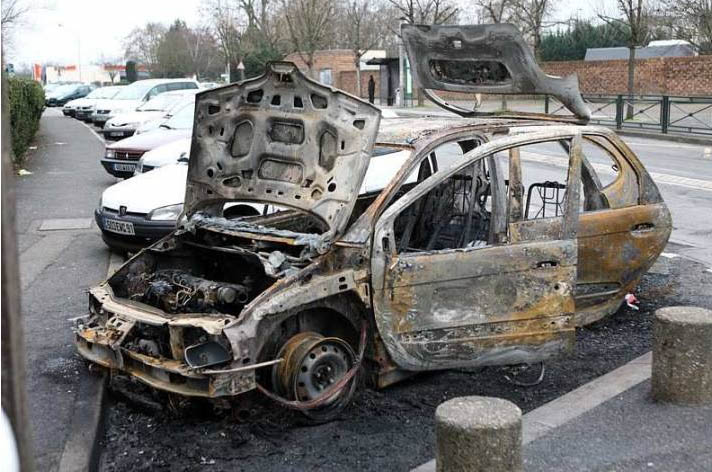


 A new
A new  Over sixty vehicles were burned, as well as garbage containers, during a wave of violence that saw fifty youths opposing police and firefighters, explained Sylvaine Astic, director of the precinct cabinet of La Marne...
 Armies of anarchists clashed with Swiss police following the May Day labor marches in Switzerland last week, in a very under-reported series of dramatic battles on the streets of Zurich and elsewhere.


 They must see that the bridge of hope that family life offers, requires undiminished effort and unending renewal of purpose if it is to lead to a far better world than the self-imposed dark age paralysis the nihilists select for themselves.