Showing posts with label French riots. Show all posts

Wednesday, July 14, 2010

French Minister: "We Won't Tell You How Many Cars Get Burned Tonight"

France celebrates Bastille Day today.

Some French celebrants will honor their Fête Nationale by attending veterans parades and fireworks displays.
Others tend to pursue less noble traditions: 35,000 extra police are being mobilized throughout the country in the hopes of subduing France's notorious generation of uncivilized youth, a show of force to prevent the expected spike in the number of nightly car burnings which, sadly, now haunts the annual French holiday.

Trouble has already begun: the night of July 13th, the eve of the national holiday, the police brought charges against 306 arrested young arsonists and thugs, compared to 190 at this time the year before.

One statistic, however, will apparently escape us this year, according to Brice Hortefeux, France's Minister of the Interior: he officially declared today that there will be no official figures released on the number of cars set ablaze throughout the country on France's Bastille Day:

"[...] no numbers for burned cars will be released for the nights of July 13 and 14, in order to put an end to this unhealthy tradition which promotes, every year at this same time, these criminal acts."

"Instructions have been issued to police headquarters so that they too will not release the number of cars burned in their départements. Hereafter, only annual reports will be made public."
French commentors cynically recommend that the French government adopt this approach to reporting on unemployment statistics and health figures as well, if hiding from the truth can prove such an effective remedy for dealing with their beleaguered nation's social nightmare.

[A tip of the Phrygian cap to the French blog Le Salon Beige]

One of the more pleasant results that has come from years of blogging about this unpleasant mess in France, has been the many inspiring emails, heartening comments (and even face-to-face meetings) we have received from our French readers in France. It's easy to lose sight of the full scope of the truth that there is such a thing as a French Heartland, there are many good and decent people there deserving of support, encouragement and appreciation... deserving a respite from the incessant French-bashing that North American blogs tend to engage in.

We read that the Lord was willing to spare Sodom and Gomorrah if there could be found as few as 50 good people there; well, there's a much higher number than that in France today, so why not put aside the inevitable English-French fraternal spite, and on this day more than most, continue to pray for those within this overwhelmed minority, determined to love family, honor honest labor and engage in social civility despite the surrounding amorality that attempts to seduce them from these values; to pray that they may withstand the folly of their confreres; and that their steadfastness in the face of so much adversity may one day result in a renewal of national spirit, leading to the emergence of a nation more worthy of them.

Thursday, June 24, 2010

France: Chinese Clash With "French Youth" And Police In Belleville

Cries of "Stop The Violence" and "Security For All" rang through the streets of Belleville, on the outskirts of Paris France last Sunday, as over 8,000 fed up and frustrated Chinese residents, belonging to as many as 40 separate business and community organizations, marched in united protest against France's lax attitude towards its feral "french youth". The Chinese community of Belleville are tired of being preyed upon by their city's vandals and thugs, and a crowd that police estimated reached 8,500 people demanded committed and coordinated actions by authorities to bring security to their afflicted neighborhoods.

Violent crime is on the increase in the 20th arrondissement of Belleville, one of the two primarily Chinese communities in the Paris region. The ferocity of the spiraling crime wave, combined with the devaluation of the Euro and Europe's overall economic crisis, is leading the hardworking community to bankruptcy, says local business spokesman Wang Jiaqing, in a Chinese media site originating in France.

The People's Daily also reports that one individual crime proved one crime too many for the besieged Chinese community: the massive Sunday protest was the result of an attack on a Chinese wedding at the Hotel Belleville back on June 1st. A group of "youths" burst in to the hotel's restaurant, barred the doors and tried to rob those attending a marriage ceremony at the hotel. (An alternative account says that the assaults took place outside the building, on the street in front of the party) One of the guests was armed, and he shot and wounded one of the would-be robbers. When police arrived, they made one arrest: the armed guest.

While the French media is well-known for its contorted tapdancing and side-stepping around the demographics of its "french youth" generation of vandals, the protesters stared reality square in the face of French journalism's preferred shadows and fog. One example: Radio France International's interview of a young female Chinese protester on her motives for joining the march:

"There are too many people attacked by Arabs. They steal purses [off you] in the street, they break [shop] windows, we don't feel safe".
As if to underscore the whole point of the gathering, a purse snatching actually took place that day, over on the margins of the protest. The thief was seen, caught through the quick initiative of the marchers, who held him until the police came. Once he was handed over to the police, however, they promptly let the thief go!

"We're not violent, but that was too much", said a witness to the escape and the resulting battle that raged for the next two hours between the summoned riot squad and outraged Chinese protesters. As French paper Le Figaro's describes the reaction:

Friday, January 01, 2010

France's Fiery New Year's Eve: 1,137 Cars Burned

French government officials are patting themselves on the back this morning for a job well done: the number of cars burned on New Year's Eve dropped from last year's record total. An unprecedented national deployment of 45,000 police and riot squad troops, supported by 50,000 firefighters, succeeded in reducing the number... by ten.

On the night of December 31/January 1st, 2009, 1,147 cars were set aflame. Last night, "only" 1,137 were torched (according to early reports released this morning to the press). France's Minister of the Interior, Brice Hortefeux, states today that the "calm" New Year's Eve "went well overall throughout the whole national territory".

The increased police presence is cited as a major contribution to the "light drop" in incidents of assaults on police, firefighters and old-fashioned Parisiens, who simply want to pop champagne corks rather than molotov cocktails on their New Year's Eve. "You'd think we were at war", observes a father who had come to the Champs Elysees to celebrate 2010's arrival with his family, in the face of the cohorts of police patrolling the capital city. Estimates are that only half the number of people chose to venture out and celebrate the New Year on the streets of Paris, compared to the year before.

The scorecard: 549 arrests were made, almost doubling the 288 arrests made in 2008/09 (2007/08's event had seen 249 arrests). 16 police officers were wounded this year, compared to the four reported injuries last year.

Paris' notorious trio of troubled suburbs, Seine-Saint-Denis, Hauts-de-Seine and Val de Marne, saw a reduction in the number of car burnings in "seriously more important proportions", the Minister reported: only 198 torched automobiles, a 20% drop over last year's total. 138 arrests were made in the 'sensitive' suburbs, compared to only 41 the previous New Year's Eve.

One of the big stories connected with last year's New Year's evil was the spread of the car burning rituals from urban to rural settings, but so far the French media does not report an increase of that trend this time around. "Just like an ordinary weekend", the Bordeaux police announce this morning.

The average French citizen hardly finds the news accounts reassuring. A comment by "Hadrien" made on Le Monde's coverage of the car burnings serves as a good summary of the comments in general, a response in direct opposition to the gallic shrug of the shoulders being exhibited by French authorities:
"It's not the number of burnt cars that worries me. It's the fact that everyone finds this normal..."
[Translated from French news accounts in Le Figaro, Le Parisien and Le Monde]

Friday, January 16, 2009

Pro-Hamas Supporters Rampage In Nice, France

It's just not news anymore, is it: another European anti-Israel protest deteriorates into a winner-take-all rampage. The backdrops change, but the story doesn't.

This latest riot erupted in, of all places, the coastal city of Nice, along the French Riviera. Last Saturday, January 10th, hundreds of the participating 5,000 protestors deviated from their pre-arranged marching route through the downtown core; the result was smashed cars, broken windows, looted shops, terrified innocent bystanders and assaults on outmaneuvered police with rains of stones and other projectiles. The report in the Nice Premium calls it "virtual guerilla warfare" [my translation]:
Approximately 200 youths set upon the Casino Rulh and the McDonald's, then went over to place Masséna. What followed was two long hours of thrown stones, or other objects against [store] windows or cars that were driving by. Police responded with tear gas, affecting both rioters and passersby.
... In the middle of the chaos, merchants had no choice but to close down their doors... locking themselves in with their customers. They found themselves trapped inside for about an hour and a half.
Another newspaper, the Nice Matin, adds that several police were wounded in the assault against them, and that a baby can be included among the injured pedestrians. A baby...
(For a series of shocking photos of the pro-Hamas rampage, go here.)
The city is bracing for another anti-Israel protest this coming Saturday.
[Hat tip to Tiberge at GalliaWatch]

Tuesday, January 13, 2009

Violence And Vandalism At Brussels Peace Protest

Belgian member of Parliamant Richard Miller can personally attest that Sunday's high-profile pro-Hamas "peace" protest staged in Brussels degenerated into violence: he was hospitalized after being hit in the head by a piece of gravel thrown by one of his anti-Israel allies.

Translated from the Belgian news site 7sur7:
"Everything was going well during the demonstration when suddenly, there were incidents during the dispersal of the procession in front of the railway station", explained M. Miller. "That's when I was hit by the cobblestone. I was groggy and found myself bloodied", he said while waiting to be evacuated by ambulance. He participated in the protest at the request of the president of his party so as to represent the MR [Reformist Movement], he added.

It was not reported whether the parliamentarian's assailant was one of the 143 vandals arrested during the "peace" protest for destruction and mayhem caused along the Albert II boulevard, and elsewhere. Three policemen were also wounded by day's end, one with a broken foot. A dozen cars were vandalized and several store and restaurant windows smashed. Police are now wading through the surveillance footage filmed that day by security cameras, matching suspects to actions.

Organizers announced that between 50,000 and 60,000 people participated in the protest march; police give a much lower figure, of 30,000.

Monday, January 12, 2009

"I Felt Like I Was In A War": Pro-Hamas Violence Plagues France

What kind of "peace movement" is this?

There's been a series of disturbing attacks on the Synagogues of France, as vandals are no longer satisfied with scrawling vulgar anti-semitic graffitti, they are graduating now to attempted arson. Here are a trio of cases, loosely translated from French media sources. First, from Strasburg and Paris:

Molotov cocktails were thrown against a private home serving as a religious gathering place for the Jewish community in Schiltigheim, Bas-Rhin, a suburb of Strasburg.

Two molotov cocktails were also thrown against a synagogue in the Paris suburb of Saint-Denis. The window of a Jewish restaurant was broken and the wall damaged by the beginning of a fire.

Next, from Toulouse:
A burning car was rammed into the front of a Toulouse suburb synagogue last Monday night. A second car with three molotov cocktails inside was then rammed into the first car, but did not catch on fire.

A rabbi was conducting a class within the synagogue when the attack took place.

Neighbors gave the alarm, and investigators hypothesize that this quick-thinking action kept the would-be arsonists from completing their intended plans.
Even smaller French cities are not being spared from the violence accompanying the pro-Hamas "peace" movement. For instance, the southern coastal city of Perpignan; who would have imagined such a scenic place would ever see the kind of stone throwing and feral rage attributed more commonly to dangerous suburbs such as Seine-Saint-Denis? The local newspaper L'Indépendant chronicles the emotional as well as financial toll that the thugs' behavior takes on the civilized residents of the community..:


A store was attacked while the owner, his wife and two daughters, aged 6 and 10, were still inside, at work. The little girls are still traumatized by the fury of the assault. A translation of an interview conducted with their mother, in the aftermath of their nightmare:


"Why?... I felt like I was in a war! I didn't sleep at all last night, I worried that they would [return and] set fire to the store. They threatened us", she says while slipping her finger across her throat.
Others shops were attacked as well, but most were closed, and a few were so well fortified against vandalism that damage tended to be minor. Many merchants in the neighborhood where the "peace" protest took place, chose to close their doors that Saturday, prefering to lose a busy day's sales rather than go through the kind of terror that the family quoted above had to endure. Some of these entrepreneurs found that they were forced to stay closed a second day, in order to repair the damage done in their absence by the anti-Israel protestors. There was apparently no police presence in the neighborhood adjacent to the "peace" protest, accounting for the scale of vandalism; the forces of law and order only arriving on scene after the attacks started taking place up and down the street. The report concludes by underscoring the stress that shopkeepers will undergo at the annoucement of any future "peace" protests downtown.

Where is this all going? Are even those who haven't forgotten their European history, being condemned to repeat it?

Friday, January 02, 2009

France's Car Burnings: More Than Just A Paris Ritual

Out of the 1,147 car burnings reported for France's fiery New Year's Eve, not all attacks were in the usual expected places, such as the internationally infamous neighborhood of Seine-Saint-Denis, on the outskirts of Paris.

Small and medium-sized cities throughout the country had small and medium-sized waves of fiery vandalism of their own. Here's a quick round-up of accounts from smaller communties that won't get much North American media attention, courtesy of various French regional newspapers [my loose translation from the original French sources]:
In the southern department of Drôme, in the town of Pierrelate (population 11,900) a fire set in a garbage can spread to a nearby electrical connection, and the resulting flames brought a team of workers from the EDF ("French Electricity Board) to the scene:

While waiting for the electricians, Pierrelate firefighers and police were hit with a rain of projectiles coming from a group of fifteen people. One of the firefighters vehicles was hit by a projectile that damaged the hood. A drunken youth in his 20s was arrested. Placed in the drunk tank, he was released yesterday morning. ...
In Avignon (population 90,000) the police and firefighters were kept busy all night long, starting with the first car being set aflame at 5:17 PM, the ninth and last call coming at 9:47 the following morning. (A Peugeot 207 was torched at exactly the stroke of midnight, in a sad display of misdirected exuberance.) Five garbage containers were also set on fire throughout the night.
In Orange (population 29,000) two cars were burned in exactly the same parking lot, two hours apart. No arrests were made...

Orange is within the département of Vaucluse; François-Xavier Lauch, the police commissioner for this southeast French region, reports that overall 15 cars were burned that night, compared to only ten cars the previous year.

"It's one of the nights that worries us the most but thankfully the damages were limited... [We] had a maximum of 90 police officers, 50 detectives, 40 riot police and 400 firefighters on the ground, positioned all over the Vaucluse. The objective is to have a presence over all public streets, not just in the so-called sensitive neighborhoods or big cities.
The Journal de Saône-et-Loire offers a dry summary of their département's tally of torched automobiles; four cars in Chalon-sur-Saône (population 191,000), one car in Autun (population 16,400), two cars in Mâcon (population 36,000), two cars in Montceau-les-Mines (population 20,600)...

Some of the commentors at the media site, however, are less sanguine about the ritualized violence taking place in their communities:
"As if it New Year's Eve was the only night when our urban "youths" set fire to cars... It happens every night that they burn in Chalon and that firefighters and police are attacke! And how does our new city council handle it? With a brand new library, which will cost a fortune for the residents, to calm the thugs down! ... If they [the authorities] would finally take some radical measures, that would start to change things."

In Carpentras (population 26,000) in Southern France, the first call came unexpectedly early, at 9:30 PM:
... On the scene, they went through all the trouble in the world in order to intervene, suffering thrown firecrackers and stones. There were ten men in place, four vans, soon joined by police. All through the night, they put out five car fires, and two others which were partially demolished, the last [...] around 3 in the morning.

In a rare gesture of sympathy, the French media gives a voice to the victims of the rampaging youth:
Yesterday morning, residents in the neighborhood expressed their bitterness. "Now it happens almost every night", said the father of a family. "I don't want to live here anymore." And one of the unfortunate owners of a burned out car despaired, impotently: "I came here three years ago with my wife and three kids. At this moment I have no job, my insurance will not cover me. This is a catastrophe. They have to arrest these youths, why is this happening?"

Sadly, they probably know why it happens; we all know by now, don't we. The real question is, what "radical measures" are they prepared to take to reduce it...

Thursday, January 01, 2009

1,147 Cars Torched In France On New Year's Eve

Welcome to 2009: Over a thousand cars were set ablaze by French urban "youth" this past New Year's Eve, a 30% increase over last year's fiery festival.

France's President Nicholas Sarkozy vows that, in the near future, such vandalism will result in the perpetrators losing their right to a driver's license, at least not until the victim of their vandalism has been compensated for the loss of their automobile, through insurance or otherwise.
Over 30,000 police and 50,000 firefighters were deployed on New Year's Eve; 288 arrests were made, compared to 259 the previous year; four "lightly wounded" police and fire officials, which repeats the same number of injuries from last year; fights with police were said to be "sporadic" and "rare".
Minister of the Interior Michèle Alliot-Marie congratulated her troops' professionalism, which allowed for a "calm [evening] without notable incidents." [my translation]
Tell that to the team of police investigating a routine traffic accident in the violence-plagued banlieu of Seine-Saint-Denis; at 2:00 AM a car being driven by three young thugs deliberately tried to run over the helpless police officers. The kids said later that they assumed the police were in fact manning a checkpoint. A rare detail: the police took out their guns in self-defense and opened fire on the car as it tried to hit them. The three youths, aged 15-16, were pursued and eventually caught.
UPDATE: More details on France's New Year's evil here.

Wednesday, July 23, 2008

France Cooking The Books On Burned Cars Statistics..?

We know that several hundred cars were burned by out-of-control young vandals during the festivities for France's Bastille Day holiday... but how many, exactly?

Last week several mayors of the long-suffering communities hardest hit by these raging arsonists, started questioning the government's official version of the Bastille Day car-nage, implying that the ministry of the Interior's figures deliberately under-represent the actual numbers of torched cars. [my loose translation]

Elected officials on the left in Seine-Saint-Denis have contested the official report on burned cars the night of 13 to 14 July [Bastille Day], demanding from the Ministry of the Interior "numbers that haven't been fiddled with", after having counted "over 140" within their region.

Friday the minister of the Interior stuck to his report, that as of 6:00 AM on the morning of July 14th, there had been 91 cars burned (including those by propagation) [Note: the government policy is to keep two sets of numbers, one for deliberately torched cars and a separate one for cars that end up catching on fire from being located next to cars that have been set ablaze by arsonists; often the numbers cited in French reports don't include these secondary fires, unless it's stated otherwise, as the minister does here.] in Seine-Saint-Denis, in relation to the 211 vehicles set ablaze in Ile-de-France [the Parisian region] (297 throughout all of France). As ongoing complaints have been filed by the victims, "the tally must certainly have increased since then, yet no consolidated report has yet been established", the ministry was told.

In a press release, the elected officials affirmed that they had assessed, after several days, "over 140 vehicles" destroyed or damaged by fire on just that one night alone, after a "checklist" compiled from other elected officials in 23 of the 40 cities in the département. They are now "demanding" numbers that are not fudged, mostly in consideration for the residents of Seine-Saint-Denis and especially for resources so that these events do not become a ritual on each festive holiday.

According to the elected officials, these numbers were "revised" on July 14th. The first report that they refer to (20 vehicles burned in Seine-Saint-Denis), released to
the press by police sources, was established at 2:00 AM.

"Why this kind of manipulation of the figures? Is it to justify a decrease in the number of officers and resources for the police in our departments?", asks Claude Dilain, mayor of Clichy-sous-Bois...

This wouldn't be the first time that France's official accounting of its youthful residents' fiery vandalism has been called into question. The ministry of the Interior is France's equivalent, more or less, to the FBI; and the individual holding the cabinet position of Minister of the Interior, for four of the last five years prior to France's 2007 Presidential election, was France's current President, Nicholas Sarkozy.

The allegations are pretty serious; is Sarkozy pressuring his cabinet ministers to cook the books on crime statistics, in order to beef up his self-professed image of being tough on crime..? Maybe, as with political rival Segolene Royal's outrageous claims that the Sarkozy administration is breaking into her apartment, Watergate-style, the socialist mayors are just engaged in political theater.

Or maybe, where there's smoke, there's fire...

Wednesday, July 16, 2008

Hundreds Of Cars Burned On French Holiday

While many French citizens were proudly celebrating their country's own version of a red, white and blue Fête Nationale, Bastille Day, this past July 14th, hundreds of younger current residents of France were showing their true colors, through feral behavior that has been allowed to become as traditional as the nation's more civilized parades and fireworks.

297 cars were burned in France the night of July 13/14, an increase from the 266 that were burned this same time last year.
The following night, July 14/15, another 295 cars were set on fire throughout the country.

In the urban violence version of deja vu, police battled bands of dozens of youths throughout the Parisien region, once again facing a hail of stones and projectiles, and in one tragic case, pyrotechnics were fired into police, resulting in one police commissioner becoming so seriously injured that he might lose an eye.

Tiberge at GalliaWatch has done her usual excellent work in providing a thorough round-up of the news of both the official glittering Bastille Day festivities as well as the grim urban violence in its shadows. Be sure to scroll down and read her earlier reports about who France's amnesiac President, Nicholas Sarkozy, had invited to attend the military parades this year. (I'm not going to spoil the surprise, you'll have to read the scandalous news for yourselves...)
The government hastens to point out that "only" 33 cars were burned the night of July 12/13, and that the first quarter of 2008 had seen an overall 20% reduction in car burnings... statistics which must be hardly reassuring to the besieged French citizens who see their vehicles being destroyed in fires as ritualistic as anything going on along the Champs-Elysées.

Monday, June 23, 2008

Belgian Battleground

Police collided with two gangs hell-bent on violent warfare on the streets of the Belgian municipality of Anderlecht, the Western-most municipality of Brussels, capital of the EU. The story of the Anderlecht riots is from late May of this year, and it’s still generating occasional headlines in the Belgian press.

What follows is a series of loose translations of French-language media accounts covering developing angles to the story.

The initial report, as carried in the Belgian news source 7sur7:

The situation started deteriorating around 8:30 pm. The police were between a group of "youths of foreign origin" [later specified later in their reporting as "youths of north-african origin"] and "fans of the Anderlecht soccer team".


Charges by police officers mounted on horseback managed to keep the two hostile groups far apart from each other. The "youths of foreign origin" started throwing stones at the police, wounding at least one of them. A bus shelter was destroyed, several cars were damaged and store windows shattered.

The article says that, on Thursday, an (unspecified) blog carried a call for violence, inciting the "youths of foreign origin" to take on the "white supporters" of the Anderlecht team. This call to battle was set off by a fight that took place the Sunday before, on May 18, following an Anderlecht soccer game.

A later account adds that police made no less than 193 arrests that Friday night. Four of the individuals arrested were carrying baseball bats, which the article describes as "prohibited weapons". 14 police officers were injured throughout that evening. All were hospitalized, two with serious wounds.

A French-language news video showing the scale of the urban warfare, here:


The next day, Gaëtan Van Goidsenhoven, mayor ["burgomaster"] of Anderlecht passed an ordinance prohibiting a gathering of more than 5 persons within the territory of the municipality.

The following Friday (May 30), police arrested another 100 persons "pre-emptively" in Anderlecht. Most of them were minors, and were not from the local community. Some had already been arrested during the violence of the week before, and evidently released in the interim.

Some of the individuals arrested were carrying bladed weapons. Police also found two molotov cocktails among the arrested.

The police later issued a requisition order aimed at local media, asking that press and television sources give them images and video taken during the violent night, whether or not it had been aired or published. The General Association of professional Belgian journalists (AGJPB) have asked Belgian media to not cooperate with this demand.

According to the association, this requisition "illustrates the lack of respect for the function of media to inform in total independence." Giving over the material "would place journalists in an auxiliary position to the police and would put [the journalists] in danger -- whether they are before the camera or editors -- as soon as they would cover events on the ground."

The AGJBP further states that "the judicial preoccupation with identifying persons involved in the Anderlecht riots does not weigh sufficiently in regards to the interests at stake in relation to freedom of the press."

They add that "nothing is stopping the authorities from gaining information from the images that the media have already themselves broadcast or published."

Heavy police presence on weekends since the initial clash have kept things tense, but calm. Tensions are not being helped by waves of false rumors, claiming that attacks have happened or are about to happen, rumors designed to spark off new riots.

This past weekend, over 350 people participated in a "Mothers March" through the streets of Anderlecht. The marchers walked behind a banner which said "Let's talk for respect and tolerance".

One of the organizers said: "It's important to talk with everybody. The residents have a role to play to keep similar incidents from happening again. We must make an attempt for each to express themselves in words and not in stones. There is no malaise in particular in Anderlecht. But once in a while we recognize difficulties here as in all the large cities where several cultures co-exist."

Deputy Mayor Fabrice Cumps, participating in the march, said "We want to show today what unites us rather than what divides us. The future of Anderlecht and of Brussels more generally is this multiculturalism. We must live together in respect."

(Some googling reveals that I'm hardly posting a "scoop" with this story. It was news to me when I came across it in my recent French media readings, however, so I'm hoping that for some of our readers this is news for you, as well.)

UPDATE: Esther at the European blog Islam in Europe has some further details on the Anderlecht riots and their aftermath, translated into English from Dutch news sources.
Also, the Brussels Journal provides yet more background on the Belgian riots.
As well, it's fitting that I humbly link back to an earlier Covenant Zone post on an additional problem on top of all the others connected with this story: Belgian prisons have little room for these hundreds of arrested juvenile delinquents.

Sunday, June 15, 2008

50 Youth Attack French Police In Weekend Riots

A new Battle of the Marne took place in France over the weekend, as dozens of "French youths" went on an all-night rampage following the shooting death of a "French youth" earlier on Saturday evening, in the small eastern country town of Vitry-le-François.

In 2006, youth riots in France made international headlines, as a shocked world witnessed car-nage on a nightly basis. In 2008, like purse-snatchings and prostitution, France's riots are no longer "news", so the headlines are now few and far between... yet the beatings, the car burnings, the urban violence continue.

My translation of the account carried by Paris newspaper Le Parisien on the latest Night of Violence:

Clashes between youths and police erupted overnight on Saturday in Vitry-le-François (Marne), leaving nine lightly wounded, after the death of a young man from gunshots, whose murderer has been arrested, it was learned Sunday from police.
Over sixty vehicles were burned, as well as garbage containers, during a wave of violence that saw fifty youths opposing police and firefighters, explained Sylvaine Astic, director of the precinct cabinet of La Marne...

Two firefighters, two police officers and five residents, "not implicated in the violence", were lightly wounded.

Several police and firefighting vehicles were also pelted with stones, added Mme Astic.

The clashes started about 10:00 pm, after the death of a young man in his twenties, killed by a gunshot in the neighborhood at the entrance to Vitry-le-François, a city of approx 17,000 people, located some 30 km from Châlons-en-Champagne, according to Mme Astic, which caused very violent reactions".

"Around 10:00 pm, a gunshot was fired in a neighborhood of Vitry-le-François. The young man who was hit, died about a half-hour later, and his death sparked off a reaction from residents, from youths, who then engaged in exactions all through the city", she explained, clarifying that the violent acts ended by the early morning.

The perpetrators of the violence, armed mostly with baseball bats or molotov cocktails, numbered around fifty, and were accompanied by a dozen others who watched the acts without participating in them, she said.

Over sixty police officers were dispatched to the scene during the night and were still there Sunday morning.
...
The suspected murderer of the young man was arrested "in the middle of the night", she added, without explaining the reasons for the homicide or if other individuals were also arrested.
The newspaper Le Figaro adds details on the rioters' motivation [my translation]:
"Youths who had identified the suspected shooter, set themselves to searching for him", explained Dominique Laurens, district attorney for Châlons-en-Champagne. "

Given the manner in which they were looking for him, we understood very quickly that the suspect would be in difficulty if they found him", she added.
Covenant Zone has been one of the only English-language blogs to follow in detail the waves of urban violence relentlessly percolating in France. Here are some stories we covered from earlier this year that were under-reported (or simply un-reported) in our North American media; these will give a sense of the scope of the nightmare the French are now living with:
We have grown so dependant, so attached to the window that television provides us of our world, that if we do not see something on tv, we can have trouble believing that it exists.
Well, France's post-Christian downward spiral is real... even if it no longer being televised.

Monday, March 17, 2008

French Police Surge On Grigny

Earlier this month we reported on a grisly evening of violence in the French suburb of Grigny.
That weekend a force of two hundred police officers faced off against a marauding army of youths threatening to set fire to a bakery. The resulting clash of molotov cocktails answered with tear gas grenades ended with four police officers shot by the youths, and no arrests being made.

This weekend saw a hopeful follow-up to that grim battle, as an assembled force of three hundred police officers descended on the neighborhood to make arrests, based partially on having identified suspects in video footage taken by security cameras at the bakery.

Translated from Le Parisien:
18 individuals were arrested this morning during a vast police operation in the city of Grande-Borne, near Grigny and Viry-Châtillon (Essonne), where in early March five police officers were wounded by shotgun blasts...

At six am, 160 police officers, supported by two companies of CRS [riot police] also comprising 160 men, penetrated this city where on March 2 police from the departmental Section for intervention ["Section départementale d'intervention", SDI] and the anti-criminality Brigade (Bac) were wounded by shotgun blasts following an attack on a bakery.
Different details are available from Le Figaro:
Fifteen people -- five minors and ten youths aged 18 to 22 -- were arrested Monday morning during a vast police operation...
The article says the operation was without incident, comparing it to the studied calm maintained during the deployment of the larger troop surge of 1,000 police a few weeks before, dispatched to the notoriously sensitive Parisian suburb of Villiers-le-Bel.

Of the forty arrests made during that earlier February expedition, so far 19 people have been charged for taking part in violent rioting back in November of 2007.

Both incursions were assisted by anonymous witnesses contacting police with leads.

It's astonishing that conditions in these neighborhoods have gotten so out of control that the police feels troops are needed on such a massive scale in order to arrest these bands of thugs. Imagine the cost of these operations...

Monday, March 03, 2008

French Youths Ambush Police In Grande-Borne

Two hundred police faced off against dozens of youths in an ambush in the neighborhood of Grande-Borne, France, over the weekend.

Police were called in to deal with young thieves threatening to set fire to a baker's shop unless they emptied the till; as is increasingly becoming the case, the scene quickly transformed into a violent ambush, with the thugs' rain of molotov cocktails answered by volleys of tear gas.

The final score: no arrests, four police officers injured.


Translated from the Paris city paper, Le Parisien:


The clashes began around 4:00 pm, according to a judicial source, as a dozen youths were ganging up on a bakery in the reportedly sensible neighborhood of Grande-Borne, in Grigny. They were threatening to set fire to the shop and were demanding money out of the till.
Four police officers were wounded. Three of the police were lightly wounded in the face and legs by the spray of projectiles, a judicial source explained.
A fourth [police officer] was hit by a blast of lead fired by an individual armed with a pump-action shotgun. He was struck on the thigh and had to be transported to the Evry hospital, according to the same source. The firefighters said that the injury was not serious.
When the police arrived, the young rampagers took flight before being joined by over twenty other individuals. Two of them brought out shotguns and fired in the direction of the police. According to [the Alliance police union], the weapons were not loaded with real bullets, but with lead. Several other youths were in possession of brass knuckles, but weren’t able to make use of them, said the Alliance union. Projectiles and Molotov cocktails were thrown at the police. A car was burned. The neighborhood was beefed up by numerous reinforcements, among them CRS [riot police] and Mobile Gendarmerie officers. Calm returned around 5:30 pm, according to police, who made no arrests. Several patrols kept watch over the neighborhood through the night.

The account of the story being carried in the British press adds the gruesome detail that the french thugs were firing shotguns filled with buckshot and nails.

Nails!

There was no mention of that detail, that I could find, in French media reports on the ambush. Is there an error in the english translation, or have the French press decided that this is news not fit to print..?

A local resident captured some, sadly, routine images of the back-and-forth fighting on a cel phone camera; the shaky but nonetheless clear footage can be viewed here, at another account in Le Parisien.

Sunday, February 10, 2008

French Youths Rampage On Reunion Island

Last week the French departement of the sleepy Island of La Reunion, tucked away in the South-West corner of the Indian Ocean, was again transformed into a veritable war zone, as a frightfully large army of youths, in a game of oneupmanship with their confreres back in the Parisian suburbs, went on a fiery rampage, possibly to protest an arrest made earlier the same day.

Last December the Island's rioting teenagers made the headlines when they specifically targeted one of the island's few police stations, attempting to set it on fire. Outnumbered police were at pains to contain the marauders.

This time, the police had to call in reinforcements from neighboring cities, in order to prevail... or so it sounds, from this [translated] account out of a local paper:
Around 8:00 pm, about fifty young men gathered at the Titan traffic circle, most of them masked by scarves. Many garbage cans were set on fire and placed in the middle of the causeway, on both sides of the street.
When fire-fighters from [the city of] Le Port arrived on the scene, the tension was palpable. Police were called to escort the firemen. Rioters and law officers watched them. Then a rain of stones poured down on the police. The warning is given. A rumor spreads. The arrest of a young thug earlier in the afternoon might have been the action's point of point of departure.
Reinforcements arrived from Saint-Denis. The police charged, the youths fell back to the buildings, fleeing on scooter. Tear gas grenades dispersed the youths. But the action kept getting bigger. Burning bottles started flying, molotov cocktails. A first car is set afire, then a second. Stones were thrown from windows. Soon, the ground is littered with dozens of projectiles and the remains of garbage cans, and various garbage still aflame.

Authorities took stock of the situation and the senior officers headed to the scene to be at the side of their troops. Nathalie Authebon, police commissioner of [the city of] Port is aboard a 4x4 with one of her teams. The departmental director of public security, Michel Clément, is also on scene. Soon, the sub-prefect of Saint-Pierre also heads to the area to oversee this exceptional situation. In the crush, the police manage to make arrests, immediately transporting the arrested to the Port precinct. The media is also targeted, a cameraman had his car stolen, which then ended up ablaze in the middle of the street. Between the youths and the police, a crowd of bystanders stood still at the base of the apartment buildings in order to watch the "show".

Over the radio airwaves, terrorized residents related what they were living through: "Impossible to go outside, I've barricaded myself in my own home, there are youths everywhere that are throwing stones and molotov cocktails. It doesn't stop. I won't be able to sleep the whole night", says one terrified female caller.

Around 10:00 pm, the situation seemed to calm down. Michel Clément makes a point on the situation: "Somewhere around 8:00 pm, there was a redeployment of about fifty youths at the Titan traffic circle setting fire to several garbage cans and when the police arrived, they became the target for showers of stones by these individuals. Therefore reinforcements were called in, coming from [the city of] Saint-Denis, they are now in action for making arrests and dispersing these individuals. The situation is almost under control at this time. Actually, there are about fifty police officers on the scene." ...
Here and there, police and youths continue to clash. But the majority of the bands are dispersed. And it comes down to face-to-face intimidation. Insults are hurled. Then a youth advances while rolling his shoulders. The police go forward, helmeted. When they find themselves close enough to the boy, they catch him and handcuff him before putting him in the van.
Hard to sum up last night's damages, the youths seemed ready to fight for a good part of the evening. Today, those arrested will have to explain themselves to the court. But most of them are minors. No doubt a strategy on the part of the elders, to send the youngest into the nets of law enforcement, all the better for [the older kids] to get away in the diversion. Also, it's difficult to establish precise responsibilities in these types of events, which are, on top of things, at night.
"For now, we have no exact explanation for these incidents. But we're going to figure out what happened", explained Michel Clément last night.
Here's a French language account from the island's television news program. It's pretty much the same information as in the written account, so I won't translate it...:


If this story hadn't been picked up by French blogs, such as the vigilant Francois deSouche, where I found it, would anyone within continental Europe have heard about it otherwise? It doesn't seem to have been mentioned in any of the major French papers that I follow, a complaint echoed in FDS' comments section at his blog.
The island's press gave it lots of coverage, but elsewhere, I suppose, it's just not news anymore that a substantial number of teenagers living in French suburbs seem to be growing up as barbarians.

Saturday, February 09, 2008

Mademoiselle Thug: France's Violent Girls

Some tragic background to last week's story of female gang violence in France, in this follow-up account interviewing the daily witnesses to the ongoing rise of female violent youths in France.

Translated from Le Parisien:
"Needing to affirm themselves", to "make themselves respected"; some adolescent women are more and more inclined to make use of violence, following the example of the boys, as with the scheduled confrontation between two gangs of girls, from Meaux and Noisiel, last Monday in Chelles (Seine-et-Marne).

According to the National Observatory of Delinquence (OND), the number of female minors brought to court for "voluntary physical assaults" had doubled between 2002 and 2007 (the rise for male minors was by 33%).

The [female minors] today represent one out of seven [youths] indicted for violence and threats.

Monday, in Chelles, about sixty people, the majority of which were girls, gave themselves a rendezvous at the bus station, for a settling of grudges, with bats, screwdrivers, knives.

"At high school there are clans, the one from Meaux, from Noisiel, from Montfermeil. Fights are common, the girls arrange their meetings by MSM [text messaging]. Most of the time, it's because of boys, but it can also be because of a look, a little sister who got hit...", an anonymous female student from Louis-Lumière high school explained, the school attended by one of the arrested girls from Monday night's fight.

For most of the students, the Monday meeting was noteworthy for its scale, but otherwise hardly unheard of. "This happens often. It's the girls from one city that want to confront the girls from another city, for everything and for nothing", explains another young woman. In this war for "territory", the girls imitate their male counterparts. "These are stories of neighborhood enemies. The guys from Meaux went down to Torcy to punch the lights out of the guys in Noisiel a few weeks ago", remembered Mohamed Chahib, physical education instructor in the Beauval neighborhood of Meaux.

"Marie", 17, attends Gaston-Bachelard high school in Chelles. Large pants, t-shirt down to her knees, headband in her hair, she's a "girl from Meaux", even if she says she never fights, except "one time because a girl had insulted my mother".

"We girls are aggressive towards each other. It's like that every day. In looks, in words. If you lower your eyes, it means you're weak. It's a matter of rivalry between clans, sometimes between nationalities, like between the West Indians and the Africans. The girls give themselves importance that way", the young lady explains calmly.

"It's the boys that push the girls to this... in how they under-value them, in showing them no respect (...) They were seen as chicks who did their homework and the dishes, they're fed up", she says. A point-of-view shared by the boys. "The girls do this to make themselves respected... you can't really call them girls anymore, these are guys!"

An anonymous teacher from Louis-Lumière [high school] confirms this: "The girls are compelled to conduct themselves this way, so that they aren't subjected to the boys' rules. They don't want to be victims. It's a question of equality".

Monday, February 04, 2008

100 Rampaging Youth In Paris Suburb

Not five, not fifteen, but a gang of one hundred French Youths attacked French police in the Paris suburb of Courcouronnes this weekend.

Translated from Le Parisien: Tensions in Courcouronnes
Police had to resort to firing flash-ball guns during a face-off with one hundred people, Saturday night in the Canal neighborhood of Courcouronnes (Essone), it was learned Sunday from police sources.

Police fired flash-ball guns and tear gas to disperse a group of youths who answered by throwing various projectiles, the same source said.

Police officers proceeded with identity checks but there was not a single arrest. No one was wounded, it was said.

The police were initially called in by residents who were complaining about forty rioters in a square, a group rapidly joined by over fifty more guests from a party in the neighborhood. The face-off lasted more than an hour.
If you're planning on visiting the southern Parisian suburb of Courcouronnes, to obtain a follow-up on this or other stories taking place there, please consider the safety measures suggested by the region's official website, on how to visit Courcouronnes: [my translation]
"Theft from cars: do not tempt the devil!"
...Even when you are behind the wheel, keep vigilant. Remember to never leave your bag, or any other object of value, in plain sight on the seats. Instead, place your personal objects in the shadows, or on the floor and redouble your caution whenever the windows of the vehicle are open. Never hesitate to lock [yourself in] your car, even after you've reached your building's parking.
They're honest with the tourists, even if they are keeping the deteriorating conditions largely secret from other citizens. Was there any coverage of this story in the French press beyond this one mention..?? I didn't see it. Will it only become newsworthy when the rioting youth grow from platoon and company strength to regimental and brigade scale in numbers?

[Thanks to Le Salon Beige, who make special mention of the lack of arrests in this case.]

Wednesday, January 23, 2008

Bagatelle Battleground: France fights back

Reading the recent news of urban guerrilla violence in the French suburb of Bagatelle, outside Toulouse, it's hard to come to grips with the fact that this isn't Baghdad we're reading about, but a city in the nation of France.

Living with a crime wave rising from 227 acts of violence in 2006, to 405 committed by November 2007, the residents of Bagatelle are in desperate straights.

Earlier this year, one incident seemed to be the tipping point for the forces of law and order in the region. Translated from a report in the French newspaper La Depeche, an account of one incident too many:

Jean-Paul Breque, controller general of public security: "At 7:30 pm, we were alerted to a car on fire. A unit from the anticriminality brigade arrived very quickly on-scene. The team was set upon by about fifteen individuals. The officers were not able to continue. We had to mobilize reinforcements.

This took a while...

In Toulouse, we oversee 500,000 citizens. We can not concentrate our forces into just one neighborhood. And if the firefighters arrive alone, they are immediately targeted. It is my responsibility that neither they, nor my own men take short-sighted risks ["inconsidérés", in original... "inconsiderate risks"? I think he means "unnecessary risks"...] Especially when the cars burn away from inhabited areas. At least, out of immediate danger.

For residents, facing a burning car, these minutes are interminable...

I sympathize with them. This will always be too long. As soon as our forces were sufficient, we advanced and the opponents disappeared very quickly. They were pursued to du Cher street where a hail of stones were curbed by the use of tear gas. The site was then secured and firefighters could proceed.
The solution: an occupation force will be sent into the troubled region. Again from the article:
This time, enough is enough. After weeks of demands from exasperated residents... the securing of the Bagatelle neighborhood, a "sensitive" suburb of Toulouse, has been announced. [On January 9th], police dispatched a sizable force. Officials specializing in maintaining order, in identity verification, and even a team of dog trainers. "And we're staying the time that will be required. The time until certain young residents understand that there exists other ways of amusing themselves besides burning cars and pelt police and firefighters with stones. And until the time when the people find the calm they deserve", said controller general Breque, chief of public security.
That's a pretty vague exit strategy. I guess that means that they are never leaving..?

Sadly, the surge seems only to be exacerbating the potential for savagery in the neighborhood youth. A recent sniping raid by thugs resulted in a riot police officer getting his face burned by fire from a tossed Molotov cocktail. Thankfully, he escaped with wounds much less serious than might have been the case.

Another translated article from La Depeche has the details:
The stonings of police officers in sensitive neighborhoods repeats itself at a troubling rate and the neighborhood of Bagatelle has once again become the frame for one of these assaults. Monday, shortly after 10 pm, a CRS [riot police] police van was being driven through the city. In the heart of the sensitive sector, at the corner of du Lot and du chemin [streets] in Bagatelle, a dozen youths placed themselves behind the police van and threw five incendiary missiles. Three of these Molotov cocktails hit the CRS vehicle in a rear window. They broke into flames as they shattered upon the metal plate sides. The window was damaged, and some flaming liquid was projected into the interior [of the vehicle]. One of the CRS was struck in the face by this spray and was burned in his temple and cheekbone. First degree burns and therefore fortunately lightly wounded, representing three days of lost work. The assailants took flight.
...
The police unions have strongly denounced yesterday's actions. UNSA ["Union nationale des syndicats autonomes", National union of autonomous unions] is alarmed over "the trivialization of these urban guerrilla actions. Police on this patrol as well as other intervening teams have been profoundly shocked by this attack in general". These situations, continues the union, will conclude "inevitably in tragedy". "We demand that all means be put into effect so that the perpetrators of these events can be identified and charged with attempted homicide", says a union spokesperson...
To really be effective, the troop surge needs to be accompanied by moves to stem the flow of new insurgents crossing over the border and replenishing the ranks of the rebel forces holding out in their remaining strongholds in the no-go-zones. Otherwise this conflict can only lead to a war of attrition, with a daily drip-drip-drip of news stories about mounting casualties that will weaken the resolve of the voters to continue to support an armed presence in the region.
But that's just me playing armchair general...

All humor aside, Godspeed to these besieged people as they try to take back their neighborhoods. May the state be on their side, for a change.

[More on Toulouse's urban violence here.]

[Thanks to the tireless Tiberge at GalliaWatch for alerting me to these new developments in Bagatelle.]

Tuesday, January 15, 2008

France's Kindergarten Horrors

Seine-Saint-Denis, one of France's highest profile battlegrounds between teenage thugs and police, was in the news again last week, as the French newspaper Le Figaro took a closer look into the statistics on the increase in juvenile delinquency.

Out of
82 556 cases in 2005, 3474 of them dealt with children under 13 years of age. What kind of people are these children destined to grow up to become? If you can bear it, read through this partial translation of several of the individual cases they site in their investigation, previewing the next generation of urban violence for France:

Eyes rolled up, with his breathing "wheezing, sonorous, animal-like", earning him the nickname "the exorcist", "Aziz" is rabid. Hyperactive behavior, insults, punches… the last time he struck someone, it was a teacher. Who brought charges against him. Aziz is not one of those hardened teenagers who hang out in gangs, he is five years old and lives in the city of Saint-Denis…

Aziz is not an isolated case. The rejuvenation of delinquency in the difficult neighborhoods is a regular phenomenon. Aged from 3 to 10 years old, these mini gangbangers, called "extremely disruptive children" by the administration, are not content to steal candies, but instead fight, smoke, loiter in the streets, torch cars, etc.

For instance like "Bemba", 7 years old, who comes to school stinking from gasoline, after having burned cars with his brothers in the neighboring parking lot. Or even the 3 year old child dubbed "Hannibal Lecter", in reference to the cannibal character from Silence of the Lambs, for his having bitten the nose off a little girl. Or mentioning "Kader", 6 years old, who, under the influence of his step-father, smokes cannabis each night "to sleep better". "Hakim", 9, has stabbed his own mother with a knife. It was six years ago. After many other serious misdemeanors, he is today imprisoned in Fresnes. All these children… come from Seine-Saint-Denis.
...
For Patricia, mother of three children living in the city of Floreal in Saint-Denis, the rejuvenation of delinquency has been observable "for about a dozen years, with an emboldening and a feeling of impunity since the riots of November 2005". She is worried for her little girl, Chloe, aged 10, who has been assaulted several times at school : "It is no longer possible for our children. They have no chance here", she says… "Is it normal to leave three or four year old children outside until 11 at night ?", she says indignantly. It’s the surest path "to put them on the road to delinquency", adds Isabelle, a counselor in a recreation center for the last 8 years. A few months ago, while pregnant, she was struck repeatedly in the stomach by "Maxime", 7 years of age...

In the examples of these feral children, are we seeing human beings stripped of their humanity, reduced to an unnatural existence, fallen to the level of animals… or do we encounter here mankind in its natural, default state, awaiting the trio of gifts which raise us above the animals, and make us humane: self-examination, self-criticism, and self-control, all applied so as to effect self-directed inner change.

“We are our own worst critics”, goes the old saying. If only it were true..! All too often, it is we ourselves who are likeliest to find excuses for our worst acts, it is we in our self-pity who are the most ready to whisper justifications to ourselves, to lullaby our guilty consciences back into silent slumber. Being cruel to others, this story suggests, is a choice that comes frightfully easily to human beings, if we can see choices of such unrestrained cruelty in ones so young.

Wanting to be good: surely this is the seed that every good parent aspires to plant within their children. Maybe it is the case that the seed is already born within us, part of our natural equipment, and merely waits for a loving family and civilization’s welcoming embrace to nurture it through the seasons like a fertile field, so that maturity may yield a harvest of desire for returning that love through civility. Maybe it waits in a locked room of the mind, for someone to come along with the key.

One humane voice in this article sends out a cri de coeur for her daughters, and in her lament there is the challenge: I am living up to my side of the bargain, why are you not living up to yours? Why don’t you choose to cull the weeds from the garden, so that they do not choke out the life of the flowers we are trying to raise. For what lessons will the young Chloes of the world draw from their youthful experiences? Will they find there further evidence for the need to be good, or more excuses to believe that it’s not so bad to be bad? The experience of history attests that some will cling to the search for reasons to live a good life, keeping themselves from succumbing to the easy choice of committing cruelty against their fellow human beings. Whether sowed by an unseen hand, or landing through the whims of fate, some such seeds always, thank God, seem to find fruitful soil in every time and place.

For too many others, however, the chorus of violence will be a siren song they will let drag them away from the struggle to live in search of what it means to be good. It is so much easier to be cruel, it is seemingly the natural, instinctive choice, or so this article portends. Having chosen one step along that path, each act of cruelty easily greases the wheels to enable another, until habit casts us into a state of self-justification unhampered by any self-restraint, untamed by any self-expectations. Then people choose to burn cars. Then people choose to allow people to choose to burn cars.

To want to be good demands that a person be at eternal war with himself. The odds of victory in such a battle are stacked against us, as every day is filled to overflowing with evidence suggesting that living a good life is an unnatural, and therefore unattainable, objective.

Fortunately, there is help in this inner conflict against our own nature. There exists a tool that can provide us with the hope of forestalling defeat on the inescapable battlefield of life. It’s a bottomless resource that helps us renew our commitment to the struggle, despite a thousand excuses and justifications for surrender. It’s a flickering candle shining light on how to continue even in our darkest hour of despair, when we come closest to losing the courage of our convictions that this war is worth the fighting. It’s a blessing that grows as we grow, teaching us to live for more than the present moment, to connect to the far distant future, of our own lives and that of our progeny… to see ourselves as combattants in a conflict so enduring that it exists beyond time itself.
That tool is the Judeo-Christian value system. Whether bestowed upon us from above, or derived miraculously by us down here below, it exists to help us avoid choosing evil. That there may have been bad parents, bad teachers, bad Christians, does not give us the excuse to believe that parenthood is bad, teaching is bad, Christiniaty is bad.

Some of us admit that we need all the help we can get to continue to search for what it means to live a good life. Our battered bones search for a crutch, our tempted souls reach for a guardrail, our punctured vanities humbling themselves sufficiently to see the existence of all this assistance, of God, our worst critic, yet at the same time our ultimate ally in this fight.

Wednesday, January 02, 2008

Inflammatory Statistics On French Car Burnings

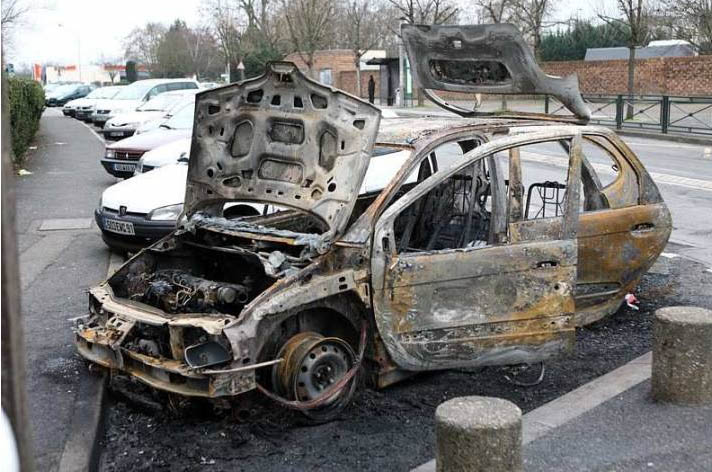
Challenges are casting new light on the "calm" official figures put forward for France's New Year's Evil "French Youth" ritual of car burnings.
While the DGPN ["Direction générale de la police nationale", General Direction of the National Police] claims that there were "only" 372 car burnings occurring throughout the nation on that one evening, France's Socialist Party expresses official doubts on the official figures, throwing a wet blanket on the government's warm reassurances that urban violence is on the decline.

The PS is citing evidence that the overall number does not, in fact, represent a drop from the previous year, as claimed by the government. In Strasbourg, for example, they point out that while the official report claimed only twenty burned cars, the prefecture for the city actually reported that it was a total of 51 cars that were burned overnight.

In doing some research on the discrepancy I came across this revealing article from way back in October 2007, from a news outlet in the beleaguered French city of Toulouse, reporting on the significant rise in car burnings for that community, up to that point in the year.

The article contains a reference on the manner in which these statistics are calculated, which I don't see being reported in the English media accounts of these incidents. (Maybe it is, and I just keep missing it).

You see, the numbers of car burnings are counted as two distinct statistics. One set of figures is kept for cars deliberately targeted for fiery attack, while a separate set of figures is kept for cars that burn only through the unintentional spreading of flames coming from the first set of cars, those that were deliberately set on fire.
At first I thought that this might explain the competing figures for New Year's Eve's car burnings, but no; the official statements account for the distinction. They clarify that, out of their number of 372 torched cars, 273 were "deliberate". So the discrepancies remain.

What follows is a loose translation of the article out of Toulouse's La Depeche newspaper for October 4, 2007. "More than 1,000 cars burned":
1,122 cars have been burned in Toulouse and surrounding banlieues since the beginning of the year. This is a 58% increase over that of the previous year at the same time. When the number of vehicles burned due to the spreading of fires [is added], then the number grows to 1,490 cars burned since January 1st 2007, a record number.
... For several days, rue du Lot has become accustomed to joyrides of [stolen] cars and motorcycles. When the troublemakers overturn cars onto their roofs, the first flames shine out into the dark of night, causing the police to arrive. For about a year, "groups of people have radicalized themselves out of any control", says a resident. Toulousian torchings follow the national trend: 49,114 cars burned in France in 2005, compared to 44,075 in 2004...
Garages tasked with towing the charred vehicles don't know where to pile up the carcasses anymore. Charged 250 euros, the nightly rate, the cost of towing away the burned vehicle is still the responsibility of the insured. "Many times, the victim who just lost their car doesn't have the money for paying their bill", says a tow truck operator.
...
A commenter at the site writes in with a personal story:
"In our street in the neighborhood of St Cyprien an abandoned car was left there for several weeks. When they were alerted about it, my municipal police told me that it wasn't their responsibility, same with the national police. Shortly thereafter the car was set on fire one night. The two cars parked in front and behind it were damaged, the trees were burned and this required the intervention of the fire department. Now, who is responsible?"
An article published today in the same newspaper reports on how Toulouse's total car burnings for 2007 ended up much higher than the national average. Here's a summarized translation of their article, "Twice As Many Car Burnings Than Last Year At This Time":
Over New Year's Eve, Toulouse experienced 26 car burnings, five times higher than on a "normal" night. This is twice the number of New Year's in 2006, where 13 cars were burned.
... Firefighters intervened each time under police protection. Some runs lasted up to six hours... Toulouse reached the worrisome level of 2,000 car burnings in 2007.
... At 3:00 pm in the afternoon, the firefighters arrived at rue Erik-Satie to put out another car fire. Helmeted riot police carrying shields had to protect the firefighters on an embankment bordering the parking lot of an apartment building.
In an unrelated story, new car sales are up 3.2% in France in 2007, compared to 2006.