Showing posts with label french youths war on police. Show all posts

Wednesday, July 14, 2010

French Minister: "We Won't Tell You How Many Cars Get Burned Tonight"

France celebrates Bastille Day today.

Some French celebrants will honor their Fête Nationale by attending veterans parades and fireworks displays.
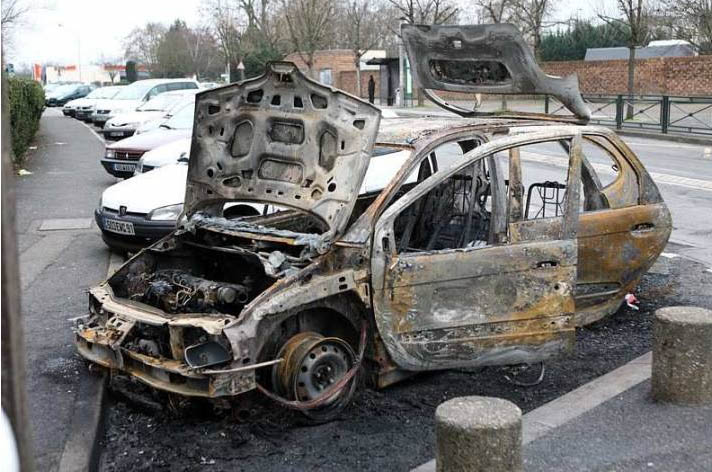
Others tend to pursue less noble traditions: 35,000 extra police are being mobilized throughout the country in the hopes of subduing France's notorious generation of uncivilized youth, a show of force to prevent the expected spike in the number of nightly car burnings which, sadly, now haunts the annual French holiday.

Trouble has already begun: the night of July 13th, the eve of the national holiday, the police brought charges against 306 arrested young arsonists and thugs, compared to 190 at this time the year before.

One statistic, however, will apparently escape us this year, according to Brice Hortefeux, France's Minister of the Interior: he officially declared today that there will be no official figures released on the number of cars set ablaze throughout the country on France's Bastille Day:

"[...] no numbers for burned cars will be released for the nights of July 13 and 14, in order to put an end to this unhealthy tradition which promotes, every year at this same time, these criminal acts."

"Instructions have been issued to police headquarters so that they too will not release the number of cars burned in their départements. Hereafter, only annual reports will be made public."
French commentors cynically recommend that the French government adopt this approach to reporting on unemployment statistics and health figures as well, if hiding from the truth can prove such an effective remedy for dealing with their beleaguered nation's social nightmare.

[A tip of the Phrygian cap to the French blog Le Salon Beige]

One of the more pleasant results that has come from years of blogging about this unpleasant mess in France, has been the many inspiring emails, heartening comments (and even face-to-face meetings) we have received from our French readers in France. It's easy to lose sight of the full scope of the truth that there is such a thing as a French Heartland, there are many good and decent people there deserving of support, encouragement and appreciation... deserving a respite from the incessant French-bashing that North American blogs tend to engage in.

We read that the Lord was willing to spare Sodom and Gomorrah if there could be found as few as 50 good people there; well, there's a much higher number than that in France today, so why not put aside the inevitable English-French fraternal spite, and on this day more than most, continue to pray for those within this overwhelmed minority, determined to love family, honor honest labor and engage in social civility despite the surrounding amorality that attempts to seduce them from these values; to pray that they may withstand the folly of their confreres; and that their steadfastness in the face of so much adversity may one day result in a renewal of national spirit, leading to the emergence of a nation more worthy of them.

Wednesday, July 23, 2008

France Cooking The Books On Burned Cars Statistics..?

We know that several hundred cars were burned by out-of-control young vandals during the festivities for France's Bastille Day holiday... but how many, exactly?

Last week several mayors of the long-suffering communities hardest hit by these raging arsonists, started questioning the government's official version of the Bastille Day car-nage, implying that the ministry of the Interior's figures deliberately under-represent the actual numbers of torched cars. [my loose translation]

Elected officials on the left in Seine-Saint-Denis have contested the official report on burned cars the night of 13 to 14 July [Bastille Day], demanding from the Ministry of the Interior "numbers that haven't been fiddled with", after having counted "over 140" within their region.

Friday the minister of the Interior stuck to his report, that as of 6:00 AM on the morning of July 14th, there had been 91 cars burned (including those by propagation) [Note: the government policy is to keep two sets of numbers, one for deliberately torched cars and a separate one for cars that end up catching on fire from being located next to cars that have been set ablaze by arsonists; often the numbers cited in French reports don't include these secondary fires, unless it's stated otherwise, as the minister does here.] in Seine-Saint-Denis, in relation to the 211 vehicles set ablaze in Ile-de-France [the Parisian region] (297 throughout all of France). As ongoing complaints have been filed by the victims, "the tally must certainly have increased since then, yet no consolidated report has yet been established", the ministry was told.

In a press release, the elected officials affirmed that they had assessed, after several days, "over 140 vehicles" destroyed or damaged by fire on just that one night alone, after a "checklist" compiled from other elected officials in 23 of the 40 cities in the département. They are now "demanding" numbers that are not fudged, mostly in consideration for the residents of Seine-Saint-Denis and especially for resources so that these events do not become a ritual on each festive holiday.

According to the elected officials, these numbers were "revised" on July 14th. The first report that they refer to (20 vehicles burned in Seine-Saint-Denis), released to
the press by police sources, was established at 2:00 AM.

"Why this kind of manipulation of the figures? Is it to justify a decrease in the number of officers and resources for the police in our departments?", asks Claude Dilain, mayor of Clichy-sous-Bois...

This wouldn't be the first time that France's official accounting of its youthful residents' fiery vandalism has been called into question. The ministry of the Interior is France's equivalent, more or less, to the FBI; and the individual holding the cabinet position of Minister of the Interior, for four of the last five years prior to France's 2007 Presidential election, was France's current President, Nicholas Sarkozy.

The allegations are pretty serious; is Sarkozy pressuring his cabinet ministers to cook the books on crime statistics, in order to beef up his self-professed image of being tough on crime..? Maybe, as with political rival Segolene Royal's outrageous claims that the Sarkozy administration is breaking into her apartment, Watergate-style, the socialist mayors are just engaged in political theater.

Or maybe, where there's smoke, there's fire...

Wednesday, July 16, 2008

Hundreds Of Cars Burned On French Holiday

While many French citizens were proudly celebrating their country's own version of a red, white and blue Fête Nationale, Bastille Day, this past July 14th, hundreds of younger current residents of France were showing their true colors, through feral behavior that has been allowed to become as traditional as the nation's more civilized parades and fireworks.

297 cars were burned in France the night of July 13/14, an increase from the 266 that were burned this same time last year.
The following night, July 14/15, another 295 cars were set on fire throughout the country.

In the urban violence version of deja vu, police battled bands of dozens of youths throughout the Parisien region, once again facing a hail of stones and projectiles, and in one tragic case, pyrotechnics were fired into police, resulting in one police commissioner becoming so seriously injured that he might lose an eye.

Tiberge at GalliaWatch has done her usual excellent work in providing a thorough round-up of the news of both the official glittering Bastille Day festivities as well as the grim urban violence in its shadows. Be sure to scroll down and read her earlier reports about who France's amnesiac President, Nicholas Sarkozy, had invited to attend the military parades this year. (I'm not going to spoil the surprise, you'll have to read the scandalous news for yourselves...)
The government hastens to point out that "only" 33 cars were burned the night of July 12/13, and that the first quarter of 2008 had seen an overall 20% reduction in car burnings... statistics which must be hardly reassuring to the besieged French citizens who see their vehicles being destroyed in fires as ritualistic as anything going on along the Champs-Elysées.

Sunday, June 29, 2008

Belgian Off-Duty Police Attacked By Mob Of 30 Youths

If they see you, they attack you; little self-control on display in this story of Belgian police officers who were enjoying a day off, when all of a sudden they are pounced upon by no less than 30 young thugs.

Loosely translated from the Belgian paper La Derniere Heure: 5 police officers from Brussels were assaulted by 30 youths, in the Bruparck parking lot in Heysel, on Sunday morning.

The officers were not on duty and were coming back from an evening together. As they entered the parking lot, they were recognized by a group of youths that were hanging around and who had already had problems with the police.

The youths beat up four of the officers so severely that they will be unable to return to work for some time. One of the police officers suffered a broken elbow. The young thugs also damaged the officers' cars. ...

One of the problems making urban violence worse in Belgium are the juvenile detention centers; they are full, and often young offenders are released shortly after they are caught, due to lack of space.

Yesterday we covered a similar story out of France, where off-duty police officers were attacked by a smaller gang of feral youths. Just how common an occurance has this become?

A Day In The Life Of French Police

Life as a police officer, in today's France, as read in the short account carried (with scarce details) at the French news site "Le Post" (loosely translated from the original):

Two off-duty police officers were jogging in the Parc de la Feyssine, at Villeurbanne. The police were jogging out of uniform and came upon a group of youths, who started to insult them. To calm down the situation, the two joggers revealed that they were policemen. At that moment they were attacked by the youths, beaten up to the point that one of the police officers needed seven days leave, the other four days leave.

Later, three of the youths, two of them aged 16 and the other 15 years of age, were arrested with a stolen moped.
Some readers in the comments section want to know why the paper doesn't go into any further description of the thugs than the simple shadow term, "youths". An example: at 5:13 pm on June 26, "Matthieu" says:

"I find it distorting that instead of saying scum, thugs, they say 'youths'. Also we don't know what is being hidden behind the term 'youths'...."
At 5:27 "Robespierre" writes in reply:

"yes but as you're aware matthieu, with censorship nowadays... as well, 'youth' are 'vitims' of the system therefore forcibly innocent... as a matter of fact, if this continues, they'll say: 'Two police thugs were jogging out of uniform, they are attacked by young victims of our system!' "

If you're tempted to add your 2 francs to the discussion, make sure you read the news site's fine print for participating in their comments section (my translation):

We remind you that, conforming to the law, all injurious, defamatory and xenophobic statements [you may make], expose you to eventual legal prosecution. Anonymity does not prevent you from being identified.
Now there's a welcoming invitation for honest debate..!

To buck up readers' flagging spirits, at 6:53, "Circulez" offers a personal anecdote filled with poetic justice and an inevitable ending to the path that such suppression of reality leads us towards [loosely translated]:

One day in the middle of Paris, on a busy avenue, I saw a young thug and his mother, both aboard a BMW that was trying to get around a police checkpoint. The kid floored his BMW and escaped the cops on bicycles... who later caught up with him at the traffic lights because there were so many cars it was impossible to get around them. The cops tried to extract the guy from his car, he resists by hanging on to the steering wheel. It was then that out of the crowd came one of those heroes of modern times! A lefty in his fifties, with his little woolen vest, long curly hair attempting to cover up his bald head! This fellow runs to the scene and yells at the cops "don't you hit him, I'm watching you, don't hit him!" Even though they were only trying to pull him out, without nightsticks or anything. One of the cops ousts the mother from the passenger side, who's yelling and drawing a crowd to the scene. The lefty throws himself towards the door on the driver's side and gets in the way of the cop trying to make an arrest! The suspect is now lying across both front seats and is giving kicks to the police officer who is trying to get him out of there. Since the lefty also has his head in there, despite the police officer pushing him so that he goes away, the lefty gets a magnificient boot right to his nose, he falls backward, his nose all bloodied, and starts rolling around on the ground, whimpering. Finally, the cop gets the guy out, other police arrive and help him handcuff [the youth]. Every one is okay... except for superman who's yelling and sniveling that he has a broken nose and that they should call [9-11]... !

[Thanks to Le Salon Beige]

Monday, June 23, 2008

Belgian Battleground

Police collided with two gangs hell-bent on violent warfare on the streets of the Belgian municipality of Anderlecht, the Western-most municipality of Brussels, capital of the EU. The story of the Anderlecht riots is from late May of this year, and it’s still generating occasional headlines in the Belgian press.

What follows is a series of loose translations of French-language media accounts covering developing angles to the story.

The initial report, as carried in the Belgian news source 7sur7:

The situation started deteriorating around 8:30 pm. The police were between a group of "youths of foreign origin" [later specified later in their reporting as "youths of north-african origin"] and "fans of the Anderlecht soccer team".


Charges by police officers mounted on horseback managed to keep the two hostile groups far apart from each other. The "youths of foreign origin" started throwing stones at the police, wounding at least one of them. A bus shelter was destroyed, several cars were damaged and store windows shattered.

The article says that, on Thursday, an (unspecified) blog carried a call for violence, inciting the "youths of foreign origin" to take on the "white supporters" of the Anderlecht team. This call to battle was set off by a fight that took place the Sunday before, on May 18, following an Anderlecht soccer game.

A later account adds that police made no less than 193 arrests that Friday night. Four of the individuals arrested were carrying baseball bats, which the article describes as "prohibited weapons". 14 police officers were injured throughout that evening. All were hospitalized, two with serious wounds.

A French-language news video showing the scale of the urban warfare, here:


The next day, Gaëtan Van Goidsenhoven, mayor ["burgomaster"] of Anderlecht passed an ordinance prohibiting a gathering of more than 5 persons within the territory of the municipality.

The following Friday (May 30), police arrested another 100 persons "pre-emptively" in Anderlecht. Most of them were minors, and were not from the local community. Some had already been arrested during the violence of the week before, and evidently released in the interim.

Some of the individuals arrested were carrying bladed weapons. Police also found two molotov cocktails among the arrested.

The police later issued a requisition order aimed at local media, asking that press and television sources give them images and video taken during the violent night, whether or not it had been aired or published. The General Association of professional Belgian journalists (AGJPB) have asked Belgian media to not cooperate with this demand.

According to the association, this requisition "illustrates the lack of respect for the function of media to inform in total independence." Giving over the material "would place journalists in an auxiliary position to the police and would put [the journalists] in danger -- whether they are before the camera or editors -- as soon as they would cover events on the ground."

The AGJBP further states that "the judicial preoccupation with identifying persons involved in the Anderlecht riots does not weigh sufficiently in regards to the interests at stake in relation to freedom of the press."

They add that "nothing is stopping the authorities from gaining information from the images that the media have already themselves broadcast or published."

Heavy police presence on weekends since the initial clash have kept things tense, but calm. Tensions are not being helped by waves of false rumors, claiming that attacks have happened or are about to happen, rumors designed to spark off new riots.

This past weekend, over 350 people participated in a "Mothers March" through the streets of Anderlecht. The marchers walked behind a banner which said "Let's talk for respect and tolerance".

One of the organizers said: "It's important to talk with everybody. The residents have a role to play to keep similar incidents from happening again. We must make an attempt for each to express themselves in words and not in stones. There is no malaise in particular in Anderlecht. But once in a while we recognize difficulties here as in all the large cities where several cultures co-exist."

Deputy Mayor Fabrice Cumps, participating in the march, said "We want to show today what unites us rather than what divides us. The future of Anderlecht and of Brussels more generally is this multiculturalism. We must live together in respect."

(Some googling reveals that I'm hardly posting a "scoop" with this story. It was news to me when I came across it in my recent French media readings, however, so I'm hoping that for some of our readers this is news for you, as well.)

UPDATE: Esther at the European blog Islam in Europe has some further details on the Anderlecht riots and their aftermath, translated into English from Dutch news sources.
Also, the Brussels Journal provides yet more background on the Belgian riots.
As well, it's fitting that I humbly link back to an earlier Covenant Zone post on an additional problem on top of all the others connected with this story: Belgian prisons have little room for these hundreds of arrested juvenile delinquents.

Sunday, June 15, 2008

50 Youth Attack French Police In Weekend Riots

A new Battle of the Marne took place in France over the weekend, as dozens of "French youths" went on an all-night rampage following the shooting death of a "French youth" earlier on Saturday evening, in the small eastern country town of Vitry-le-François.

In 2006, youth riots in France made international headlines, as a shocked world witnessed car-nage on a nightly basis. In 2008, like purse-snatchings and prostitution, France's riots are no longer "news", so the headlines are now few and far between... yet the beatings, the car burnings, the urban violence continue.

My translation of the account carried by Paris newspaper Le Parisien on the latest Night of Violence:

Clashes between youths and police erupted overnight on Saturday in Vitry-le-François (Marne), leaving nine lightly wounded, after the death of a young man from gunshots, whose murderer has been arrested, it was learned Sunday from police.
Over sixty vehicles were burned, as well as garbage containers, during a wave of violence that saw fifty youths opposing police and firefighters, explained Sylvaine Astic, director of the precinct cabinet of La Marne...

Two firefighters, two police officers and five residents, "not implicated in the violence", were lightly wounded.

Several police and firefighting vehicles were also pelted with stones, added Mme Astic.

The clashes started about 10:00 pm, after the death of a young man in his twenties, killed by a gunshot in the neighborhood at the entrance to Vitry-le-François, a city of approx 17,000 people, located some 30 km from Châlons-en-Champagne, according to Mme Astic, which caused very violent reactions".

"Around 10:00 pm, a gunshot was fired in a neighborhood of Vitry-le-François. The young man who was hit, died about a half-hour later, and his death sparked off a reaction from residents, from youths, who then engaged in exactions all through the city", she explained, clarifying that the violent acts ended by the early morning.

The perpetrators of the violence, armed mostly with baseball bats or molotov cocktails, numbered around fifty, and were accompanied by a dozen others who watched the acts without participating in them, she said.

Over sixty police officers were dispatched to the scene during the night and were still there Sunday morning.
...
The suspected murderer of the young man was arrested "in the middle of the night", she added, without explaining the reasons for the homicide or if other individuals were also arrested.
The newspaper Le Figaro adds details on the rioters' motivation [my translation]:
"Youths who had identified the suspected shooter, set themselves to searching for him", explained Dominique Laurens, district attorney for Châlons-en-Champagne. "

Given the manner in which they were looking for him, we understood very quickly that the suspect would be in difficulty if they found him", she added.
Covenant Zone has been one of the only English-language blogs to follow in detail the waves of urban violence relentlessly percolating in France. Here are some stories we covered from earlier this year that were under-reported (or simply un-reported) in our North American media; these will give a sense of the scope of the nightmare the French are now living with:
We have grown so dependant, so attached to the window that television provides us of our world, that if we do not see something on tv, we can have trouble believing that it exists.
Well, France's post-Christian downward spiral is real... even if it no longer being televised.

Wednesday, April 23, 2008

350 French Police Seal Off Seine-Saint-Denis In Raid

Another excursion into enemy territory for the French forces of law and order this week, as 350 French police descended on the sensitive zone of Saine-Saint-Denis to smash a ring of drug dealers.

This follows similar raids last month, in comparable company-strength.
The story was carried by several French media sources, with little variation in the details provided. I've translated this account from Yahoo France:
A vast police operation was conducted Wednesday night in the neighborhood of Beaudottes a Sevran (Seine-Saint-Denis) against drug traffickers, leading to the arrest of four people.
Three hundred and fifty police officers were deployed to seal off this neighborhood considered, according to a report from General Intelligence, as a hub for drug trafficking, especially cannabis.

François Molins, the district attorney for the Republique de Bobigny, specified on France Info that house searches had taken place "in 12 apartments that were squatted in for the last several weeks, if not months, and were targeted as possible stockpiling areas for drugs."

"The result, is four persons arrested for infractions related to drugs", he said. The scale of the operation justified itself notably "from the need to exploit information that was in our possession from various court proceedings", he underlined, observing that no "regrettable" incidents took place during the arrests.
The size of the police forces enlisted for the raid no longer seems to raise gallic eyebrows, considering the wartime conditions under which the police operate. There have been sufficient precedents, such as the incidents in Courcouronne and Grande-Borne, to warrant taking extra precautions when organizing their raid; for all the police knew, they would have needed every single one of those troops, in order for all of them to escape with their lives.
The attacks on police are no longer as newsworthy as they used to be; like vandalism and petty theft, the youths' war on police is relegated to ho-hum backpage filler. Like this short piece from Monday's Le Figaro newspaper:
Two police from the anti-criminality Brigade (BAC) were wounded from blows from iron bars and a third by a hail of stones, in the sensitive neighborhood of Toulouse, it was learned from police sources.
The police and fire-fighter unions regularly reveal an increase in the force of the violence which they meet during their interventions in several Toulousian suburbs.
A car struck a pedestrian crossing the street, a cat got stuck up a tree, police were attacked by thugs wielding iron bars... it's shocking to see such horror reduced to the mere banal. But then...

C'est La Guerre....

[Thanks to one of my favorite French blogs, the inspiring Le Salon Beige, for the Figaro story]

Wednesday, March 19, 2008

Let's Go Sarko

Ever since the shocking scale of the French urban riots started making headlines outside of France a few years ago, there has been much talk about what might happen when the pendulum starts swinging the other way, should the day come when the French ruling class would grow fatigued at having to pretend there was some kind of justification for this raw adolescent rage.

President Nicholas Sarkozy, no stranger to wildly swinging from policy to policy himself, now sits astride a government sending in police by the hundreds, in company strength, in order to subdue a few dozen of the more barbaric youths, a manageable handful at a time. It is a sign of how bad things have become, that it should require forces of such magnitude to make such small changes for the better.

Reading the French media accounts of these massive police incursions into France’s worst no-go zones leaves me hoping, and saying a silent prayer, much as the French heartland holds its breath in cautious anticipation, that the cure does not end up worse than the disease.

What does it portend for France, that police operations need to take on the scope of military maneuvers, in order to be successful? Or that assembling a virtual army of occupation has come to be seen as the best way to fight crime? When the line blurs between the police and the military, I'm not convinced that this is a step in the right direction... although maybe I'm just in denial, as I struggle to avoid settling for the lesser of evils, thinking instead that there may still exist a "good" solution.

In trying to give shape to my conflicted thoughts on this new phase in France’s civil war, I created the following video, "Let’s Go Sarko".

Monday, March 17, 2008

French Police Surge On Grigny

Earlier this month we reported on a grisly evening of violence in the French suburb of Grigny.
That weekend a force of two hundred police officers faced off against a marauding army of youths threatening to set fire to a bakery. The resulting clash of molotov cocktails answered with tear gas grenades ended with four police officers shot by the youths, and no arrests being made.

This weekend saw a hopeful follow-up to that grim battle, as an assembled force of three hundred police officers descended on the neighborhood to make arrests, based partially on having identified suspects in video footage taken by security cameras at the bakery.

Translated from Le Parisien:
18 individuals were arrested this morning during a vast police operation in the city of Grande-Borne, near Grigny and Viry-Châtillon (Essonne), where in early March five police officers were wounded by shotgun blasts...

At six am, 160 police officers, supported by two companies of CRS [riot police] also comprising 160 men, penetrated this city where on March 2 police from the departmental Section for intervention ["Section départementale d'intervention", SDI] and the anti-criminality Brigade (Bac) were wounded by shotgun blasts following an attack on a bakery.
Different details are available from Le Figaro:
Fifteen people -- five minors and ten youths aged 18 to 22 -- were arrested Monday morning during a vast police operation...
The article says the operation was without incident, comparing it to the studied calm maintained during the deployment of the larger troop surge of 1,000 police a few weeks before, dispatched to the notoriously sensitive Parisian suburb of Villiers-le-Bel.

Of the forty arrests made during that earlier February expedition, so far 19 people have been charged for taking part in violent rioting back in November of 2007.

Both incursions were assisted by anonymous witnesses contacting police with leads.

It's astonishing that conditions in these neighborhoods have gotten so out of control that the police feels troops are needed on such a massive scale in order to arrest these bands of thugs. Imagine the cost of these operations...

Monday, March 03, 2008

French Youths Ambush Police In Grande-Borne

Two hundred police faced off against dozens of youths in an ambush in the neighborhood of Grande-Borne, France, over the weekend.

Police were called in to deal with young thieves threatening to set fire to a baker's shop unless they emptied the till; as is increasingly becoming the case, the scene quickly transformed into a violent ambush, with the thugs' rain of molotov cocktails answered by volleys of tear gas.

The final score: no arrests, four police officers injured.


Translated from the Paris city paper, Le Parisien:


The clashes began around 4:00 pm, according to a judicial source, as a dozen youths were ganging up on a bakery in the reportedly sensible neighborhood of Grande-Borne, in Grigny. They were threatening to set fire to the shop and were demanding money out of the till.
Four police officers were wounded. Three of the police were lightly wounded in the face and legs by the spray of projectiles, a judicial source explained.
A fourth [police officer] was hit by a blast of lead fired by an individual armed with a pump-action shotgun. He was struck on the thigh and had to be transported to the Evry hospital, according to the same source. The firefighters said that the injury was not serious.
When the police arrived, the young rampagers took flight before being joined by over twenty other individuals. Two of them brought out shotguns and fired in the direction of the police. According to [the Alliance police union], the weapons were not loaded with real bullets, but with lead. Several other youths were in possession of brass knuckles, but weren’t able to make use of them, said the Alliance union. Projectiles and Molotov cocktails were thrown at the police. A car was burned. The neighborhood was beefed up by numerous reinforcements, among them CRS [riot police] and Mobile Gendarmerie officers. Calm returned around 5:30 pm, according to police, who made no arrests. Several patrols kept watch over the neighborhood through the night.

The account of the story being carried in the British press adds the gruesome detail that the french thugs were firing shotguns filled with buckshot and nails.

Nails!

There was no mention of that detail, that I could find, in French media reports on the ambush. Is there an error in the english translation, or have the French press decided that this is news not fit to print..?

A local resident captured some, sadly, routine images of the back-and-forth fighting on a cel phone camera; the shaky but nonetheless clear footage can be viewed here, at another account in Le Parisien.

Sunday, February 10, 2008

French Youths Rampage On Reunion Island

Last week the French departement of the sleepy Island of La Reunion, tucked away in the South-West corner of the Indian Ocean, was again transformed into a veritable war zone, as a frightfully large army of youths, in a game of oneupmanship with their confreres back in the Parisian suburbs, went on a fiery rampage, possibly to protest an arrest made earlier the same day.

Last December the Island's rioting teenagers made the headlines when they specifically targeted one of the island's few police stations, attempting to set it on fire. Outnumbered police were at pains to contain the marauders.

This time, the police had to call in reinforcements from neighboring cities, in order to prevail... or so it sounds, from this [translated] account out of a local paper:
Around 8:00 pm, about fifty young men gathered at the Titan traffic circle, most of them masked by scarves. Many garbage cans were set on fire and placed in the middle of the causeway, on both sides of the street.
When fire-fighters from [the city of] Le Port arrived on the scene, the tension was palpable. Police were called to escort the firemen. Rioters and law officers watched them. Then a rain of stones poured down on the police. The warning is given. A rumor spreads. The arrest of a young thug earlier in the afternoon might have been the action's point of point of departure.
Reinforcements arrived from Saint-Denis. The police charged, the youths fell back to the buildings, fleeing on scooter. Tear gas grenades dispersed the youths. But the action kept getting bigger. Burning bottles started flying, molotov cocktails. A first car is set afire, then a second. Stones were thrown from windows. Soon, the ground is littered with dozens of projectiles and the remains of garbage cans, and various garbage still aflame.

Authorities took stock of the situation and the senior officers headed to the scene to be at the side of their troops. Nathalie Authebon, police commissioner of [the city of] Port is aboard a 4x4 with one of her teams. The departmental director of public security, Michel Clément, is also on scene. Soon, the sub-prefect of Saint-Pierre also heads to the area to oversee this exceptional situation. In the crush, the police manage to make arrests, immediately transporting the arrested to the Port precinct. The media is also targeted, a cameraman had his car stolen, which then ended up ablaze in the middle of the street. Between the youths and the police, a crowd of bystanders stood still at the base of the apartment buildings in order to watch the "show".

Over the radio airwaves, terrorized residents related what they were living through: "Impossible to go outside, I've barricaded myself in my own home, there are youths everywhere that are throwing stones and molotov cocktails. It doesn't stop. I won't be able to sleep the whole night", says one terrified female caller.

Around 10:00 pm, the situation seemed to calm down. Michel Clément makes a point on the situation: "Somewhere around 8:00 pm, there was a redeployment of about fifty youths at the Titan traffic circle setting fire to several garbage cans and when the police arrived, they became the target for showers of stones by these individuals. Therefore reinforcements were called in, coming from [the city of] Saint-Denis, they are now in action for making arrests and dispersing these individuals. The situation is almost under control at this time. Actually, there are about fifty police officers on the scene." ...
Here and there, police and youths continue to clash. But the majority of the bands are dispersed. And it comes down to face-to-face intimidation. Insults are hurled. Then a youth advances while rolling his shoulders. The police go forward, helmeted. When they find themselves close enough to the boy, they catch him and handcuff him before putting him in the van.
Hard to sum up last night's damages, the youths seemed ready to fight for a good part of the evening. Today, those arrested will have to explain themselves to the court. But most of them are minors. No doubt a strategy on the part of the elders, to send the youngest into the nets of law enforcement, all the better for [the older kids] to get away in the diversion. Also, it's difficult to establish precise responsibilities in these types of events, which are, on top of things, at night.
"For now, we have no exact explanation for these incidents. But we're going to figure out what happened", explained Michel Clément last night.
Here's a French language account from the island's television news program. It's pretty much the same information as in the written account, so I won't translate it...:


If this story hadn't been picked up by French blogs, such as the vigilant Francois deSouche, where I found it, would anyone within continental Europe have heard about it otherwise? It doesn't seem to have been mentioned in any of the major French papers that I follow, a complaint echoed in FDS' comments section at his blog.
The island's press gave it lots of coverage, but elsewhere, I suppose, it's just not news anymore that a substantial number of teenagers living in French suburbs seem to be growing up as barbarians.

Monday, February 04, 2008

100 Rampaging Youth In Paris Suburb

Not five, not fifteen, but a gang of one hundred French Youths attacked French police in the Paris suburb of Courcouronnes this weekend.

Translated from Le Parisien: Tensions in Courcouronnes
Police had to resort to firing flash-ball guns during a face-off with one hundred people, Saturday night in the Canal neighborhood of Courcouronnes (Essone), it was learned Sunday from police sources.

Police fired flash-ball guns and tear gas to disperse a group of youths who answered by throwing various projectiles, the same source said.

Police officers proceeded with identity checks but there was not a single arrest. No one was wounded, it was said.

The police were initially called in by residents who were complaining about forty rioters in a square, a group rapidly joined by over fifty more guests from a party in the neighborhood. The face-off lasted more than an hour.
If you're planning on visiting the southern Parisian suburb of Courcouronnes, to obtain a follow-up on this or other stories taking place there, please consider the safety measures suggested by the region's official website, on how to visit Courcouronnes: [my translation]
"Theft from cars: do not tempt the devil!"
...Even when you are behind the wheel, keep vigilant. Remember to never leave your bag, or any other object of value, in plain sight on the seats. Instead, place your personal objects in the shadows, or on the floor and redouble your caution whenever the windows of the vehicle are open. Never hesitate to lock [yourself in] your car, even after you've reached your building's parking.
They're honest with the tourists, even if they are keeping the deteriorating conditions largely secret from other citizens. Was there any coverage of this story in the French press beyond this one mention..?? I didn't see it. Will it only become newsworthy when the rioting youth grow from platoon and company strength to regimental and brigade scale in numbers?

[Thanks to Le Salon Beige, who make special mention of the lack of arrests in this case.]

Saturday, February 02, 2008

France's "Customary Rebellions"

When does it stop being crime, and start becoming war?

Reports on France's crime statistics for the previous year raise serious concerns over the hardening of attitude seen in the generation of thugs that are attacking French police. Law enforcement officials are being targeted with a fury and a frequency that is starting to take a marked effect on police morale.

A particularly troubling aspect is that the battle doesn't subside once the attackers are caught; now arrests are accompanied by promises of retaliation once the thugs are released, retaliation at a very personal level... "We know where you live", the arresting officers are told by the unrepentant youth in their handcuffs. (I have a translation post "in the works" on what the thugs are doing to off-duty police officers, which I hope to publish soon)

A spokesperson for one of France’s police unions was interviewed recently in the French media, sounding alarm bells that few are prepared to hear... because the answers require sweeping changes that so few are prepared to imagine.

In regards to this glorious balance sheet, one result nevertheless casts a shadow over the 2007 activity report: the flagrant rise in violent acts against agents of public authority. Gérard Bastian is the police sergeant of the Léman BAC [Anti-Criminality Brigade] and is the departmental secretary of the Alliance national police union.

"In 2007, there was a 9% rise of violence against agents of public authority at the departmental level. This represents 115 recorded acts compared to 96 in 2006.... The report is alarming. We can no longer tolerate this. For the last three years, the phenomenon has been growing exponentially. And if it previously only really affected night personnel, today it touches those who work during the day as well.

What do these assaults entail?

"Foremost, there is violent behavior, that occur almost daily and are being committed by simple offenders, which is rather exceptional. And watch out, when we roll up a violent scene, it has to be organized at force 10, because if they were all rolled up, the courts would never empty. Its also verbal threats towards the officials. 'We know where you live, well catch up with you.' There is a form of intimidation that has installed itself."

Physical violence also?

The rebellions are becoming customary. Before, when there was an arrest, the guy went along, today, they dare us to arrest them, by physically opposing us. Its the same thing when theyre brought to jail. Another new phenomenon: the rise of material destruction and the large-scale stonings of police cars. Six or seven vehicles were damaged by stonings in Thonon-les-Bains over the last four months!

What are the solutions for stemming the tide of this phenomenon?

“There must first be an adaptive judicial answer. If they don’t take this problem seriously, we’ll quickly reach another level of violence. We must not play down the situation. For myself, I don’t feel reassured; the violence has grown truly significantly [over] the last three years."
Things look bleak, but there have been periods in French history where society suffered under even worse chaos than at present. There was, for one example, the time when France started to emerge from the shadow of the Hundred Years War:
[In 1422] Henry VI of England was crowned King of France; but as he was not yet a year old, the Duke of Bedford ruled as his regent... He suppressed brigandage by hanging 10,000 bandits in a year; judge therefrom the condition of the land.
Demobilized soldiers -- ecorcheurs (skinners), coquillards (shell men) -- made the highways perilous, and terrorized even large cities like Paris and Dijon. Over Normandy the ravage of war had passed back and forth like an infernal, murderous tide; even in luckier Languedoc a third of the population had disappeared. Peasants fled to the cities, or hid in caves, or fortified themselves in churches, as armies or feudal factions or robber bands approached. Many peasants never returned to their precarious holdings, but lived by beggary or thievery, or died of starvation or plague. Churches, farms, whole towns, were abandoned and left to decay. In Paris in 1422 there were 24,000 empty houses, 80,000 beggars, in a population of some 300,000. People ate the flesh and entrails of dogs. The cries of hungry children haunted the streets.
___Will Durant, The Reformation, chapt III, "France Besieged", pgs 70-71
As France’s economic foundations are besieged by a new generation of brigands, there is increasingly evidence of a slow-but-sure shift in the hearts and minds of victimized citizens, no longer viewing the veritable army of vandals as the victims but as the predatory force they reveal themselves to be. The leftist pretension that unemployment is at the root of a teenager’s decision to set a police car ablaze, is melting under the flames of the Molotov cocktails the teenager is raining on everyone’s heads.

Sunday, January 27, 2008

Belgium's Al Qaida Fan Club

Brussels youth attack police, are tracked down, and are found surfing an al-qaida website when police arrive to arrest them.

Translated from Belgian news site Derniere Heure [exclamation points in original]:
A bus shelter that no longer shelters anything, thousands of shards of glass on the ground... these are the remains of an ambush set Friday night on the Brussels-Capitale-Ixelles police... youth from the neighborhood of Versailles, in Brussels, made Molotov cocktails. They planted them in several key areas, near apartment buildings, and when they were ready to receive the police, they simulated a fight...

Around 4:30 pm, according to Brussels police headquarters, dispatch was informed that a fight had seemingly broken out between several youths on Versailles avenue. A patrol rides to the scene and on arrival is assaulted by the youth who do not hesitate to hurl fiery projectiles towards the car.

Reinforcements were naturally called for. Numerous police cars are quickly at the scene. Meanwhile, the youths have multiplied themselves! There were more than thirty teens armed with axes and Molotov cocktails looking to hurt the forces of law and order.

Finally, the fiery youth disappeared, leaving behind them a sorry spectacle. The homemade explosives had completely destroyed the bus shelter. Several glass bottles containing gasoline corked with newspaper were found on scene. During a search of the area, investigators discovered a 10-liter can of gasoline! The police also captured a panoply of prohibited weapons, such as brass knuckles and axes.

We don't dare imagine the fate they had in mind for the police!

Thanks to the clues uncovered [at the scene], investigators quickly identified some of the perpetrators. And then, surprise... When [the youth] had returned home, they busied themselves in surfing an al-qaida website!

Four youths were arrested. Ali, 18 years old, was quickly released. On the other hand, Ismael, M., 17 years old (known to police for one [prior]incident), Ali B., 18 years old (known for 8 incidents), and Yassine D., 16 years old (known for 5 incidents), were retained at headquarters.
[Hat tip to Francois deSouche]

Wednesday, January 23, 2008

Bagatelle Battleground: France fights back

Reading the recent news of urban guerrilla violence in the French suburb of Bagatelle, outside Toulouse, it's hard to come to grips with the fact that this isn't Baghdad we're reading about, but a city in the nation of France.

Living with a crime wave rising from 227 acts of violence in 2006, to 405 committed by November 2007, the residents of Bagatelle are in desperate straights.

Earlier this year, one incident seemed to be the tipping point for the forces of law and order in the region. Translated from a report in the French newspaper La Depeche, an account of one incident too many:

Jean-Paul Breque, controller general of public security: "At 7:30 pm, we were alerted to a car on fire. A unit from the anticriminality brigade arrived very quickly on-scene. The team was set upon by about fifteen individuals. The officers were not able to continue. We had to mobilize reinforcements.

This took a while...

In Toulouse, we oversee 500,000 citizens. We can not concentrate our forces into just one neighborhood. And if the firefighters arrive alone, they are immediately targeted. It is my responsibility that neither they, nor my own men take short-sighted risks ["inconsidérés", in original... "inconsiderate risks"? I think he means "unnecessary risks"...] Especially when the cars burn away from inhabited areas. At least, out of immediate danger.

For residents, facing a burning car, these minutes are interminable...

I sympathize with them. This will always be too long. As soon as our forces were sufficient, we advanced and the opponents disappeared very quickly. They were pursued to du Cher street where a hail of stones were curbed by the use of tear gas. The site was then secured and firefighters could proceed.
The solution: an occupation force will be sent into the troubled region. Again from the article:
This time, enough is enough. After weeks of demands from exasperated residents... the securing of the Bagatelle neighborhood, a "sensitive" suburb of Toulouse, has been announced. [On January 9th], police dispatched a sizable force. Officials specializing in maintaining order, in identity verification, and even a team of dog trainers. "And we're staying the time that will be required. The time until certain young residents understand that there exists other ways of amusing themselves besides burning cars and pelt police and firefighters with stones. And until the time when the people find the calm they deserve", said controller general Breque, chief of public security.
That's a pretty vague exit strategy. I guess that means that they are never leaving..?

Sadly, the surge seems only to be exacerbating the potential for savagery in the neighborhood youth. A recent sniping raid by thugs resulted in a riot police officer getting his face burned by fire from a tossed Molotov cocktail. Thankfully, he escaped with wounds much less serious than might have been the case.

Another translated article from La Depeche has the details:
The stonings of police officers in sensitive neighborhoods repeats itself at a troubling rate and the neighborhood of Bagatelle has once again become the frame for one of these assaults. Monday, shortly after 10 pm, a CRS [riot police] police van was being driven through the city. In the heart of the sensitive sector, at the corner of du Lot and du chemin [streets] in Bagatelle, a dozen youths placed themselves behind the police van and threw five incendiary missiles. Three of these Molotov cocktails hit the CRS vehicle in a rear window. They broke into flames as they shattered upon the metal plate sides. The window was damaged, and some flaming liquid was projected into the interior [of the vehicle]. One of the CRS was struck in the face by this spray and was burned in his temple and cheekbone. First degree burns and therefore fortunately lightly wounded, representing three days of lost work. The assailants took flight.
...
The police unions have strongly denounced yesterday's actions. UNSA ["Union nationale des syndicats autonomes", National union of autonomous unions] is alarmed over "the trivialization of these urban guerrilla actions. Police on this patrol as well as other intervening teams have been profoundly shocked by this attack in general". These situations, continues the union, will conclude "inevitably in tragedy". "We demand that all means be put into effect so that the perpetrators of these events can be identified and charged with attempted homicide", says a union spokesperson...
To really be effective, the troop surge needs to be accompanied by moves to stem the flow of new insurgents crossing over the border and replenishing the ranks of the rebel forces holding out in their remaining strongholds in the no-go-zones. Otherwise this conflict can only lead to a war of attrition, with a daily drip-drip-drip of news stories about mounting casualties that will weaken the resolve of the voters to continue to support an armed presence in the region.
But that's just me playing armchair general...

All humor aside, Godspeed to these besieged people as they try to take back their neighborhoods. May the state be on their side, for a change.

[More on Toulouse's urban violence here.]

[Thanks to the tireless Tiberge at GalliaWatch for alerting me to these new developments in Bagatelle.]

Tuesday, January 01, 2008

Paris Toasts 2008 With Champagne And Tear Gas

While there had been many headlines alerting party-goers not to expect any fireworks in Brussels, it seems there were to be no fireworks displays for Paris either, much to the surprise and disappointment of many of the 400,000 celebrants who gathered at the Champs Elysees to greet the New Year.

While there were no sparks in the sky, there were plenty of flames on the ground, as French Youths torched over one hundred cars in Paris alone:

"The night was relatively calm, without notable incident, there were very few direct clashes with the security forces," said a spokesman for the national police.

At 12:00 a.m. EST, the Interior Ministry said 372 vehicles had been burned -- 144 in the Paris region and 228 in the rest of France. That was down from 397 last New Year's Eve.

... Police had stepped up their presence on French streets in anticipation of the year-end celebrations and the sale of petrol in cans was banned in some places.

The French city paper, Le Parisien, carries some additional details, including a rather depressing video, where the soundtrack rings with showers of glass breaking and bursts of tear gas cannisters:
It was hardly ten minutes after midnight before fights broke out along the block. Groups that seemed not to be organized started harassing the CRS [riot police] and bombard them with glass bottles and beer cans.... On four occasions, within a short radius of 100 meters, [the riot police] launched counter-attacks. Three times, they used tear gas to dislodge the rioters, who were all very young, for the most part.
...
Many strollers who came to celebrate the passing of one year to another left with tears in their eyes, caused by the tear gas.

Wednesday, December 26, 2007

French Youths Attack Police On Christmas Eve

There was more than a mouse stirring late Christmas Eve in Belleville, France. French "youths" continue to escalate their violent nihilism, offering a regional police station a series of fiery Christmas presents, which seemed to represent only a fraction of their overall plan.

Loosely translated from Yahoo France:

Three molotov cocktails were thrown at the police force of Belleville (Rhone) over Monday night/Tuesday Morning, according to police.

Moreover, the tires of « 7 or 8 vehicles » belonging to police officers and parked within the enclosures of the police station, were sprayed with gas, but were not set ablaze, said Francis Battut, the prosecutor for Villefranche-sur-Saône.

At 4 :25 Tuesday morning, three glass bottles filled with inflammable liquids were thrown at the area surrounding the local squad [headquarters].

A car parked in the lot next to the police station’s parking enclosure was completely destroyed by the flames and another private vehicle, belonging to a police officer, also suffered serious damage, say the police.

Investigators from the police station in Lyon then discovered traces of gas on the tires of other cars.

« Was the culprit or culprits interupted by a noise ? I have no idea, but if they had set fire to the cars’ tires, the consequences could have been much more serious », said M. Battut.

At first, when the French "youths" escalated their criminal behavior from theft and muggings to vandalism, the novelty of the change made news. Then it became routine, and would only be covered when a detail made an act of vandalism "newsworthy" for being different than all the other acts of vandalism. Then petty vandalism turned into car burnings, and those images made international headlines... until their novelty factor wore off. The burnings continued, but fewer news cameras bothered to cover "old news", such fiery vandalism reduced to the same routine as thefts and muggings.

Now the French "youths" advance to an ever more frightful next stage, which, true to form, is attracting media coverage for its novelty factor: the youths are attacking the police, treating them like a rival gang, whether by setting deadly traps or, as happened in the French overseas department of Reunion Island, waging war upon the actual police station itself.

Imagine the state that France shall find herself in, when even these stories become routine... and stop becoming news.

May the France of 2008 find its strength of character and renew its sense of spiritual purpose sufficiently to douse the flames of burning nihilism in its young, before the next escalation raises the bonfires to even more sorrowful ravages of post-christian decay.